A retractable charging cable solves a problem that is boring and constant: the bag full of tangled leads, none of which fits the device you are holding. Instead of several cables, you carry one housing with a spool inside and a small set of tips on the end. Pull out what you need, click it back when you are done.
This guide explains what a multi-tip retractable charging cable does well, what the four common connector types are for, what fast charging figures actually mean in practice, how to use one without wearing it out, and where the format has genuine limitations. There is a checklist at the end and the questions buyers ask most.
Why a retractable charging cable makes sense
Most households now own devices with at least two different connectors. A phone, a tablet, a pair of earbuds, a power bank and an older camera or e-reader will rarely all take the same tip, and every one of them came with its own lead. The result is a drawer nobody enjoys opening.
Tangling is not just annoying; it is the main cause of cable failure. Every knot creates a tight bend, and repeated tight bends at the same point break the fine conductors inside. A retractable charging cable is stored under gentle, even tension on a spool, which is close to the ideal way to keep a cable.
Then there is length discipline. A one-metre cable used across thirty centimetres leaves seventy centimetres to catch on things, drag the phone off a table or wrap around a bag strap. Being able to extend only what you need is a genuine practical advantage rather than a gimmick.
The multi-tip aspect matters most when travelling or working away from a desk. One housing that covers phone, tablet and laptop connectors removes the moment at an airport gate where you discover the one cable you brought is the wrong one.
Finally, there is the shared-space argument. A single retractable charging cable in a car, a meeting room or a family living room serves whoever needs it, whatever they are carrying, without anyone hunting for their own lead.
What makes a good retractable charging cable
The retracting mechanism and the connector quality decide everything. These are the details worth checking.
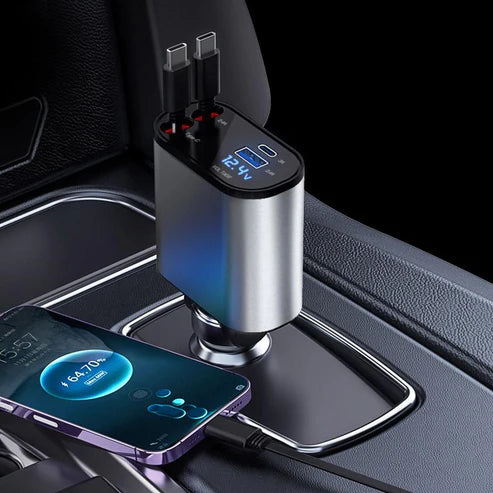
The retraction mechanism
This is the part that fails first on a cheap retractable charging cable. A good spool locks positively at several lengths and retracts smoothly with a light tug rather than needing to be coaxed. Test it repeatedly if you can; a mechanism that already feels notchy in the shop will feel worse in six months.
Connector coverage
Four tips covering USB-C, Lightning, Micro USB and USB-A handles almost everything in circulation. USB-C is now the standard for new phones, tablets and many laptops; Lightning covers older iPhones and accessories; Micro USB persists on countless older devices; USB-A is what most chargers, laptops and car sockets still accept on the input side.
Strain relief at the ends
Look at where the cable meets each connector. There should be a moulded collar that flexes gradually rather than a hard join. That collar is the difference between a retractable charging cable lasting two years and failing in three months, because that is exactly where bending concentrates.
Conductor quality and charging support
Fast charging depends on a retractable charging cable being able to carry the current safely and, for higher power, on it being correctly specified. Manufacturer claims should be read alongside what your charger and device actually support, since the slowest link in the chain sets the speed.
Housing size and shape
The whole point of a retractable charging cable is portability, so the housing should be pocketable and smooth-edged. A bulky or sharply angled case defeats the purpose, and something that snags on a bag lining will quietly stop being carried.
Tip storage
Unused tips need somewhere to live. The best designs hold spare connectors in the housing itself, so nothing can be lost. Loose tips in a separate pouch will go missing within a month, and a retractable charging cable missing its Lightning tip is much less useful than it was.
Data as well as power
Some multi-tip cables carry power only, and a retractable charging cable is no exception. If you ever need to transfer files or connect a device to a computer, check this before buying, because a power-only cable will simply appear not to work when plugged into a laptop.
The WLD Store pick: 4 in 1 Retractable Charger
WLD Store lists this as a multi-tip USB charging cable. The following comes directly from the product listing:
- Category: Accessories, listed under Chargers and Cables.
- Brand: WLD. SKU: WLD-KSA-0092-(KD-167).
- Four connector types: Type-C, Lightning, Micro USB and USB-A.
- Listed at 100W fast charging, described as supporting phones, tablets and laptops.
- Tangle-free retractable design.
- Stated compatibility with iPhone, Samsung and Huawei devices.
- Available across Saudi Arabia with secure checkout.
Photographs and current availability are on the 4 in 1 Retractable Charger product page. For background on the connector standard that now covers most new devices, the reference article on USB-C is a clear explanation.
Understanding the four connector types
Knowing what each tip is for makes a retractable charging cable far more useful, and prevents the common mistake of assuming any tip will fit any port.
USB-C is the reversible oval connector now used by new phones, tablets, laptops, cameras and games consoles. It carries the most power and the fastest data, and it is the tip most people will reach for by default on a retractable charging cable bought today.
Lightning is the slim connector Apple used on iPhones and iPads for many years, and it remains on a great many devices still in daily use. It is not interchangeable with USB-C despite looking broadly similar in size.
Micro USB is the small trapezoid connector that dominated for a decade. It is still on countless power banks, older headphones, e-readers, torches and cheap accessories, and it is the tip people are most surprised to still need.
What fast charging figures actually mean
Wattage claims cause more confusion than any other specification on a retractable charging cable, so it is worth understanding what determines real charging speed.
Charging speed is set by the weakest link between three things: the power adapter, the cable and the device. A 100W-rated cable will not make a phone that accepts 20W charge any faster, and a high-capability cable connected to a low-power adapter delivers only what that adapter can give.
What a higher rating does provide is headroom. It means the cable is not the bottleneck, which matters if you also charge a tablet or a laptop from the same lead. That is the practical argument for a well-specified retractable charging cable rather than a bargain one.
It is also worth knowing that charging naturally slows as a battery fills. The impressive numbers quoted for fast charging apply to the first part of the cycle; the last twenty percent is deliberately slower on almost every device to protect the battery.
Using it without wearing it out
A retractable charging cable lasts a long time when treated sensibly and fails quickly when it is not. These habits make the difference.
- Pull the cable out straight rather than at an angle to the housing.
- Extend only as far as you need, then let the lock engage before plugging in.
- Support the housing rather than letting it hang from a wall socket by the cable.
- Guide the cable back in with your fingers instead of letting it snap home.
- Never yank the cable out of a port; grip the connector itself.
- Keep the tips clean and dry, and blow out pocket lint rather than digging it out.
- Avoid leaving the cable fully extended and stretched taut over a table edge.
- Store the housing loose in a bag rather than crushed under heavy items.
Letting a retractable charging cable snap back at speed is the single most damaging habit, because the connector strikes the housing every time. Two seconds of guiding it home adds months of life.
The second most damaging habit is charging while a phone is in use with the cable bent sharply. That bend sits in one spot for an hour at a time and is where nearly every cable eventually breaks.
What one cable replaces when travelling
Travel is where a retractable charging cable justifies itself most obviously, and it is worth thinking about what actually comes out of the bag.
For a typical trip that means a phone lead, a tablet lead, a lead for earbuds or a watch dock, and often an older Micro USB lead for a power bank. A single retractable charging cable with four tips covers all of those in one pocketable housing.
The knock-on effect is a smaller charging kit overall. One cable and one multi-port adapter is a far tidier arrangement than four cables and two adapters, and it goes through security without unpacking half the bag.
The honest caveat is length. Retractable designs are usually shorter than standard cables, so a hotel socket behind a bed can still defeat you. A short extension lead is the sensible companion for anyone who travels often.
Desk and car use
At a desk, the appeal of a retractable charging cable is tidiness. A cable that retracts into its housing when you unplug removes the loop of slack that otherwise lives permanently across the desk.
In a car, the appeal is that passengers carry different phones. One retractable charging cable in the centre console serves everyone, and it retracts out of the way instead of coiling into the gearstick area.
The one caution for cars is heat. A closed car in summer gets extremely hot, and prolonged heat degrades cable insulation and any plastic mechanism. Keeping it in the glovebox rather than on the dashboard is a small habit that adds real life.
Why cables fail, and how to slow it down
Almost all retractable charging cable failures are mechanical rather than electrical, and they happen in predictable places.
The commonest is a break in the fine conductors just behind a connector, caused by repeated flexing at that point. This is why strain relief collars matter so much and why charging with the cable sharply bent is such a reliable way to kill one.
The second is contamination in the tip. Pocket lint compresses into a phone port and prevents full seating, which people then interpret as a failed cable. Cleaning the port carefully with a wooden toothpick, with the device switched off, solves it more often than a new retractable charging cable would.
Who it is not for
If you need a long cable, this is the wrong format. Retractable mechanisms are usually limited in length, and no amount of pulling changes that. Anyone charging from a socket well away from where they sit will be happier with a long fixed lead.
It is also not ideal for a permanent, never-moved installation. A cable that lives behind a bedside table and is never coiled gains nothing from a spool, and a plain cable there will outlast a mechanism that adds moving parts you do not need.
Retractable, braided or coiled
Each format optimises for something different, and there is no single best answer.
Braided cables prioritise durability. The woven jacket resists abrasion well and they come in long lengths, but they still tangle, and a braided cable in a bag is exactly as knotted as a plain one.
Coiled cables stretch and spring back, which suits a car dashboard or a fixed desk position. They are bulky when compressed and they pull on the connector constantly, which is not ideal for a phone port.
A retractable charging cable prioritises packing size and tidiness. It gives up maximum length and adds a mechanism that can wear, in exchange for the smallest, tidiest package of the three. For a bag or a glovebox, that trade is usually worth making.
Care and maintenance
A retractable charging cable needs very little care, but the little it does need matters.
- Wipe the connectors occasionally with a dry cloth; never use liquid on contacts.
- Check the tips for bent pins or debris if charging becomes intermittent.
- Keep the housing away from prolonged heat, especially in a parked car.
- Store spare tips in the housing so none are lost.
- Retire any retractable charging cable that becomes warm in use or shows exposed wire.
- Do not attempt to open the spool housing; the return spring is not user-serviceable.
A cable that gets noticeably warm, sparks, or has any damaged insulation should be replaced immediately rather than taped up. This is the one area where there is no sensible economy.
Common problems and quick fixes
- Charging is slower than expected. Check the adapter and the device, not just the cable; the weakest of the three sets the speed.
- The cable will not retract fully. Extend it completely, then guide it back slowly rather than releasing it; twisted spooling is the usual cause.
- A tip will not seat properly. Almost always lint in the device port. Clean it gently with the device switched off.
- Charging cuts in and out when moved. The conductors near a connector have started to fail. Replace the retractable charging cable rather than nursing it.
The first three are fixable in seconds. The fourth is the end of that cable’s working life, and continuing to use it is not worth the risk.
Buying checklist
- Does it include every connector your household actually uses, including Micro USB?
- Does the mechanism lock positively and retract smoothly rather than sticking?
- Is there a proper moulded strain relief collar at each connector?
- Are spare tips stored in the housing rather than loose?
- Is the maximum extended length enough for how you normally sit and charge?
The last question catches most people out. Measure the distance from your usual socket to your hand before choosing any retractable charging cable.
Keeping a charging kit organised at home
A single tidy cable helps most when the rest of the kit is organised around it. Two or three small decisions stop the drawer refilling itself within a month.
Start by deciding where charging happens. Most homes have two or three real charging points, typically a bedside table, a desk and a kitchen worktop. Give each one a permanent adapter, and reserve the retractable charging cable for the bag rather than letting it become a fourth fixed lead.
Next, be honest about what is genuinely obsolete. Leads for devices you no longer own are the bulk of any cable drawer, and keeping them costs space without ever saving a trip to the shop. Recycle them properly at an electrical recycling point rather than putting them in general waste.
Label the survivors. A small strip of tape naming the device on each remaining fixed cable removes the guessing entirely, which matters most for the older leads that all look identical.
Finally, keep one spare adapter with the travel kit. A retractable charging cable covers the connector problem completely, but it still needs something to plug into, and a forgotten adapter is the failure that actually strands people away from home.
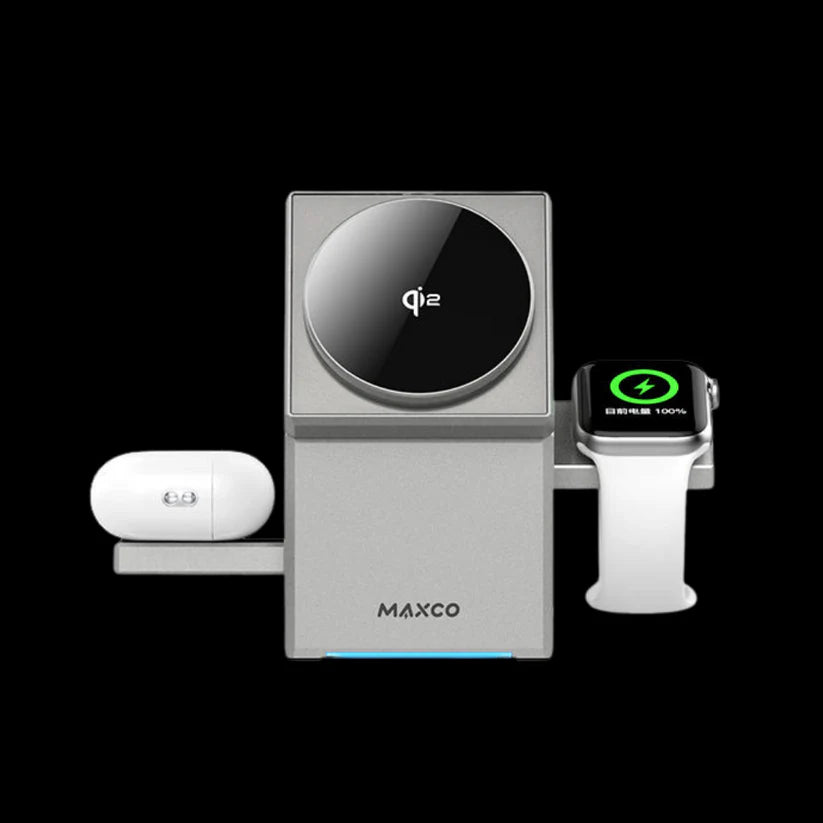
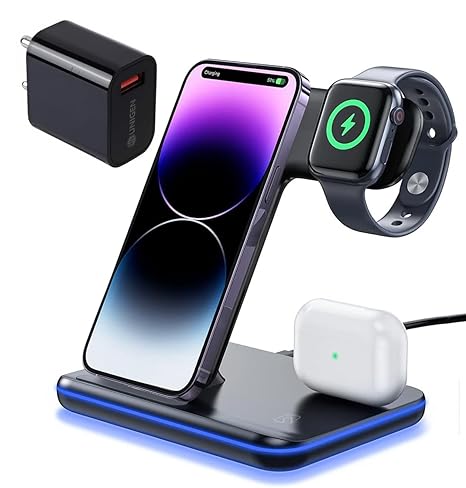
Other Accessories picks at WLD Store
Three more charging and phone accessories from the same section.

Frequently asked questions about a retractable charging cable
Will it charge my laptop?
The WLD listing states 100W fast charging with support for phones, tablets and laptops. Whether a specific laptop charges depends on that laptop accepting USB-C power delivery and on the adapter you pair with it.
Can it transfer data as well as charge?
Multi-tip cables vary on this, so check the listing for the model you are buying. If file transfer matters to you, confirm it before ordering rather than assuming.
How long is the cable when fully extended?
Retractable designs are generally shorter than standard cables, which is the main trade-off of the format. Check the stated length against the distance you actually need before buying.
Does using a multi-tip cable slow charging down?
Not inherently. Speed is determined by the adapter, the cable specification and the device together. A well-specified retractable charging cable is not the limiting factor for typical phone charging.
What if I lose one of the tips?
Choose a design that stores the spare tips inside the housing, because loose tips do get lost. It is the single most common way a four-in-one cable becomes a two-in-one cable.
Is it safe to leave plugged in overnight?
Charging overnight is normal, but use a good quality adapter, avoid covering the cable with bedding, and stop using any cable that gets warm or shows damaged insulation.
One housing, four tips and no tangle is a small upgrade that removes a daily irritation from a bag or a glovebox. If that appeals, look at the retractable charging cable on its product page, or browse more charging accessories in the Chargers & Cables section.






Add comment