Most home kitchens contain a drawer of blunt, mismatched blades and one knife that does ninety percent of the work, which is exactly the situation a proper chef knife set is meant to replace. This guide covers which knives genuinely earn their place, how to judge steel, tang and handle from a listing, and the sharpening and storage habits that keep a chef knife set performing for years rather than months. It also covers cutting boards, safe technique, the faults that come up most often, and six questions buyers ask before ordering.
Why a chef knife set changes how you cook
Sharpness is the least appreciated cooking skill. A dull blade crushes rather than slices, which bruises herbs, tears tomato skin, makes onions weep more and turns simple preparation into a chore. Most people who say they dislike chopping are really saying they dislike chopping with a blunt knife.
There is a safety argument too, and it runs opposite to intuition. A sharp knife bites where you place it, while a dull one skids across a surface before catching. Most serious kitchen cuts happen when a blade slips off food rather than through it, which is why a well-maintained chef knife set is genuinely safer than a drawer of neglected ones.
Matching the blade to the task is the other half. A heavy chef’s knife is wrong for hulling strawberries, a paring knife is hopeless at breaking down a squash, and a straight edge will destroy a crusty loaf. A chef knife set exists so that the right tool is within reach rather than three drawers away.
The final benefit is consistency. When knives share a handle shape and balance, your hand adapts once rather than recalibrating for every blade. That familiarity builds real speed and confidence over a few weeks of ordinary cooking.
Which knives actually earn their place
Large sets look impressive and are often padded with blades nobody uses. A focused chef knife set of a few genuinely useful knives beats a block of fifteen almost every time.
- Chef’s knife: the workhorse, usually 20 centimetres or so. Chopping, slicing, dicing, mincing. If you own one good knife, this is it.
- Paring knife: small and nimble, for peeling, trimming, deveining and any job done in the hand rather than on a board.
- Serrated bread knife: the only blade that cuts crusty bread without crushing it, and it also handles tomatoes and citrus well.
- Utility knife: the middle size, useful for sandwiches, smaller vegetables and anything where the chef’s knife feels oversized.
- Santoku: a shorter, flatter alternative to the chef’s knife favoured by cooks who chop with a downward motion rather than a rocking one.
Beyond these, additions are genuinely specialist. Boning and filleting knives matter if you break down meat or fish regularly and are dead weight if you do not. When comparing a chef knife set, count the knives you would use weekly rather than the total in the box.
What makes a good chef knife set
Photographs show the handles and tell you almost nothing about performance. Four things decide whether a set is a pleasure or a disappointment.
Blade steel and edge retention
Nearly all kitchen knives use some form of stainless steel, and the trade-off within that family is straightforward. Harder steel holds an edge longer but is more brittle and harder to sharpen; softer steel dulls faster but is forgiving and easy to bring back. For most home cooks a mid-range stainless in a chef knife set is the sensible middle ground.
Tang, balance and how it feels in the hand
A full tang, where the steel runs the whole length of the handle, gives better balance and far better durability than a short tang pinned into a grip. Balance matters more than weight: a well-balanced knife feels lighter than it is because the mass sits near your hand rather than out at the tip.
Handle shape, grip and safety
You will hold this for long stretches with wet hands. A handle that is comfortable dry and slippery wet is a poor handle. Look for a shape without hard edges pressing into the palm, and a material that keeps some grip when damp. Handle comfort in a chef knife set matters more than any specification on the blade.
Edge geometry and what it suits
A thinner blade with a narrower edge angle slices more cleanly and is better for precise work. A thicker blade with a wider angle is more robust and tolerates heavier jobs and occasional misuse. Neither is better in the abstract; the question is whether the chef knife set matches how you actually cook.
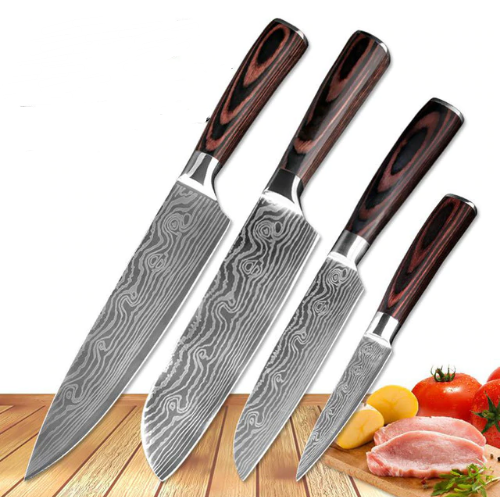
The WLD Store pick: Professional Chef Kitchen Knife Set
WLD Store lists the Professional Chef Kitchen Knife Set for everyday home cooking. Here is what the listing states, with nothing added:
- Product: Professional Chef Kitchen Knife Set
- Categories: Home & Kitchen, Kitchen Tools
- Brand: WLD
- Described as: a sharp, balanced chef knife set for confident everyday cooking
- Available in: the USA, with secure checkout
- SKU: WLD-US-0020
Balance is the word worth pausing on, since it is what separates a knife that feels natural after ten minutes from one that tires the hand. Current photographs and details are on the Professional Chef Kitchen Knife Set product page.
Holding and using a knife properly
Technique delivers more improvement than any upgrade, and two habits get the most out of a chef knife set.
The first is the pinch grip. Instead of wrapping the whole hand around the handle, pinch the blade itself between thumb and the side of the index finger just in front of the bolster, wrapping the remaining fingers round the handle. This puts your hand closer to the cutting edge and gives dramatically more control. It feels strange for a day and natural forever afterwards.
The second is the claw. Curl the fingertips of your guiding hand under, so the knuckles face the blade and the fingertips are tucked safely behind them. The flat side of the blade rests against your knuckles and cannot reach your fingertips. Every professional uses a chef knife set this way, and it is the single habit that prevents most cuts.
Beyond grip, let the knife do the work. Long, drawing strokes cut better than downward pressure, and forcing a blade through food is a sign it needs sharpening rather than more force.
Cutting boards matter more than you think
The surface you cut on affects your edge more than almost anything else you do. Glass, granite, marble and ceramic boards destroy a knife edge within a few uses, and no chef knife set survives regular contact with them.
- End-grain wood is the gentlest option, because the fibres part around the blade and close again.
- Edge-grain wood is a good, more affordable compromise and is what most wooden boards are.
- Soft plastic boards are kind to edges, easy to sanitise and sensible for raw meat.
- Bamboo is harder than most woods and slightly more abrasive, but acceptable.
- Glass, stone and ceramic should never be used for cutting, whatever the packaging claims.
A damp cloth under the board stops it sliding, which is a genuine safety improvement and costs nothing.
Sharpening, honing and the difference between them
These two words get used interchangeably and mean completely different things, which is why so many people believe their knives are unsharpenable.
Honing realigns an edge that has rolled slightly out of true through normal use. It removes almost no metal and should be done often, even every few uses, with a honing steel. It restores the feeling of sharpness quickly and is what keeps a chef knife set performing between real sharpening.
Sharpening removes metal to form a new edge, using a whetstone, a pull-through sharpener or a professional service. It is needed far less often, perhaps a few times a year for a home cook. A whetstone gives the best result and takes practice; a pull-through is quick and convenient but removes more metal than necessary.
The simple test is paper. Hold a sheet up and slice down through it. A sharp knife glides; a knife that tears or slips needs attention. Test each blade in your chef knife set this way every month or two and you will never be caught out mid-recipe.
Washing and daily care
Most knife damage is done in the sink and the dishwasher rather than on the board.
- Wash by hand, always. Dishwasher detergent is abrasive, and blades knock against racks and other items throughout the cycle.
- Wash promptly after use, especially after acidic foods such as citrus, tomato or vinegar, which can mark even stainless steel if left.
- Dry immediately with a cloth rather than leaving knives on a draining board. Stainless resists rust but is not immune to it.
- Never leave a knife in a full sink. It is both the most common way blades get chipped and the most common way people get cut reaching in.
- Wipe with the spine towards you, folding the cloth over the back of the blade rather than running it along the edge.
Two minutes of care after cooking preserves a chef knife set better than any amount of expensive equipment.
Storing knives without ruining them
Loose in a drawer is the worst place for a chef knife set and unfortunately the most common. Blades knock against each other and against utensils, the edges chip, and reaching blindly into a drawer of exposed knives is an obvious hazard.
A knife block is the traditional answer and keeps edges protected, though slots need to stay dry and should be cleaned occasionally. Insert blades spine-down where the design allows, so the edge is not dragged across wood each time. A magnetic strip saves counter space, keeps blades visible and dries them naturally, provided you place knives on it deliberately rather than slapping them against it.
For a chef knife set kept in a drawer, individual edge guards or a knife roll solve the problem completely and cost very little. Whichever method you choose, the principle is the same: nothing hard should touch the cutting edge when the knife is not in use.
Common problems and quick fixes
Four issues cover nearly every complaint about a chef knife set.
- It went blunt quickly: usually the cutting board. Check you are not using glass or stone, then hone regularly rather than waiting for a full sharpen.
- Small rust spots appeared: moisture left on the blade, often from a draining board or a dishwasher. Remove gently with a mild abrasive paste and dry properly in future.
- Food sticks to the blade: normal on a flat-sided knife. Nothing is wrong; a scalloped blade or simply wiping between cuts helps.
- The handle feels loose: stop using it. A moving handle on a partial tang is a real hazard and worth replacing rather than repairing.
Buying a set versus buying knives individually
Both routes are defensible, and the right answer depends on how much you already own. A chef knife set gives you a matched collection with consistent handles and balance in one go, which is exactly what you want when starting a kitchen from scratch or replacing a drawer of tired blades.
Buying individually lets you spend more on the knife you use most and skip the ones you never would. An experienced cook who already owns a bread knife and a paring knife may be better served by a single excellent chef’s knife than by another full set.
The practical test is honest: if you would use at least three or four of the knives regularly, a set makes sense. If you would use one, buy that one well. Padding a kitchen with blades that never leave the block is the most common way people overspend in this category.
Buying checklist
Five questions worth answering before ordering a chef knife set.
- How many of these knives would I genuinely use in an average week?
- Does the handle look comfortable for my hand size, with no hard edges to press into the palm?
- Are the blades full tang, with steel visible running the length of the handle?
- Do I own a suitable wooden or soft plastic cutting board, rather than glass or stone?
- Do I have a safe way to store them, whether a block, a magnetic strip or edge guards?
The first week with a new set
A little care in the first few days sets the pattern for how long everything lasts. Start by unwrapping each blade carefully, keeping the packaging away from the edges, and checking each knife for transit damage before anything goes near food. Look along the edge under a light: it should be a clean, continuous line with no visible chips or flat spots.
Wash every piece by hand before first use, even though the knives look clean. Manufacturing and packing leave residue and oils that you do not want in the first meal, and it also gives you an early feel for the weight and balance of each blade while your hands are on them.
Test the factory edge with the paper test before you assume anything. Knives arrive sharpened but the standard varies, and knowing where a new chef knife set starts tells you when it has genuinely dulled later. If a blade struggles with paper straight out of the box, a few passes on a honing steel usually resolves it.
Sort out storage before the knives ever reach a drawer. Decide on a block, a magnetic strip or edge guards on day one, because the temporary arrangement almost always becomes permanent. This is the single decision that most affects how a chef knife set looks and performs a year later.
Spend the first week deliberately practising the pinch grip and the claw. Both feel awkward at first and both become automatic quickly, and learning them on a fresh set is far easier than unlearning old habits later.
- Day one: inspect, hand wash, dry and test each edge on paper.
- Day two: set up a wooden or soft plastic board and a damp cloth beneath it.
- Through the week: use the chef’s knife for everything you reasonably can, to build familiarity.
- End of week one: hone each blade once, so honing becomes routine rather than a rescue measure.
- After a month: repeat the paper test on the whole chef knife set and note which blades dull fastest.
Other WLD Store picks worth a look
A few more items from the wider WLD Store range.

Frequently asked questions about the chef knife set
How many knives do I actually need?
Three cover almost everything: a chef’s knife, a paring knife and a serrated bread knife. A utility knife is a useful fourth. Anything beyond that is specialist, so judge a chef knife set by how many blades you would use weekly rather than by the total count.
Can I put them in the dishwasher?
You should not, even where a manufacturer permits it. Harsh detergent dulls edges, and blades knock against racks and other items during the cycle. Hand washing and drying immediately takes under a minute and dramatically extends the life of every blade.
How often should I sharpen them?
Hone every few uses with a steel, which takes seconds and keeps the edge true. Properly sharpen far less often, typically a few times a year for a home cook. Use the paper test to decide rather than a calendar, since how much you cook matters more than how much time has passed.
Why do my knives rust if they are stainless?
Stainless steel resists rust rather than being immune to it. Spots appear when moisture sits on the blade, most often from air drying or a dishwasher cycle. Drying by hand straight after washing prevents it almost entirely.
Is a wooden or plastic board better?
Both are good and both are far better than glass or stone. Wood is gentler on edges and looks better; soft plastic is easier to sanitise and sensible for raw meat. Many kitchens keep one of each and use a chef knife set on either quite happily.
What is the single most important knife to get right?
The chef’s knife, without question, because it does the overwhelming majority of the work. If one blade in a chef knife set is going to feel excellent in your hand, it should be that one, and it is worth checking its balance and handle before anything else.
Chosen with attention to balance and handle comfort, and looked after with a board that does not wreck the edge, a chef knife set is one of the few kitchen purchases that improves cooking every single day. Hone often, wash by hand, dry immediately and never store blades loose in a drawer. You can view the Professional Chef Kitchen Knife Set on the storefront, or browse more in the Kitchen Tools section.



Add comment