A well-chosen arabic islamic necklace is one of those pieces that gets worn every day rather than saved for occasions. The appeal is simple: it carries meaning, it is small enough to sit under a collar, and it suits almost every outfit without competing with anything else you are wearing.
This guide walks through what to look for in an arabic islamic necklace, how calligraphy quality differs between pieces, how to pick a chain length that actually sits where you want it, and how to keep the finish looking new in a hot climate. It closes with a checklist, six common questions, and the WLD Store pick set out exactly as the listing describes it.
Why an arabic islamic necklace is such a lasting choice
Jewellery that means something tends to outlive jewellery that is only decorative. That is most of the reason this category stays popular across generations, and why an arabic islamic necklace is often the first piece a young woman is given and the last one she stops wearing.
The design language helps. Arabic script is naturally flowing and asymmetric, so a calligraphy pendant reads as an ornament even to someone who cannot read it. That makes the piece appropriate in almost any setting, from a university lecture hall to a wedding.
Scale is the other factor. Most pieces in this category are deliberately small. A dainty pendant sits neatly in the hollow of the throat, does not catch on clothing, and layers comfortably with other chains. Larger statement pieces exist, but the delicate versions are what people wear daily.
Finally, it travels well as a gift. An arabic islamic necklace works for a graduation, an engagement, Eid, a birthday or a new baby, and it does not require knowing someone’s size the way a ring or a bracelet does. That flexibility is why it is such a common present.
What makes a good arabic islamic necklace
Two pieces can look identical in a photograph and feel completely different in the hand. These are the details that separate them, and most can be checked from good product images before you order.
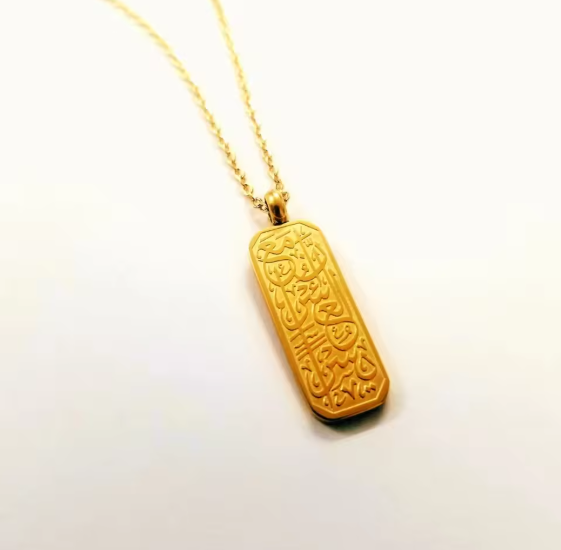
The calligraphy itself
Look closely at the letterforms. In good work the strokes vary in thickness the way handwritten script does, the curves are smooth rather than faceted, and the connections between letters are clean. Poor work looks stiff and evenly weighted, as though the shapes were traced rather than drawn.
Check the counters too, the enclosed spaces inside letters. On a cheap casting they fill in and the word becomes a blob at small sizes. On a well-made arabic islamic necklace those spaces stay open and the script stays readable even on a pendant a centimetre tall.
Always read the product photos to confirm exactly what the pendant says before buying, particularly if it is a gift. Descriptions sometimes say only that a piece features calligraphy without spelling out the wording.
Metal, plating and finish
Most affordable pieces are plated rather than solid. That is not a problem in itself, but it changes how you care for the piece. A thicker plating layer over a stable base metal lasts far longer than a thin flash of colour over a soft alloy.
Finish affects how the script reads. A high-polish surface throws highlights that can make fine strokes hard to see, while a lightly brushed or matte finish keeps the letterforms legible. Neither is better; it depends whether you want the piece to catch light or to be read.
Chain type and clasp
The chain does more work than people expect. Cable and box chains hold a pendant straight and are easy to untangle. Rope and snake chains look richer but kink more easily if they are thin.
Clasps are where cheap pieces fail first. A lobster clasp is more secure than a spring ring and easier to work with one hand. Whatever the type, check that the jump ring joining pendant to chain is fully closed, since an open ring is the most common reason a pendant goes missing.
Weight and hypoallergenic materials
A light pendant is more comfortable for all-day wear and puts less strain on a fine chain. If you have reacted to jewellery before, look specifically for a nickel-free or hypoallergenic description, and be aware that plated pieces can expose the base metal once the plating wears at a rub point.
Pendant construction
Check how the pendant attaches. A soldered bail is stronger than a simple loop bent from wire, and it keeps the script facing forward instead of twisting sideways. On an arabic islamic necklace with a horizontal design, two attachment points hold the piece flatter than one.
The WLD Store pick: Dainty Arabic Islamic Necklace
WLD Store lists this piece as a minimalist everyday necklace. Everything below is taken from the listing itself, kept separate from the general guidance above.
- Product: Dainty Arabic Islamic Necklace, described as a delicate minimalist pendant
- Design: features elegant Arabic calligraphy, according to the listing
- Finishes: offered in gold-tone and silver-tone
- Comfort: the listing describes a lightweight, hypoallergenic design intended for all-day wear
- Category: Fashion, filed under Islamic Jewelry & Accessories
- Brand: WLD
- SKU: WLD-KSA-0058-(KD-KD0188)
- Positioning: presented as an Islamic jewellery gift for women, available across Saudi Arabia with secure checkout
The complete description, all product photographs and current availability are on the Dainty Arabic Islamic Necklace product page. Check the images there for the exact calligraphy and chain style before ordering.
Choosing the right chain length for an arabic islamic necklace
Length is the decision people most often get wrong, and it is the one that determines whether a piece is worn or left in a drawer. A rough map helps.
A short chain of roughly forty centimetres sits at the base of the throat. It is the most visible option and works well above a round neckline, but it can look crowded on a high collar.
Around forty-five centimetres is the standard everyday length. The pendant lands just below the collarbone, which suits most necklines and is the safest choice when buying an arabic islamic necklace as a gift.
Fifty centimetres and above drops the pendant onto the chest. This is the length to choose for layering, or if the piece will usually be worn over a top rather than against skin.
If you are layering, leave at least five centimetres between chains so the pendants do not tangle or overlap. Pair the necklace with plainer chains rather than a second pendant, which keeps the calligraphy as the focal point.
Matching the necklace to your neckline
Where a pendant lands relative to your neckline decides whether it looks deliberate or accidental, and it is the easiest styling detail to get right once you know the pattern.
A round or scoop neckline gives the most room. A short or mid-length chain sits inside the opening with clear space around it, which is the classic way to wear an arabic islamic necklace and the reason most product photos are shot that way.
A V-neck wants a pendant that echoes the shape rather than fights it. Mid length works best here, sitting above the point of the V. A pendant that drops below the point looks disconnected from the outfit.
High necklines, polo collars and turtlenecks call for a longer chain worn over the fabric. This is also the case where a slightly larger pendant reads better, because fabric texture competes with fine detail.
With an abaya or a buttoned shirt, the choice is whether the piece is seen or private. Worn underneath, an arabic islamic necklace is something only you know is there, which is exactly why many people prefer a small, light pendant. Worn over, choose a length that clears the closure line so the chain hangs straight.
One general rule holds across all of these: the busier the neckline, the plainer the chain should be. Ruffles, embroidery and prints all compete with fine script, so save decorative chains for simple tops.
Wearing an arabic islamic necklace day to day
Daily wear is where plated jewellery either survives or does not, and most of what shortens its life is avoidable.
Put jewellery on last. Perfume, hairspray and body lotion all contain solvents and oils that attack plating, so let them dry fully before the necklace goes on. This one habit does more for longevity than anything else.
Take it off before swimming. Chlorine is harsh on plated finishes, and salt water is worse. The same applies to hot tubs and, ideally, to long sessions in a steam room.
Practices around removing jewellery before wudu vary from person to person, and it is a matter for your own preference or guidance you trust. Practically speaking, repeated wetting and drying does shorten the life of a plated finish, so many people take a delicate arabic islamic necklace off and keep it in a small pouch nearby.
In a Saudi summer, perspiration is the other consideration. Salt residue dulls plating over time, so a quick wipe with a soft dry cloth at the end of the day makes a visible difference over months.
Buying an arabic islamic necklace as a gift
This category is bought as a present more often than for oneself, so a few notes on getting it right.
Match the metal to what she already wears. Someone who wears gold-tone rings and watches will not switch to silver for one pendant. If you genuinely cannot tell, gold-tone is the more common choice in the region.
Choose the middle chain length unless you know her preference. It is the most forgiving with different necklines and the easiest to shorten with an extender if needed.
Confirm the wording on the pendant from the product photos, and consider whether she would prefer something legible from a distance or something subtle that only she recognises. An arabic islamic necklace given as a gift should feel personal rather than generic, and that detail is what makes it so.
Arabic islamic necklace care and cleaning
Plated jewellery does not need much, but what it needs it needs consistently.
- Wipe after wearing. A soft dry cloth removes perspiration and skin oils before they have time to work on the finish.
- Clean gently when needed. Lukewarm water with a drop of mild soap, applied with a soft cloth, then dried immediately and completely.
- Never use silver dip or abrasive polish on plated pieces. These strip the plating rather than cleaning it.
- Store it flat and separately. A soft pouch or a lined box stops the chain tangling and prevents harder pieces scratching the pendant.
- Keep it out of the bathroom. Humidity accelerates tarnishing on almost every finish.
- Rotate your pieces. Giving an arabic islamic necklace a day off between wears genuinely extends the life of the plating.
If you are curious about the tradition behind the script itself, the Wikipedia overview of Arabic calligraphy covers the main styles and their history, which makes it easier to recognise what you are looking at on a pendant.
Common arabic islamic necklace problems and quick fixes
- The chain keeps tangling. Fine chains tangle when stored loose. Fasten the clasp before putting it away and lay it flat; a drinking straw threaded over the chain keeps it straight in a travel bag.
- The pendant sits sideways. The bail is twisting on the chain. A slightly wider bail or a flatter chain profile fixes it; a jeweller can swap either cheaply.
- Colour is wearing at one spot. Plating wears fastest where the chain rubs the back of the neck. Rotating which way you fasten the clasp spreads that wear out.
- Skin turns green under the pendant. This is a reaction between perspiration and the base metal beneath worn plating. Stop wearing it against damp skin, and choose a nickel-free piece next time.
Gold-tone or silver-tone arabic islamic necklace
Both finishes are offered on most pieces in this category, and the choice is more practical than aesthetic once you think it through.
Gold-tone is the more traditional choice regionally, sits well against warmer skin tones, and coordinates with the gold jewellery many women already own. It also hides small scratches better than a bright white finish.
Silver-tone reads as more contemporary and pairs easily with steel watches and white-metal rings. Fine script often looks crisper in silver, because the cooler colour gives more contrast in the recesses of the letters.
Mixing metals is entirely acceptable now, so if you like both, an arabic islamic necklace in one tone worn with a bracelet in the other will not look wrong. The only rule worth keeping is consistency within a single layered stack.
Who an arabic islamic necklace is not for
A dainty pendant is the wrong choice for someone who wants a bold statement piece. If she wears heavy chains and large stones, a fine calligraphy pendant will disappear on her.
It is also not ideal for very rough daily wear. Anyone working with their hands, in a laboratory, a kitchen or a workshop, will find a fine chain snags and a plated finish dulls quickly. A sturdier piece is the better tool for that life.
And it is not a substitute for a fine-jewellery investment purchase. An arabic islamic necklace at this level is designed to be worn and enjoyed, not to be valued or resold, and it is worth being clear about that when giving one.
Arabic islamic necklace buying checklist
- Can you read the calligraphy clearly in the photos? If the product images do not show the pendant close up, ask before ordering.
- Is the clasp a lobster or a spring ring? Lobster clasps are more secure and much easier to fasten alone.
- Does the description mention hypoallergenic or nickel-free? Important if you have reacted to jewellery before.
- Is the chain length stated? Match it to the neckline she wears most, and default to the mid length for a gift.
- Does the metal tone match her existing jewellery? This matters more than the pendant design for whether it gets worn.
Other Islamic gift picks at WLD Store
If you are shopping for a gift and a necklace is not quite right, these three sit nearby in the same part of the catalogue.
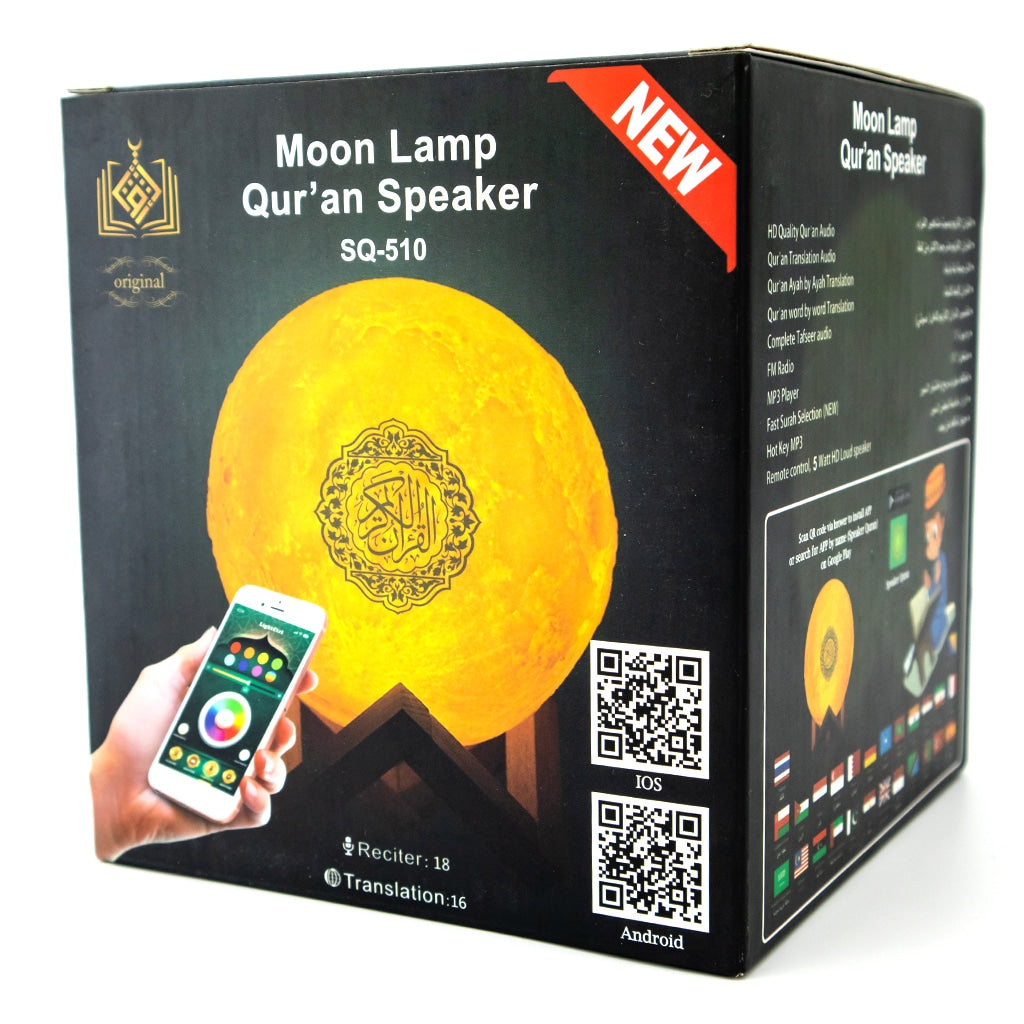
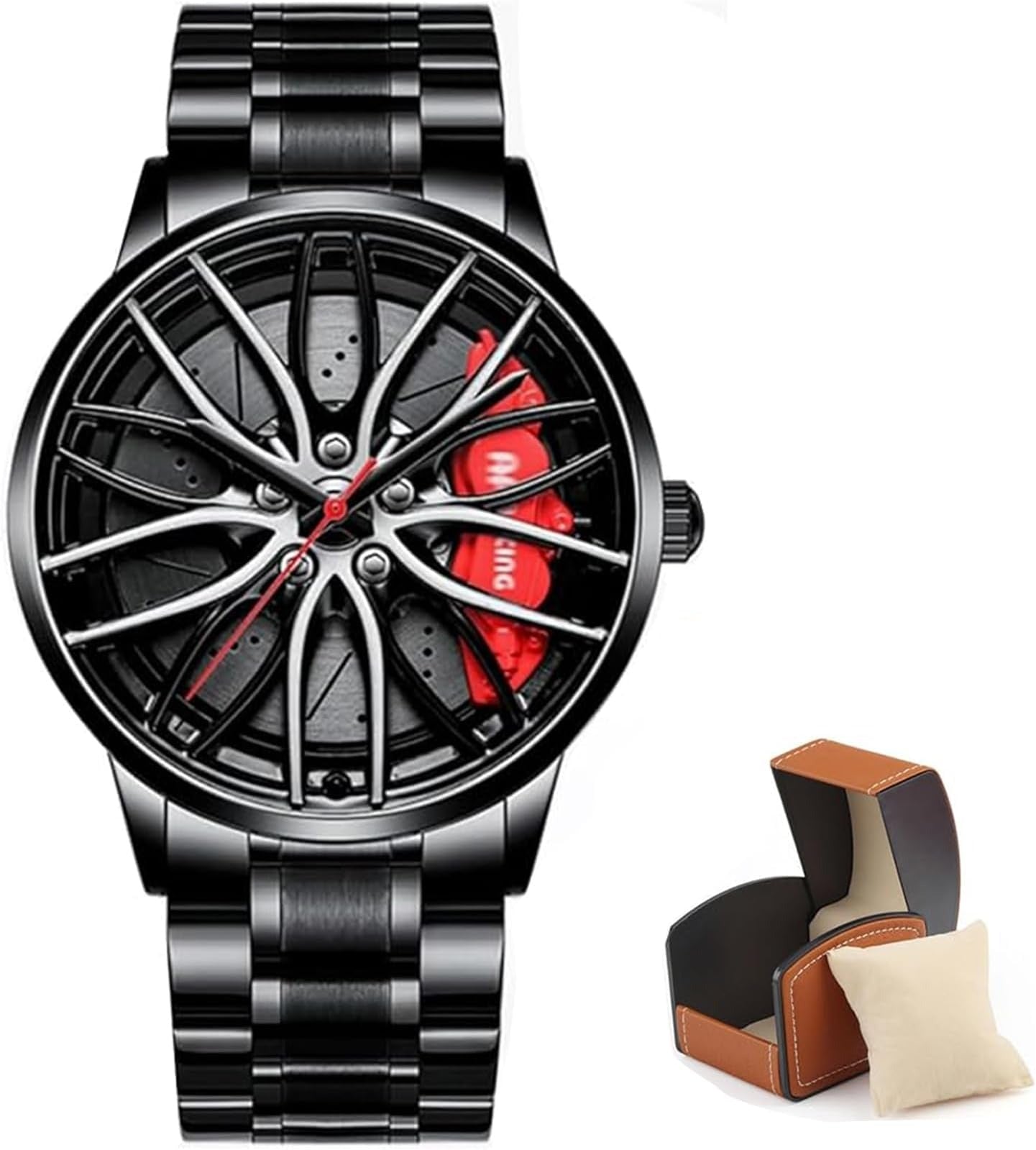
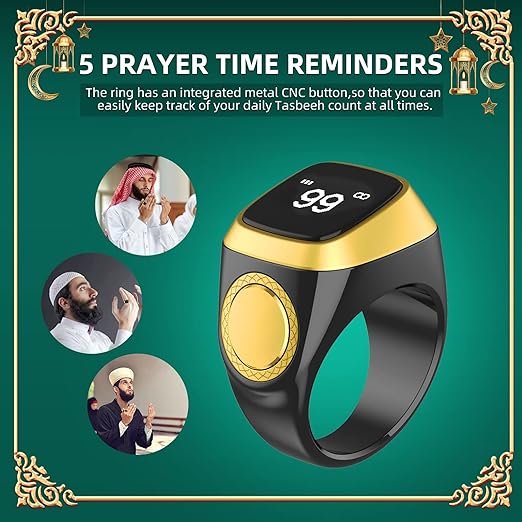
The moon lamp speaker is the choice for a home gift rather than something worn, the rotating wheel watch suits a man on your list, and the qibla ring is the closest alternative if you want something wearable and functional.
Frequently asked questions about an arabic islamic necklace
Will an arabic islamic necklace tarnish?
Plated pieces dull rather than tarnish in the way solid silver does, and how fast depends almost entirely on care. Keeping it away from perfume, chlorine and prolonged damp, and wiping it after wear, makes the difference between a finish lasting months and lasting years.
Can it be worn every day?
Yes, and most people do. A dainty pendant is designed for continuous wear. The main caution is removing it for swimming, sleeping in it less often than you might think, and letting cosmetics dry before putting it on.
What chain length should I order as a gift?
Around forty-five centimetres is the safest choice. It suits most necklines and sits just below the collarbone, which is where most people expect a pendant to fall. An extender chain adds flexibility if she prefers it lower.
Is this suitable for someone with sensitive skin?
Look specifically for a hypoallergenic or nickel-free description, which the WLD Store listing includes for this piece. Bear in mind that plating can wear through at rub points over time, exposing the base metal underneath, so care matters for sensitive skin.
Can men wear this style of pendant?
Calligraphy pendants are made in a wide range of sizes and weights, and heavier designs on thicker chains are commonly worn by men. A dainty arabic islamic necklace of the kind described here is styled for a finer, more delicate look.
How do I stop the chain from tangling?
Fasten the clasp before storing, lay the chain flat rather than dropping it into a bowl, and keep it in its own pouch. For travel, threading the chain through a drinking straw before fastening keeps it perfectly straight.
An arabic islamic necklace succeeds or fails on details that are easy to check: legible script, a secure clasp, a chain length that matches her wardrobe, and a finish looked after with a soft cloth. Get those right and it becomes a piece worn daily rather than kept for occasions. See the full description on the Dainty Arabic Islamic Necklace page, or browse related gift ideas in the Islamic Jewelry & Accessories section.



Add comment