A hair straightener brush exists because most people do not actually want poker-straight hair. They want the frizz gone, the volume under control and the whole thing done before they leave the house. A flat iron clamps and flattens; a brush glides, so you get smooth, soft, slightly-still-alive hair in a fraction of the fuss. This guide explains how the two differ, what to look for when comparing one hair straightener brush against another, which temperature suits which hair, and how to use one without paying for it in split ends. The 5-stage model at WLD Store is the worked example.
What a hair straightener brush does differently from a flat iron
A flat iron works by compression. Two heated plates close on a section of hair and pull it dead straight, which is why it produces the sharpest results and why it is also the easiest tool to damage hair with: all the heat is delivered to a thin section held tightly between two hot surfaces.
A hair straightener brush works by contact instead. Heated bristles pass through the hair while the brush shape separates and tensions it, so the heat is spread across a wider area and no section is clamped. The result is smoothing rather than flattening, which suits anyone who wants their hair sleek but not board-flat.
The bigger practical difference is speed and skill. A flat iron requires sectioning, clipping and a steady hand, and it is unforgiving of a slow pass. A hair straightener brush is used more or less the way you already brush your hair, which is why people who never mastered a flat iron get usable results from a brush on their first attempt.
The trade-off is honest and worth stating. If you have very coarse or tightly curled hair and you want it genuinely straight, a brush will get you smoother but not the same result as a flat iron. What it will do is halve the time for the everyday tidy-up that most mornings actually need. For context on how the whole category developed, the overview of hair irons is a useful primer.
What to look for in a hair straightener brush
Five things separate a brush you will use daily from one that lives in a drawer.
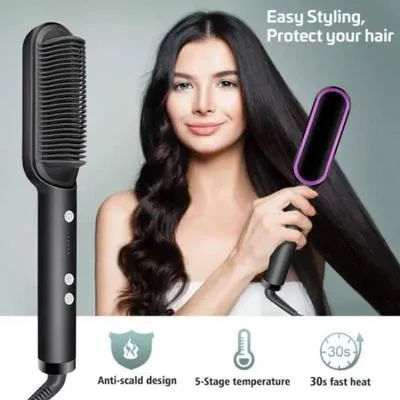
Temperature stages, not just a maximum
A single on-off setting is the biggest weakness in cheap tools, because hair type varies enormously and one temperature cannot suit all of it. Multiple stages let fine hair be treated gently and coarse hair get the heat it needs. When comparing one hair straightener brush with another, count the stages before you look at the top number, because the ability to go low matters more than the ability to go high.
Heat-up time
This decides whether the tool fits into a real morning. A brush that is ready in around half a minute gets used on a rushed Tuesday; one that takes three minutes gets skipped. It also matters for touch-ups, where you want a quick pass over a fringe rather than a project.
Bristles and anti-scald tips
The bristles are the part that touches your scalp, so their design is a safety feature rather than a detail. Anti-scald tips, usually rounded and insulated, let you get close to the roots without burning skin. This is the single most common complaint about badly designed heated brushes, and the reason people end up leaving an unsmoothed inch at the roots.
The heated surface
Look for an even, smooth heated surface between the bristles, because uneven heating produces uneven results and hot spots that damage hair. A surface that grabs or drags is a warning sign; a hair straightener brush should glide through a section with light resistance and no snagging.
Weight, cable and safety features
You will hold this above shoulder height with your arm bent, so balance matters. A swivel cable stops the lead twisting into a knot as you work around your head, and a long enough cable means you are not tethered to one corner of the mirror. Automatic shut-off is worth having on any heated styling tool.
The WLD Store pick: Hair Straightener Brush
Here is the hair straightener brush we stock, described using only what the listing states:
- Product: Hair Straightener Brush
- Brand: WLD
- Category: Beauty and Personal Care
- Temperature control: 5 temperature stages
- Heat-up: heats in 30 seconds
- Safety: anti-scald design
- Technique: brushes and straightens in one stroke
- SKU: WLD-PK-0011-(MK-682513)
- Availability: available across Pakistan through WLD Store with secure checkout
Five stages plus a thirty-second heat-up is a sensible combination for daily use, since the stages cover different hair types and the fast start is what makes a hair straightener brush a morning tool rather than a weekend one. Full details and current availability are on the Hair Straightener Brush product page.
Choosing the right temperature for your hair
This is where most heat damage comes from, and it is entirely avoidable. The rule is simple: use the lowest setting that gets the result, and never go straight to maximum because it seems faster.
- Fine, thin or coloured hair. Start at the lowest stage. Fine hair transmits heat quickly and is the easiest to damage, and colour-treated hair is already chemically stressed.
- Normal, healthy medium hair. A middle stage is usually plenty for smoothing frizz and controlling volume.
- Thick, coarse or very curly hair. Higher stages exist for this hair, which genuinely needs more heat to respond. Even then, work up from the middle rather than starting at the top.
- Damaged or previously over-processed hair. Go lower than you think and accept a slightly less smooth result. Heat will not repair anything.
Test on a small section at the back before doing the whole head at a new setting. If one pass is not enough at a given stage, try a slower pass before you reach for a higher temperature, because dwell time and heat are not the same thing.
How to use a hair straightener brush properly
- Start with completely dry hair. Damp hair plus heat is how you get the crackling sound and the damage that goes with it. Unless a tool is specifically sold for wet use, dry first.
- Apply a heat protectant. This is not an upsell, it is the single most effective thing you can do to limit damage from any heated tool.
- Brush the tangles out first. A hair straightener brush is not a detangler, and dragging it through knots damages hair and strains the bristles.
- Work in sections. Clip the top up, start underneath at the back, and release layer by layer. Sections mean you are not passing repeatedly over the same hair.
- Keep the strokes slow and continuous. One slow, smooth pass beats four fast ones, and repeated passes are what cause damage.
- Follow with your other hand. Running a comb or your hand behind the brush keeps tension on the section and gives a noticeably smoother finish.
- Finish the roots carefully. This is what the anti-scald tips are for, but keep the brush moving and never rest it against the scalp.
- Let it cool before you touch anything else. Hair sets as it cools, so leave it alone for a minute at the end.
Making the smoothness last
People usually blame the tool when a style drops within a few hours, and usually the cause is humidity or the finishing routine rather than the hair straightener brush. Hair reabsorbs moisture from the air, which is what brings the frizz back, so the two minutes after styling matter almost as much as the styling itself.
Let the hair cool completely before you tie it, brush it out or put a scarf over it. Hair sets as it cools, and handling it while it is still warm undoes the shape you have just made. Leaving it alone for a few minutes is the cheapest improvement available to anyone.
Use a light finishing product rather than a heavy one. Serums and oils weigh hair down and collect dust; a small amount worked through the ends is enough to seal the surface. On a humid day an anti-humidity spray does far more for longevity than another pass with the hair straightener brush, which only adds heat to hair that is already smooth.
Care and cleaning
- Unplug and cool completely before cleaning. Every time, without exception.
- Remove trapped hair after each use. Hair wrapped around the bristle bases burns onto the heated surface and creates the smell people mistake for a fault.
- Wipe product build-up off gently. A slightly damp cloth on the cool surface, then dry it. Styling products carbonise onto a heated plate and cause drag.
- Never submerge it. It is a mains appliance, not a hairbrush.
- Do not wrap the cable tightly around the handle. This is the most common cause of a lead that eventually fails at the joint.
- Store it cool, dry and uncovered. Putting a warm hair straightener brush into a drawer or a bag is a burn and fire risk.
Common problems and quick fixes
- The hair is not getting smooth. Usually the sections are too thick or the pass is too fast. Take thinner sections and slow down before you raise the temperature.
- It drags or snags. Either the hair was not detangled first, or there is product build-up on the heated surface. Comb through properly, and clean the brush when cool.
- Your scalp gets touched by heat. Angle the brush so the bristle tips lead and keep it moving. If it still happens, you are working too close to the roots on too high a stage.
- There is a burning smell. Almost always hair or product burning onto the surface rather than an electrical fault. Unplug, cool, clean thoroughly. If the smell persists on a clean tool, stop using it.
Hair straightener brush buying checklist
- How many temperature stages does it have? More stages means it can suit your hair rather than an average.
- How fast does it heat up? This is the difference between daily use and occasional use.
- Are the bristle tips designed against scalp contact? Ask this before anything about styling results.
- Does the cable swivel, and is it long enough? A twisting lead is a daily irritation.
- Is it comfortable to hold with your arm raised? Try the weight and balance if you can; you will hold it for several minutes at a time.
More Beauty and Personal Care picks at WLD Store
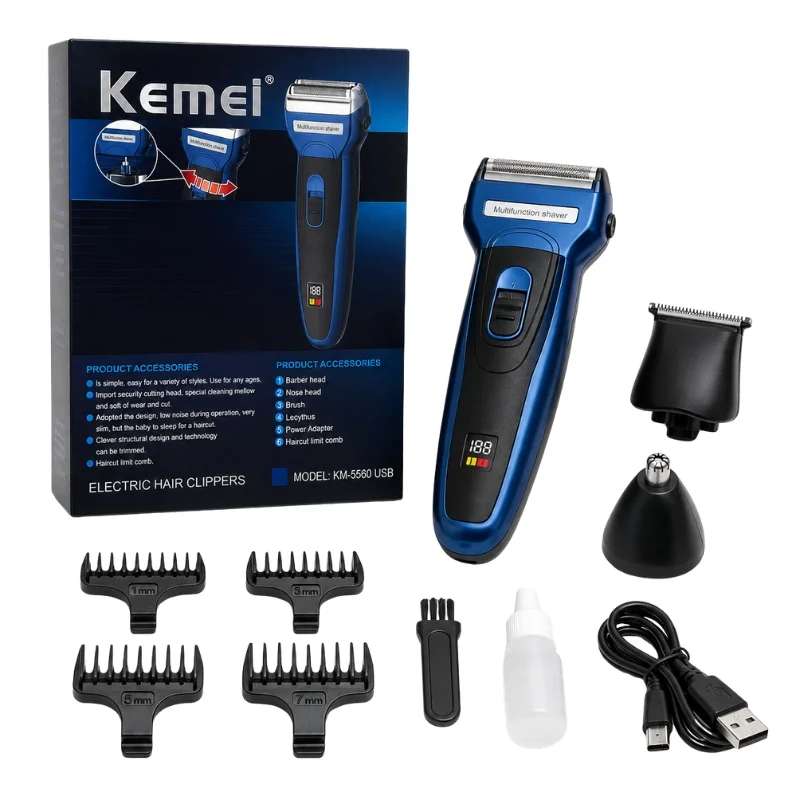
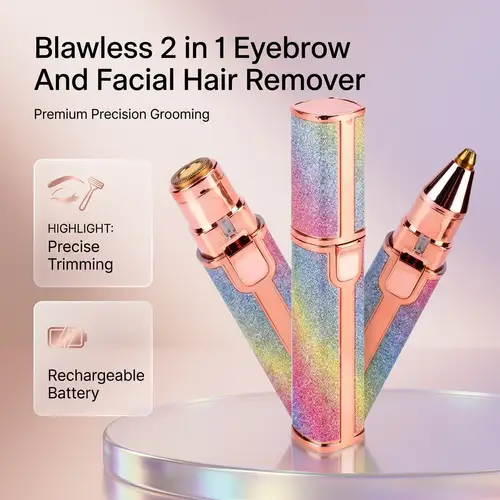
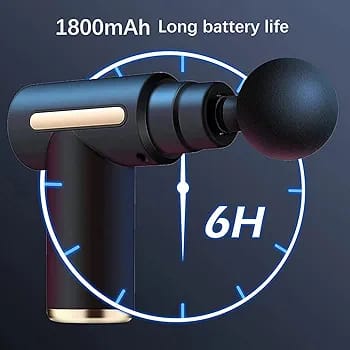
These three come up often alongside a hair straightener brush:
Who a hair straightener brush suits, and who should skip it
A hair straightener brush is not equally good for every head of hair, and the honest picture saves a lot of disappointment.
It works best on hair with a loose wave, a bit of frizz, or the kind of bulk that only needs smoothing rather than reshaping. Shoulder-length and longer hair suits it, because the bristles need something to pull through. Anyone who wants a quick tidy-up between washes, rather than a poker-straight finish, is exactly the person it was designed for.
It is a poor fit for tightly coiled or very coarse hair. A hair straightener brush smooths by combing warm hair under light tension and does not apply the compression that plates do, so tight curl patterns usually end up softened rather than straightened. If a mirror-flat finish is the goal on that hair type, a plate tool will get there in fewer passes and, in practice, with less total heat exposure.
Very short hair is awkward for a different reason. There is not enough length for the bristles to grip, and the heated base ends up close to the scalp. Fringe-length sections need the same caution.
Two more groups should think twice. Anyone whose hair is already heat-damaged, bleached to a pale level or freshly chemically straightened should keep heat styling to a minimum and get a professional opinion first. And synthetic extensions and wigs melt, so a hair straightener brush is for human hair unless the maker of the piece says otherwise.
Travelling with a hair straightener brush
Heat styling away from home causes more small disasters than it should, and nearly all of them are avoidable with two minutes of thought.
Check voltage before anything else. Many heated tools are single-voltage, and the wrong supply will either destroy the tool or trip the room. A plug adapter changes the shape of the pins; it does not change the voltage. If the tool is not marked dual voltage, you need a proper converter or a different tool for that trip.
Pack it cool and pack it last. A hair straightener brush needs a good ten to fifteen minutes to cool down, and hot bristles will mark a suitcase lining or melt a nylon pocket. A heat-resistant pouch is worth the small space it takes. Wrap the cable loosely around the outside of the pouch rather than tightly around the handle, which is how cables fail at the base.
- In hand luggage: corded heated tools are generally accepted; anything with a gas cartridge is not.
- Hotel rooms: style at the bedroom mirror on a hard surface, away from the shower.
- Never on a bed: a hot brush resting on a duvet is a genuine fire risk.
- Auto shut-off: useful at home, close to essential in a room you leave in a hurry.
One last habit: unplug at the socket rather than by pulling the cable, and let the hair straightener brush cool on tile or stone. Airport mornings are exactly when a hot tool gets shoved into a bag, and a melted case is a poor start to a holiday.
Frequently asked questions about a hair straightener brush
Is a hair straightener brush less damaging than a flat iron?
Generally it is gentler, because the hair is not clamped between two hot plates and the heat is spread over a wider contact area. That does not make it harmless. Heat is heat, so a low setting, a heat protectant and a single slow pass still matter more than the tool you choose.
Can I use it on wet hair?
No, unless the product is specifically sold as a wet-to-dry tool. Applying a hot surface to wet hair boils the water inside the strand, which is the fastest way to cause the damage everyone is trying to avoid. Dry fully, then style.
Will it work on very curly hair?
It will smooth curls and reduce frizz considerably, but a brush is not the tool for turning tight curls poker straight. Expect a softer, sleeker result rather than a complete transformation, and use a higher stage with slow, sectioned passes.
How often can I use one?
Daily use is common and is fine for healthy hair used at a sensible temperature with protectant. If your hair is fine, coloured or already damaged, alternating days and dropping a stage does far more good than any product you can buy afterwards.
Why does it not straighten near the roots?
Usually because people are understandably nervous about the scalp. That is exactly what the anti-scald bristle design is for: it lets the brush get closer safely. Keep the tool moving and lift the section slightly away from the head as you start the stroke.
Does it work on short hair?
Yes, though the shorter the hair the more the brush shape matters, since you need enough length to sit between the bristles. For a short bob or a fringe, a hair straightener brush is often easier than a flat iron because there is no clamping and no risk of a crease.
A hair straightener brush earns its place by being fast enough to use on an ordinary morning, and the temperature stage you choose matters more than anything else you do with it. If the 5-stage model with a thirty-second heat-up suits your routine, the full listing is on the product page, and the rest of the personal care range is in the Beauty & Personal Care section.


Add comment