A selfie ring light is the cheapest upgrade most people can make to how they look on camera, and it works because of physics rather than marketing. A ring of light placed around the lens throws even, shadow-free illumination straight at your face, which is exactly what a phone camera struggles to produce indoors on its own. This guide covers what actually matters when choosing one, how to position it for video calls, short-form video and product photos, and where the 6-inch model with tripod stand and phone holder at WLD Store fits in.
Why a selfie ring light makes such a visible difference
Phone cameras have small sensors. In dim conditions they compensate by raising sensitivity, and that is what produces the grainy, muddy, slightly grey look of an evening video call. Give the camera more light and it stops compensating: noise drops, colours firm up, and the image gets noticeably sharper without you touching a single setting.
The shape matters as much as the quantity. A lamp off to one side casts a hard shadow down one half of your face; a ceiling light overhead puts shadows under your eyes and nose. A ring surrounds the lens, so the light arrives from the same direction you are being viewed from and shadows fall behind you instead of across you. That is why a selfie ring light flatters faces in a way a desk lamp never will.
There is a signature to it as well. The ring reflects in the eyes as a bright circle, the catchlight that makes portraits look alive rather than flat. Photographers have chased that effect for decades, which is why the ring flash existed long before anyone was filming themselves on a phone.
The practical upshot is consistency. Daylight through a window is lovely and completely unreliable: it changes hour to hour, and disappears exactly when most people record. A selfie ring light gives you the same lighting at nine in the morning and nine at night, which is what makes a series of videos or a shelf of product photos look like they belong together.
What to look for in a selfie ring light
Ring lights vary more than their near-identical photographs suggest. Six things decide whether one earns a permanent place on your desk.
Ring size and what it is good for
Diameter decides how soft the light is and how far away it can work. A large ring wraps light around a subject and can light someone standing back from it; a compact 6-inch ring is a close-range tool, which is precisely what most people need. At desk distance for a video call, at arm’s length for a piece to camera, or directly over a table for flat-lay product shots, a small selfie ring light is ideal. What it will not do is light a whole room or a full-length shot from across it, and no amount of brightness changes that.
Colour modes and colour temperature
Most ring lights offer several colour modes, typically a warm yellow tone, a neutral white and a cool bluish white. This is about colour temperature, and it is not a gimmick. If the room around you is lit by warm bulbs and your selfie ring light is set to cool white, your face will look oddly blue against the background. Matching the mode to the room is the single fastest way to make footage look natural rather than lit.
Brightness levels and dimming
More important than maximum output is how finely you can turn it down. A ring at full power ten inches from your face is uncomfortable and washes out skin tone. Several brightness steps let you find the level where the camera has enough light and you can still keep your eyes open. Look for a control you can reach without leaning out of frame.
The tripod stand
The stand does more work than people expect. It has to hold the ring and a phone steady at the height of your face, on a desk that gets knocked. Check how the legs spread, whether the height adjusts, and whether the whole thing stays upright when the phone is mounted at the top and tilted. A selfie ring light on a stand that wobbles will ruin more shots than poor lighting ever did.
The phone holder
Look at three things: the jaw width, whether it grips without covering the lens or the charging port, and whether it rotates for portrait and landscape. Turning the phone sideways is not optional if you shoot anything for a widescreen platform, and a clamp that only holds vertically will limit you immediately.
Power and cable
USB power means the light runs from a power bank, a laptop, a wall adapter or a car socket, which is genuinely flexible. The thing to check is the cable length relative to where you want the light, because a short lead decides where you can sit far more than you would like.
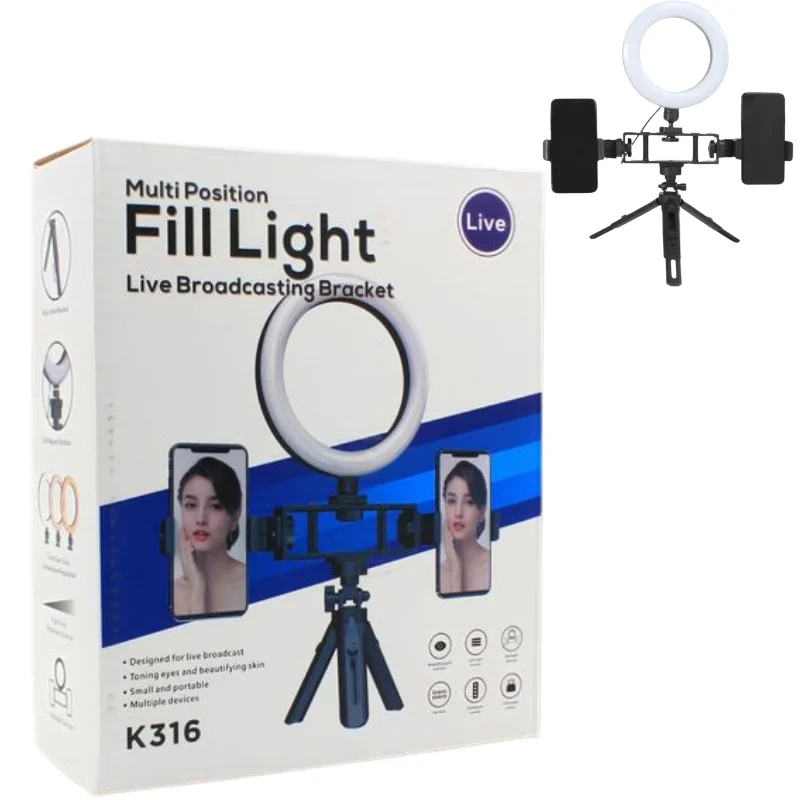
The WLD Store pick: 6-Inch Selfie Ring Light with Tripod Stand and Phone Holder
Here is the selfie ring light we stock, described using only what the listing states:
- Product: 6-Inch Selfie Ring Light with Tripod Stand and Phone Holder
- Brand: WLD
- Category: Electronics
- Ring size: 6 inches
- Colour modes: 3
- Power: USB powered
- Included: tripod stand and phone holder
- SKU: WLD-PK-0012-(YM-Vi-90-00-00-907)
- Availability: available across Pakistan through WLD Store with secure checkout
A 6-inch ring with its own stand and holder covers the jobs most people actually have: calls, short videos, and small product shots on a table. Full details and current availability are on the 6-Inch Selfie Ring Light product page.
How to set up a selfie ring light properly
Position beats specification every time. The same light can look professional or amateurish depending entirely on where you put it.
- Put the ring at eye level or very slightly above. Below your face is the classic mistake, and it produces the uplit look people associate with ghost stories.
- Keep it close, then dim it. Light gets much softer as it gets nearer. Bring the selfie ring light in and reduce brightness rather than pushing it back and turning it up.
- Match the colour mode to the room. Warm bulbs behind you, warm mode on the ring. Daylight through a window, neutral or cool.
- Watch what is behind you. A ring lights your face and leaves the background dark, which can look like a cave. A small lamp behind you fixes it.
- Wear the right thing. Glasses reflect a ring as a visible circle. Tilting your chin slightly or moving the light a few degrees off-axis removes it.
- For flat-lay product shots, point it straight down. Lay the item on a plain surface, hold the ring above it and shoot through the middle. This is where a small selfie ring light genuinely competes with expensive equipment.
- Lock your camera exposure. Once the light is set, tap and hold on your face so the phone stops rebalancing every time you move.
For online sellers this is the highest-value use. Product photographs shot under mixed household lighting look inconsistent from listing to listing, and inconsistency is what makes a small shop look improvised. One selfie ring light in one fixed position gives every photograph the same colour and the same shadows.
Getting video calls right
Calls are the most common use and the one people put the least thought into. The camera wants to be at eye level, which on a laptop means a stack of books under it rather than you looking down into the lens. With the camera level and the selfie ring light behind it, you are lit from the front and seen from a flattering angle at the same time.
Sit about an arm and a half from the screen rather than close enough to fill the frame. Leave a little headroom above your head, and keep the background plain if you can. A cluttered wall is survivable; a bright window behind you is not, because it turns you into a silhouette that no amount of front light can rescue. Close the curtains or turn around.
Do a thirty second test recording before anything that matters. Played back, it tells you more about your lighting and framing in half a minute than fiddling with a live preview does in ten.
Care and storage
- Wipe the diffuser gently. A soft dry cloth is enough; solvents will haze the plastic permanently.
- Do not leave it at full brightness for hours. Heat is what shortens the life of the diodes, and you rarely need maximum output anyway.
- Collapse the tripod before moving it. Most breakages happen when a stand is carried extended with a phone still clamped to it.
- Coil the USB cable loosely. Tight wraps around the connector are the usual cause of a lead that works only at certain angles.
- Store it away from direct sun. Plastic diffusers yellow with prolonged sunlight, which shifts the colour of your selfie ring light over time.
- Check the clamp jaws now and then. Grit in the pads scratches phone backs and reduces grip.
Common problems and quick fixes
- Your face looks blue or orange on camera. The colour mode does not match the room lighting. Switch modes, or turn off the mismatched room light entirely.
- A bright ring is reflected in your glasses. Raise the light slightly, tilt it a few degrees off centre, or angle your head a little. You are aiming to bounce the reflection away from the lens.
- The stand keeps tipping over. The phone is too heavy for the extension, or the legs are not fully spread. Lower the height, widen the legs, and keep the cable from pulling on one side.
- The light flickers on video. Usually a loose USB connection or an underpowered source. Try a different port or adapter and make sure the plug is fully seated.
Selfie ring light buying checklist
- How far from your face will it sit? A compact ring is for close range; be honest about your setup before buying a small one for a large space.
- Does the holder rotate to landscape? If you shoot widescreen video at all, this is essential.
- How many colour modes and brightness steps does it have? More adjustment means fewer situations where it looks wrong.
- What powers it, and is the cable long enough? USB is flexible, but only if the lead reaches.
- Is the stand stable with your phone on it? Test with your actual phone, not a lighter one.
More Electronics and lifestyle picks at WLD Store
These three come up alongside a selfie ring light for people setting up a home desk:
Selfie ring light vs a softbox, a panel light and a window
Choosing between a selfie ring light and the alternatives is really a choice about the size and direction of the light source. A window on an overcast day is the largest soft source most people own, and it is free. Its limitation is that it exists only in daylight, only in one room, and only on the side of that room it happens to be on. If you film in the evening, it is not an option at all.
A softbox is a window you can carry. It gives the softest and most flattering light of anything here, which is exactly why photographers use them. The cost is space: a softbox wants a stand, a metre or so of floor and somewhere to live between sessions. In a bedroom or a shared flat that is a real obstacle rather than a minor one.
A flat LED panel is compact and bright, but the light leaves a rectangle off to one side, so it casts a directional shadow across the face. It is excellent as a second light and mediocre as the only one, which is why a panel usually ends up working alongside a selfie ring light rather than instead of it.
A ring takes a different approach altogether: it puts the source in a circle around the lens, so light arrives from every direction at once and the shadows fall behind the subject instead of across it. That is why a selfie ring light flatters skin, and why it leaves the distinctive ring-shaped catchlight in the eyes. It is not as soft as a large softbox, but it is the only option here that packs into a bag, sets up in half a minute and puts the camera in the middle of its own light.
Five jobs a selfie ring light does besides selfies
The name is narrower than the use.
- Photographing things to sell. Clothes, phones, furniture, anything going onto a resale listing. Even, shadowless light keeps colours accurate, and accurate colour is what stops buyers messaging to ask what shade it really is.
- Makeup and grooming. Bathroom lighting is usually overhead, which drops shadows into precisely the places you need to see. A selfie ring light at face height shows a blend the way it will actually look outdoors.
- Detailed close work. Nail art, henna, jewellery repair, model painting or sewing dark fabric. A ring around the work area means your own hands stop throwing shadows over what you are doing.
- Recording tutorials. Anything filmed looking down at a desk, a keyboard, a whiteboard or a pair of hands benefits from light travelling down the same axis as the camera.
- Reading in a shared room. On its lowest warm setting a selfie ring light makes a perfectly good reading lamp that does not wake the whole room.
One caveat is worth knowing before you buy. Anyone who wears glasses will see the ring reflected in their lenses on camera. It is not a fault and it is fixable: raise the light slightly above eye level and angle it down a few degrees, or tilt the glasses a fraction by lowering the arms on your ears. Most people never notice until they watch a recording back, which is why it pays to shoot one test clip with the selfie ring light before the meeting that actually matters.
Frequently asked questions about a selfie ring light
Is a 6-inch selfie ring light big enough?
For anything at desk or arm’s length, yes. Ring size governs how far the light can usefully reach and how soft it is at that distance, so a compact ring is excellent for calls, talking-head video and tabletop photography. If you need to light someone standing several feet away, you want a much larger ring and a floor stand.
What are the three colour modes for?
They let you match the light to the room. Warm suits a home lit by yellow bulbs, neutral suits mixed or daylight conditions, and cool suits offices with white lighting. Mismatching them is the most common reason footage looks slightly wrong without the person being able to say why.
Can I use it for product photography?
Yes, and it is one of the best uses. Held directly above a plain surface, a selfie ring light gives even, shadow-free illumination that keeps colours consistent between shots. For online sellers, consistency across a catalogue is worth more than any single dramatic photograph.
Does it need batteries?
USB powered models draw power from whatever you plug them into: a wall adapter, laptop, or power bank. That means no batteries to replace, but it also means you need a socket or a power bank within cable reach of where you sit.
Will it work with any phone?
Any phone that fits the clamp jaws, which covers the great majority. The things to check are that the grip does not sit over the lens or the charging port, and that the holder turns for landscape if you need it. Heavier phones may need the stand kept lower for stability.
Why do my glasses reflect the ring?
Because a ring light is a large bright circle pointed straight at reflective lenses. Raise it a little, move it slightly off-axis, or lower your chin so the reflection bounces below the camera. This is normal and is fixed by position, not by equipment.
A selfie ring light is one of those small purchases whose effect is immediately visible in the first video you shoot afterwards. If the 6-inch model with tripod stand and phone holder suits your desk, the full listing is on the product page, and the rest of the range is in the Electronics section.




Add comment