A car polishing machine is the difference between a car that looks clean and a car that looks cared for. Washing removes dirt; polishing removes the fine scratches, swirl marks and dull oxidised layer that make paint look tired even when it is spotless.
This guide explains what a car polishing machine actually does to paint, why dual action tools have largely replaced rotary buffers for home use, how to match pads and compounds to the job, and the step-by-step method that produces an even finish. There is a section on working in Saudi Arabia’s heat, a maintenance routine, a troubleshooting list, a buying checklist and six questions answered at the end.
Why a car polishing machine matters
Automotive paint is not a single layer. Underneath the colour sits primer, and over the colour sits a transparent clear coat that carries the gloss and takes all the abuse. Almost every mark you can see lives in that clear layer.
Swirl marks are the classic example. They are thousands of shallow scratches, usually put there by a dirty sponge or a drive-through brush, and they scatter light in every direction. Under a showroom light or direct sun they show up as a fine halo across the panel.
Polishing works by levelling the clear coat very slightly so the surface becomes flat again and reflects light cleanly. Doing that by hand is possible but slow, and the pressure is never even across a panel. A car polishing machine applies consistent speed and pressure for as long as you need it to.
The second job is wax or sealant application. Spreading a protective layer thinly and evenly is fiddly by hand, and a machine on a low setting with a soft pad does it in a fraction of the time. That dual role is why a car polishing machine tends to get used far more often than people expect when they buy one.
Dual action versus rotary: the difference that matters
There are two broad families of machine. A rotary buffer spins the pad on a single fixed axis, like a grinder. It cuts fast, and it is what professional bodyshops have used for decades.
A dual action machine spins the pad and simultaneously moves it in a small orbit. Because the pad’s path is constantly changing, heat does not build up in one spot, and the tool is far less likely to burn through an edge or leave a holographic pattern in the paint.
For anyone who is not a full-time detailer, dual action is the sensible choice. It is slower to correct heavy defects, and that slowness is precisely the safety margin a beginner needs. The general chemistry and layering of modern finishes is covered on the automotive paint reference page, and it is worth a read before your first session.
What makes a good car polishing machine
Specifications on a box tell you less than you would hope. Four things genuinely change how a car polishing machine behaves in your hands.
Variable speed control
This is the feature to insist on. Low speeds are for spreading wax and sealant without slinging it across the driveway. Middle speeds are for finishing polish. Higher speeds are for cutting compound on a defect you are actually trying to remove.
A single-speed tool forces one compromise on every job. A car polishing machine with a proper speed dial lets you start gently, see what the paint responds to, and only increase if the result asks for it.
Balance and vibration
You will be holding this tool at arm’s length over a bonnet for twenty minutes at a time. A car polishing machine that vibrates heavily makes your forearms ache long before the panel is finished, and tired arms produce uneven pressure.
Weight distribution matters more than total weight. A well balanced car polishing machine sits flat on the panel on its own, so your hands are guiding it rather than fighting to keep it level.
Pad attachment and backing plate
Almost all modern machines use a hook-and-loop backing plate, which means pads press on and pull off in seconds. Check that the backing plate on your car polishing machine matches pads you can actually buy, because an unusual size limits you later.
Cord length and grip options
A short cord means an extension lead trailing across the ground where the machine will eventually run over it. Look for a generous cord, and for a body you can hold two or three different ways — over the top for flat panels, from the side for door skins and bumpers.
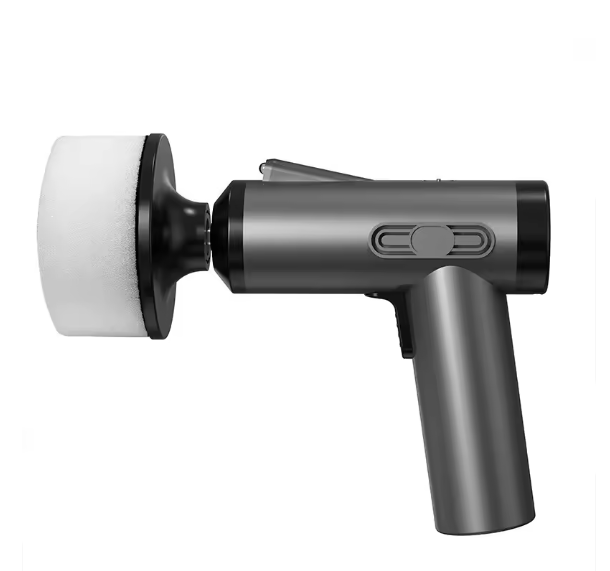
The WLD Store pick: LIYANG Automobile Polishing Waxing Machine
WLD Store lists the LIYANG Automobile Polishing Waxing Machine in its Automotive and Car Accessories range. Here is what the listing states:
- Product: LIYANG Automobile Polishing Waxing Machine
- Brand: LIYANG
- Category: Automotive — Car Accessories
- Type: the listing describes it as a professional-grade electric dual-action buffer
- Speed: variable speed settings, described as suitable for polishing, waxing or sealing
- Described use: the listing states it removes paint swirls, oxidation and fine scratches
- Availability: available across Saudi Arabia with secure checkout
- SKU: WLD-KSA-0070-(KD-KD0200)
Full details, images and current availability are on the LIYANG Automobile Polishing Waxing Machine product page.
Pads and compounds do the real work
New owners often assume the car polishing machine does the cutting. It does not. The machine supplies motion; the pad and the liquid decide what happens to the paint.
Cutting pads
These are the firmest foam, usually the most aggressive colour in a range. Paired with a compound they level deeper defects. They also leave their own fine haze, which is why a cutting stage is almost never the last stage.
Polishing pads
Softer foam, paired with a finishing polish. This is the stage that removes the haze from cutting and brings up gloss. For lightly swirled paint in reasonable condition, many people skip cutting entirely and polish only.
Finishing and wax pads
The softest foam in the set, used at low speed to spread wax or sealant. Keep these pads exclusively for protection products. A pad that has ever held compound will always carry a little of it, and it will scratch the finish you just created.
How to use a car polishing machine step by step
- Wash and dry the car completely. Any grit left on the paint will be dragged around by the pad and will create the exact scratches you are trying to remove.
- Work in shade on cool paint. Hot panels flash-dry compound before the car polishing machine can work it in, and the residue becomes very hard to remove.
- Mask delicate trim. Rubber seals, plastic trim and badges stain easily with compound. Low-tack tape takes two minutes and saves an hour.
- Prime the pad. Spread a few small drops across the pad face before the first pass so the foam is not running dry against the paint.
- Spread at the lowest speed. Dab the product onto the panel, then spread it with the car polishing machine switched to its slowest setting before increasing speed.
- Work one small section at a time. Roughly half a metre square. Overlap passes about fifty percent, move slowly, and keep the pad flat.
- Let the tool’s weight do the pressing. Leaning on a car polishing machine does not speed it up; it stalls the orbit and generates heat.
- Wipe and inspect. Remove residue with a clean microfibre and look at the section under a bright light before deciding whether it needs another pass.
Reading the paint before you start
The most useful habit in machine polishing is testing one small area first, usually somewhere low on a door where a mistake is least visible.
Run the mildest combination you have — soft pad, finishing polish, moderate speed. Wipe it clean and look. If the swirls are gone, that is your recipe for the whole car, and you have removed the minimum amount of clear coat needed.
Only if the test section still shows defects should you step up to a firmer pad or a stronger compound. Working upward from gentle is the single principle that separates a good result from a thin clear coat.
Pay particular attention to edges, raised body lines and the tops of wings. Clear coat is thinnest exactly where panels curve, so those areas need lighter pressure and fewer passes than a flat bonnet.
Polishing in the Saudi climate
Heat and sun change how this job goes. Paint parked in direct sun in Riyadh or Jeddah in summer can reach temperatures where compound dries almost on contact, and dried compound is far harder to remove than fresh.
Work early in the morning, late in the evening, or inside a garage. If the panel is too hot to rest your palm on comfortably, it is too hot to polish.
Fine airborne dust is the other factor. It settles on a panel within minutes, so a car polishing machine used on a dusty surface is effectively running sandpaper. Rinse and dry thoroughly, and keep a clean microfibre for wiping between sections.
Sun exposure is also why cars in the region benefit from a protection stage. Applying a wax or sealant with the machine after polishing takes very little extra time and is the part that actually preserves the work.
Care and maintenance
A car polishing machine itself needs very little maintenance, but the accessories need real attention.
Clean pads immediately after use. Compound that dries in the foam sets hard and turns a soft pad into an abrasive one. Warm water, a drop of mild detergent, squeeze rather than wring, then air dry face up.
Wipe the backing plate and inspect the hook-and-loop surface for compound build-up. A clogged plate lets pads spin loose mid-pass, which throws product everywhere.
Check the cord along its whole length for nicks each time you pack the tool away, and store the machine somewhere dry rather than in a car boot that bakes all afternoon.
Blow or brush dust out of the ventilation slots occasionally. A motor that cannot breathe runs hot, and heat is what shortens the life of any electric tool.
Common problems and quick fixes
- The pad stops rotating. Almost always too much pressure or an angled pad. Ease off, keep the face flat on the panel and let the car polishing machine find its orbit again.
- Product sprays across the car. The speed was too high before the product was spread. Always dab, spread at the lowest setting, then increase.
- Hazy patches after polishing. A cutting stage was not followed by a finishing stage, or the pad was saturated. Refine with a soft pad and fresh polish.
- Residue baked onto trim. Dried compound on plastic. Mask next time; for now, soften it with a damp cloth and a plastic-safe cleaner rather than scraping.
Machine polishing versus hand polishing
Hand application still has a place. For a single scuff on a bumper, or for waxing a small car occasionally, a microfibre applicator and ten minutes of effort is entirely reasonable.
What hand work cannot do is remove swirl marks across a whole vehicle. Hands cannot maintain the speed or the even pressure a car polishing machine holds automatically, needed to level a clear coat consistently, so the result is usually a slightly glossier car with the swirls still present.
A car polishing machine also changes how often the job gets done. A task that takes a full weekend by hand becomes an afternoon, and jobs that fit into an afternoon actually happen.
Choosing the right pad size
Most machines ship with one plate, but pad diameter changes the job more than people expect. A larger pad covers a bonnet quickly and keeps the finish even across a wide flat panel.
A smaller pad concentrates the same motion into less area, which makes it more effective on a stubborn patch and far easier to steer around mirrors, handles and badges. It also lets a car polishing machine reach into the shallow curves near lights and grilles.
The practical answer for most owners is one standard pad set for panels and one small set for tight areas. Fitting a smaller plate takes a minute and turns an awkward corner into a normal pass.
Setting up a safe workspace
Where you work affects the result as much as the technique. A car polishing machine needs light you can actually inspect paint under, and a flat surface where the cable is not underfoot.
A single bright work lamp held at a low angle reveals swirls that overhead lighting hides completely. Without it you are polishing blind and will only see the missed areas in daylight the next morning.
Keep a stack of clean microfibre towels within reach and change them often. A towel that has already wiped compound will smear it back onto the panel on the next pass.
Finally, give yourself time. A rushed session with a car polishing machine is where mistakes happen, and the whole point of a dual action tool is that patience is rewarded.
Who should skip a car polishing machine
If your car is leased for a short term and cosmetic paint condition is not your concern, the honest answer is that you do not need one.
If the paint is already failing — clear coat peeling, flaking or worn through to primer — polishing will not fix it and can make it worse. That is a respray job, and a body shop should look at it first.
Anyone unwilling to test on a small area first should also think twice. A car polishing machine is safe when used patiently and unforgiving when rushed, and that is entirely a matter of temperament rather than skill.
Buying checklist
- Does it have genuine variable speed? Without it you cannot spread wax gently or cut effectively.
- Is it a dual action car polishing machine? Far more forgiving than a rotary for anyone learning.
- Does the backing plate take common pad sizes? Replacement pads are consumables and you will buy many.
- Is the cord long enough for your parking space? Or are you committing to an extension lead every time?
- Can you hold it comfortably in more than one grip? Bumpers and door skins need a different hold than a bonnet.
Other automotive picks at WLD Store
These related listings sit nearby in the Automotive and Car Accessories range.

Frequently asked questions about a car polishing machine
Will a car polishing machine damage my paint?
A dual action machine used with a soft pad and finishing polish is very difficult to damage paint with. Risk rises with firmer pads, aggressive compounds, high speed and heavy pressure — which is why testing a small area first is the standard advice.
How often should I polish my car?
A car polishing machine removes a microscopic amount of clear coat each time, so it is not a monthly job. Once or twice a year is plenty for most vehicles. Waxing or sealing, which removes nothing, can be done far more often.
Can I use it to apply wax as well as polish?
Yes, and that is one of the main reasons to own one. Fit the softest pad, choose the lowest speed and spread the product thinly. A car polishing machine applies wax more evenly than hands can.
Do I need special pads and compounds?
You need pads that fit the backing plate on your car polishing machine and a compound or polish intended for machine use. Keep separate pads for cutting, polishing and wax, and never mix them, because contamination is the most common cause of new scratches.
Can it be used on motorcycles or boats?
Clear-coated surfaces generally respond the same way, so many owners use one car polishing machine across several vehicles. Curved and narrow panels need a smaller pad, more care at the edges and a slower pace than a flat car bonnet.
What should a beginner buy first?
Start with the car polishing machine, one soft polishing pad, one soft finishing pad, a light polish and a wax. That combination handles the majority of home jobs safely, and a cutting pad can be added later when a specific defect needs it.
Used patiently, a car polishing machine turns paint correction from a specialist service into an afternoon in your own driveway. You can view the current listing on the LIYANG Automobile Polishing Waxing Machine page or browse more car care items in the Car Accessories section, with secure checkout and availability across Saudi Arabia.




Add comment