A fighter jet drone toy is the aircraft most children point at first, and it is also the one most likely to end up in a tree on day one. The difference between those two outcomes is almost entirely preparation rather than luck.
This guide explains what these models actually are, why the controller frequency matters, what foam construction buys you, how to choose a flying site, a first-flight sequence that works, how to look after the battery safely, and six questions answered for families in Saudi Arabia.
What a fighter jet drone toy actually is
The name mixes two categories, and separating them prevents disappointment before you buy.
A quadcopter drone has four horizontal rotors, hovers in place, and can be flown indoors by a beginner. It stays where you put it, which is why they are forgiving.
A fixed-wing model flies like a real aircraft. It needs forward speed to stay up, it cannot hover, and it must keep moving until it lands. A fighter jet drone toy is usually this second type, styled as a jet.
That distinction shapes everything: where you can fly, how much space you need, and how long it takes to learn. Fixed-wing flight is more exciting and less immediately forgiving. The wider hobby is covered on the Wikipedia page for radio-controlled aircraft.
None of this makes it a difficult toy. It does mean the first session belongs in an open space rather than a garden.
Why a fighter jet drone toy needs 2.4GHz control
Older remote-controlled toys used fixed frequencies around 27 or 49 megahertz, and they had a well-known problem: two people flying nearby could control each other’s aircraft.
A 2.4 gigahertz system works differently. The transmitter and receiver pair with each other when switched on, then hop between channels to avoid interference from anything else in the area.
In practice this means several people can fly at the same park at the same time without anyone losing control. For a fighter jet drone toy flown at a family gathering, that matters more than it sounds.
The other benefit is range and responsiveness. A 2.4 gigahertz link holds control further out and reacts faster, which is exactly what a fast fixed-wing model needs.
Why a fighter jet drone toy is made of foam
Beginners crash. That is not pessimism, it is the normal path of learning to fly, and the material of the airframe decides what a crash costs.
Expanded foam absorbs impact by deforming and, in many cases, by simply bouncing. A hard plastic airframe transmits that energy into joints and fixings instead, and cracks propagate.
Foam is also light, and light aircraft fly slower relative to their size, which gives a new pilot more thinking time on every pass.
Best of all, foam repairs. A clean break can be glued with foam-safe adhesive and flown the same afternoon, so one bad landing does not end a fighter jet drone toy’s life.
What makes a good fighter jet drone toy
Every fighter jet drone toy looks similar on a listing page and behaves very differently in the air. Five things matter.
Real control range
Range determines how large the flying area can be. A model that loses signal at the far end of a park is a model that will be walked back rather than flown back.
The practical rule is to stay well inside whatever range is claimed. Flying a fighter jet drone toy at the limit of its link is how aircraft are lost.
Flight time and spare batteries
Small electric aircraft fly for minutes, not hours, and charging takes far longer than flying. That ratio surprises every new owner.
One spare battery roughly doubles a session and is the single best accessory to buy alongside the aircraft. Two spares turns an afternoon into something worth driving to a park for.
Availability of spare parts
Propellers and the smaller control surfaces are consumable items. A model with easily replaced parts stays in service; one without becomes a shelf ornament after the first hard landing.
Check what is in the box before buying. Spare propellers included is a good sign about how the manufacturer expects the toy to be used.
Lights for low light flying
Bright LEDs are not only decorative. They make orientation far easier to read at dusk, which is when the air is calmest and the temperature is bearable here.
A lit fighter jet drone toy is also easier to find in grass after a landing, which is a practical benefit nobody mentions until they have searched for an unlit one.
An age rating you take seriously
Age guidance reflects the coordination the toy demands, the speed it reaches and the small parts involved. It is not marketing caution.
A model rated for eight and above genuinely suits that age with supervision, and genuinely frustrates a much younger child.
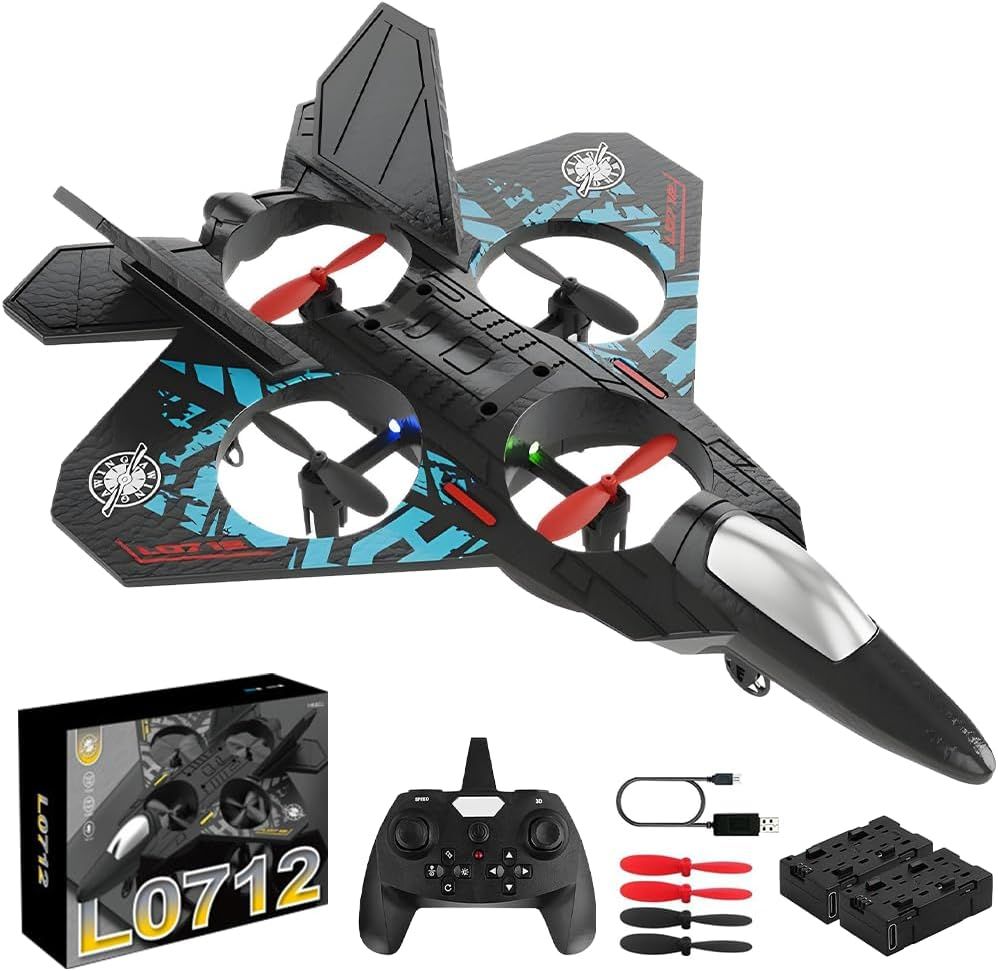
The WLD Store pick: TAK TAK RC Fighter Jet Drone Toy
WLD Store lists this model for families in Saudi Arabia. Everything below comes from the listing itself, with nothing added.
- Product: TAK TAK RC Fighter Jet Drone Toy, a remote-controlled aircraft
- Category: Baby and Kids, filed under Toys
- Brand: WLD
- SKU: WLD-KSA-0042-(KD-KD0125)
- Stated flight: described as performing spins, rolls and high-speed flights
- Stated build: listed with durable foam construction and bright LED lights
- Stated control: presented with a 2.4GHz controller for wide-range control
- Stated age guidance: the listing states it is safe for children aged 8 and above
- Market: available across Saudi Arabia
Current photographs, options and stock status are on the TAK TAK RC Fighter Jet Drone Toy product page. Those are the listing’s own descriptions, and adult supervision is sensible for any powered flying toy.
Where to fly a fighter jet drone toy
Site selection prevents most of the problems a new fighter jet drone toy pilot would otherwise discover the hard way.
- Choose open space. A football pitch or an empty park is right; a garden, a courtyard or a street is not.
- Stay away from roads, car parks and anywhere people are walking. A fighter jet drone toy travels faster than you expect and does not stop on command.
- Avoid water. Foam floats and electronics do not, and retrieving a model from a pond usually ends its service.
- Look up before launching. Power lines and tall trees are the two things that most often end a first flight.
- Check the wind. Light air is ideal; anything strong enough to move a flag is difficult for a light foam aircraft.
- Keep well clear of airports and helipads, and check the current local rules for flying model aircraft in your area before you go.
Early morning and the hour before sunset are usually the calmest parts of the day, and in a Saudi summer they are also the only comfortable ones.
Fighter jet drone toy first flight, step by step
The order below turns the first session from a gamble into a routine.
Charge the battery fully and let it cool before use. A warm pack straight off the charger performs poorly and ages faster.
Switch the transmitter on first, then the aircraft, and let them bind. Reversing that order is the most common cause of an unresponsive model.
Check the control surfaces on the ground. Move each stick and watch the aircraft respond before anything leaves your hand.
Launch into any breeze rather than away from it, with a firm level throw and the throttle already up. A timid launch is what produces an immediate nose-dive.
Climb gently to a comfortable height and then simply fly wide, lazy circles. Every instinct will be to try the rolls a fighter jet drone toy can do, and every experienced pilot will tell you to wait.
Learning orientation, the hard part
The genuine difficulty in fixed-wing flying is not the throttle. It is that the controls reverse in your mind when the aircraft is flying toward you.
Flying away, left is left. Flying toward you, the aircraft’s left is your right, and the brain takes time to accept that.
The standard fix is to keep the model flying away from you and circling in one direction while you learn, so you rarely face the reversed case at low altitude.
Height is your friend. A mistake at height gives seconds to recover; the same mistake at head height gives none, so climb before experimenting.
Most people become comfortable after three or four sessions. That is the point at which a fighter jet drone toy starts to be genuinely fun rather than tense.
Battery care for a fighter jet drone toy
The battery is the most expensive consumable and the part that needs the most respect.
Charge on a hard, non-flammable surface and never leave a pack charging unattended or overnight. This applies to every rechargeable flying toy without exception.
Let a pack cool after flying before recharging it. Charging a hot battery shortens its life measurably.
Never charge a battery that is swollen, punctured or damaged after a crash. Retire it instead, and dispose of it at a proper collection point rather than in household waste.
Store packs at room temperature and out of a hot car. Heat is the single biggest killer of small lithium cells in this climate.
If a fighter jet drone toy will not be flown for a month, store the battery partly charged rather than full or empty.
Repairs that keep a fighter jet drone toy flying
A repairable aircraft is one that gets flown all year rather than for one weekend.
Use foam-safe glue. Ordinary cyanoacrylate can melt expanded foam, so check the label before it touches an airframe.
Clear tape reinforces a repaired seam and adds almost no weight. It is the standard field fix at any flying club for a reason.
Keep propellers straight and replace bent ones. A damaged propeller vibrates, and vibration works fixings loose across the whole model.
Check the motor mount and control linkages after any heavy landing, before the next launch rather than after it.
Keep a small kit in the bag: spare propellers, glue, tape and a screwdriver. Most sessions that end early could have continued with those four items present.
Common fighter jet drone toy problems and fixes
- It will not respond to the controller. Switch the transmitter on first, then the aircraft, and re-bind. Check battery levels in both.
- It dives immediately after launch. Usually too little throttle or too gentle a throw. Launch firmly, level, with power already applied.
- It constantly turns to one side. Trim is off. Adjust the trim controls a little at a time in level flight until it tracks straight.
- Flight time has dropped sharply. The battery is aging or was stored badly. Replace it rather than flying it flat repeatedly, which accelerates the decline.
Age suitability and supervision
The listed guidance of eight and above reflects real requirements rather than caution alone.
Younger children usually lack the spatial reasoning for reversed controls, and the frustration of repeated crashes ends the interest quickly. A hovering quadcopter suits them far better.
Around eight to ten, most children fly happily with an adult standing beside them handling launches and battery changes.
Older children generally manage a fighter jet drone toy independently, though site choice should still be an adult decision because the risks are about location rather than skill.
Whatever the age, the first session goes better with two people: one to fly and one to watch where it lands.
Who this toy is not for
It is not an indoor toy. There is no room in any house for a fixed-wing model to fly, and attempting it damages both the aircraft and the furniture.
It is not a camera drone. If the goal is aerial photographs or hovering, a quadcopter is the correct purchase and this is not.
It is not suitable for someone who wants to fly for an hour at a time. Small electric flight is measured in minutes per battery, and that is inherent to the format.
It is also not a good fit for households with no open space within reach. A fighter jet drone toy without somewhere to fly is a display model.
Landing without breaking anything
Landings cause more damage than crashes do, mostly because people treat them as an afterthought once the fun part is over.
Plan the approach while there is still battery left. Trying to land a model that has just lost power turns a controlled descent into a falling object.
Come in low and level into any breeze, with the throttle reduced rather than cut completely. A little power gives you control right up to the ground.
Choose grass over sand or concrete every time. Grass slows the model as it slides and is far kinder to a foam nose.
Let it slide out rather than trying to catch it. Hand-catching a fighter jet drone toy looks impressive and is how propellers and fingers meet.
Flying in Saudi conditions
Local conditions have a real effect on small aircraft, and planning around them makes every session better.
Heat is the first factor. Batteries and motors both dislike it, and a midday session in summer shortens flight times and ages the pack faster. Early morning and the hour before sunset are the practical windows.
Wind is the second, and it is usually lighter at both ends of the day. Light foam models are pushed around easily, so a calm hour is worth waiting for.
Sand and dust are the third, and they are the ones people forget. Grit works into motor bearings and control linkages, so brush the airframe down after any landing on bare ground.
Low sun is the last. Flying into glare means losing sight of a fighter jet drone toy for several seconds at a time, which is long enough to lose it entirely. Keep the sun behind you.
Buying checklist
- Do you have genuinely open space to fly in, within a reasonable distance?
- Does the set include spare propellers, and can you buy more?
- How many batteries are included, and how long does each one charge for?
- Is the age guidance a fit for the child who will actually be flying it?
- Are there LED lights, so dusk flying and finding it in grass are both easier?
Other toy picks at WLD Store
These three listings sit in the same part of the WLD Store catalogue.
Frequently asked questions about the fighter jet drone toy
Can a fighter jet drone toy be flown indoors?
No. Fixed-wing models need forward speed and space to turn, and no room in a house provides either. Flying is an outdoor activity in an open area.
How long does one battery last?
Small electric aircraft typically fly for a handful of minutes per charge, and recharging takes considerably longer. Spare batteries are the practical way to extend a session.
What happens if it crashes?
Foam airframes usually survive, which is the main reason they are used. Check the propeller, the motor mount and the linkages before flying again, and glue any clean break with foam-safe adhesive.
Does it need registration?
Rules for model aircraft differ by country and change over time. Check the current requirements for your area before flying, keep well away from airports, and treat that as part of choosing a site.
Is 2.4GHz control better than older systems?
Yes, meaningfully. It pairs the transmitter to one aircraft, so several people can fly nearby without interference, and it holds control at greater distance.
What age is a fighter jet drone toy suitable for?
This listing states eight and above. Younger children generally do better with a hovering quadcopter, since reversed controls in fixed-wing flight take time to learn.
A fighter jet drone toy rewards a little patience: open space, a calm hour near dusk, a firm launch and wide circles until orientation feels natural. Buy a spare battery, keep foam-safe glue in the bag, and treat the charging rules seriously. You can review the current listing on the product page or browse the wider toy range in the Toys section.




Add comment