A pot strainer clip solves a problem most kitchens simply put up with: lifting a heavy pan of boiling water and tipping it into a colander balanced in the sink, with steam in your face and half the pasta going down the drain.
This guide explains how the category works, what separates a clip that grips properly from one that slides off, how to drain safely without scalding yourself, and which foods suit it. There is a cleaning routine, a storage section, a troubleshooting list, a buying checklist and six questions answered for home cooks in Saudi Arabia.
The trouble with a separate colander
A traditional colander is a good tool with three practical drawbacks that a pot strainer clip avoids, that only show up in a real kitchen.
The first is the transfer. Moving several litres of boiling water from the hob to the sink is the most dangerous thirty seconds in ordinary home cooking, and it is done with a pan in both hands and no free hand for anything else.
The second is the sink. The colander has to go somewhere, and a sink with breakfast dishes in it is not that place. A pot strainer clip needs no landing space at all.
The third is washing up. A colander is another bulky item to clean and store, and it is one of the more awkward shapes to fit into a crowded cupboard.
None of these is a crisis. Together they explain why a clip-on design appeals to anyone who cooks pasta, rice or vegetables more than once a week.
How a pot strainer clip works
The design of a pot strainer clip is simple, which is the main reason it works reliably.
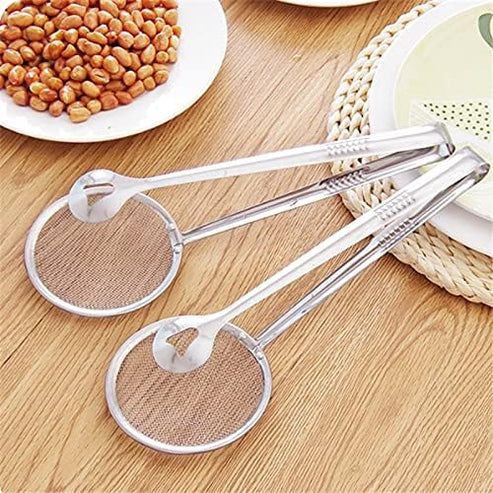
On a pot strainer clip, a mesh or slotted panel spans part of the pan opening, and two clamps grip the rim on either side. The water pours out through the mesh while the clamps hold everything in place, and the food stays behind.
Because it attaches to the pan itself, no second vessel is involved. You pour straight into the sink, which means less lifting, less carrying and no balancing act. The long history of the drainer as a kitchen tool is covered on the colander reference page.
The other quiet advantage is control. With a pot strainer clip fitted, you can pour slowly and stop halfway if you want to keep some of the cooking water, which is genuinely useful for pasta sauces.
What makes a good pot strainer clip
Four things decide whether one of these becomes a favourite or slides off the pan on its first outing.
Clamps that actually grip
This is the whole product. The clamps have to hold under the weight of moving water and against a rim that is wet and slippery.
Look for sprung clamps with a wide contact area rather than thin hooks. A pot strainer clip that grips two centimetres of rim is far more secure than one perched on a narrow lip.
Mesh fine enough for what you cook
Mesh size determines what a pot strainer clip can handle. Large slots drain pasta and potatoes and let rice and small grains straight through.
A fine mesh handles rice, couscous, quinoa and small pulses. It also drains a little more slowly, which is a fair trade for not losing half the pot.
Genuine heat resistance
A pot strainer clip sits against a pan rim while boiling water pours over it. The material has to tolerate that repeatedly without softening, warping or discolouring.
Silicone and heat-resistant nylon are the usual materials. A pot strainer clip made of thin unmarked plastic is one to be cautious about.
A size range that fits your pans
Check the stated range against the pans you actually own — the small milk pan as well as the big stockpot. A clip that fits only medium pans covers a narrow part of real cooking.
The WLD Store pick: Multifunctional Strainer with Clamp
WLD Store lists the Multifunctional Strainer with Clamp in its Home & Kitchen and Kitchen Tools range. Here is what the listing states:
- Product: Multifunctional Strainer with Clamp
- Brand: WLD
- Category: Home & Kitchen — Kitchen Tools
- Design: described as a clip-on colander that attaches directly to a pot or pan
- Purpose: the listing states it removes the need for a separate strainer bowl
- Material: described as a heat-resistant design with fine mesh
- Storage: described as space-saving and easy to store
- Availability: available across Saudi Arabia with secure checkout
- SKU: WLD-KSA-0063-(KD-KD0153)
Full details, images and current availability are on the Multifunctional Strainer with Clamp product page.
How to drain safely
Boiling water deserves respect, and a pot strainer clip changes the technique rather than removing the need for care.
- Take the pan off the heat first. Let it stop rolling for thirty seconds so the water is not actively churning when you fit the clip.
- Fit it on a dry rim if possible. Wipe splashes off the rim with a cloth so the clamps of the pot strainer clip grip metal rather than a film of water.
- Press until it seats. Both clamps should be fully home. Give the assembly a light tug before lifting anything.
- Hold the handles, not the clip. The pan handles carry the weight. The clip is a lid, not a grip.
- Pour away from you and slowly. Steam rises straight up out of a sink, so keep your face back and pour at a steady angle rather than tipping fast.
- Use the sink, not a bowl. Pouring boiling water into a bowl already in the sink risks splashing back at you.
- Let it drip before removing. Ten seconds of draining beats shaking a hot pan, and it keeps the last of the water out of your sauce.
What it drains well, and what it does not
Knowing the limits of a pot strainer clip in advance prevents the one disappointing meal that sends a good tool to the back of a drawer.
Pasta of every shape is the obvious success. So are potatoes, boiled eggs, blanched vegetables, canned beans and chickpeas, and anything else that is chunky and drains quickly.
Rice works well with a fine mesh and poorly with wide slots. If rice is a daily part of your cooking, mesh size is the specification that matters most.
Where a pot strainer clip struggles is with very full pans. A pot filled to the brim gives the water nowhere to go except around the clip, so leave a few centimetres of headroom.
It also cannot help with anything sticky or thick. Draining a starchy, gluey mixture will clog any mesh, and that is a job for a slotted spoon.
Small kitchens and storage
Storage is one of the honest advantages of this category and worth spelling out.
A standard colander occupies the volume of a mixing bowl and nests with nothing. A pot strainer clip is essentially flat and slides into a drawer alongside spatulas and tongs.
That matters in an apartment kitchen where cupboard space is the real constraint. Replacing a bulky bowl with a flat tool frees a genuinely useful amount of room.
It also travels. For a holiday apartment, a chalet or a small caravan kitchen, a flat strainer takes almost no packing space and works with whatever pans are already there.
Cleaning and care
The mesh on a pot strainer clip needs slightly more attention than a smooth surface, and a couple of habits keep it looking new.
Rinse it immediately after use, while it is still warm. Starch from pasta and rice sets into mesh as it cools and becomes far harder to shift an hour later.
Use a soft brush rather than a scourer. An old toothbrush clears the mesh of a pot strainer clip perfectly and does not scratch or deform the material.
Check the manufacturer’s guidance before putting it in a dishwasher. Many are dishwasher safe on the top rack, and the bottom rack next to a heating element is where plastics warp.
Dry it fully before it goes into a drawer. Trapped moisture in mesh leads to marks and smells, particularly in a warm kitchen.
Inspect the clamps occasionally. If the spring has weakened or a clamp face is cracked, replace it rather than trusting it with a pan of boiling water.
Common problems and quick fixes
- It slips off while pouring. The rim was wet, the clamps were not fully seated, or the pan is at the edge of the size range. Dry the rim and reseat before lifting.
- Water backs up instead of draining. The pan is too full or the mesh is blocked with starch. Leave headroom and rinse the mesh between uses.
- Small food escapes. The mesh is too coarse for what you are cooking. Fine mesh is required for rice and small grains.
- The plastic has discoloured. Common with tomato and turmeric. A paste of bicarbonate of soda left on for an hour usually lifts most of it.
How it compares with the alternatives
A pot strainer clip is one of four tools that drain food, and each has a job it does best.
A colander is unbeatable for rinsing salad leaves or washing large quantities of vegetables under a tap. It is a poor choice for pouring boiling water into.
A slotted spoon is right for lifting a few items out of liquid you want to keep, such as poached eggs or dumplings. It is slow for a full pan.
A pan with a built-in straining lid works well and only for that one pan. Most kitchens have several pans and one such lid, if any.
A pot strainer clip is the general answer: it fits several pans, stores flat and keeps the water in the pan until you choose to pour. It is not the best tool for rinsing, and it is the best one for draining.
Everyday cooking it changes
It is worth being concrete about where the difference actually shows up during a normal week.
Weeknight pasta is the obvious one. The pan goes from hob to sink in a single movement, and there is nothing extra to wash afterwards.
Rinsing tinned pulses is another. Open the tin into a small pan, fit the pot strainer clip, rinse under the tap and drain, without dirtying a colander for two minutes of work.
Boiled eggs benefit too, because the hot water can be poured off and cold water run straight into the same pan without moving the eggs at all.
Blanching vegetables becomes far less fiddly. Drain, refresh under cold water, and drain again using the same tool and the same pan throughout.
Who should skip it
Anyone whose pans have unusual rims should check carefully before buying a pot strainer clip. Rolled rims, very thick cast-iron edges and pans with a pouring spout moulded into the rim can all defeat a clamp.
Cooks who mainly rinse rather than drain will get less from it. If your colander lives under the tap washing salad and herbs, a pot strainer clip does not replace it.
Anyone uncomfortable handling a full pan should think about it honestly. This tool reduces the number of movements involved, and it does not make a heavy pan lighter.
Choosing between slots and mesh
The single decision that shapes how useful this tool is has nothing to do with the clamps. It is the drainage surface.
Slotted panels drain fast. Water leaves almost as quickly as you can pour, which matters with a heavy stockpot, and the openings are easy to rinse clean afterwards.
Fine mesh drains more slowly and catches almost everything. A mesh pot strainer clip handles rice, orzo, couscous and lentils that slotted designs simply lose.
If you can only own one, mesh is the safer choice, because a mesh panel still drains pasta perfectly well while slots cannot rescue a pan of rice. The only cost is a few extra seconds of pouring.
Using it with non-stick and coated pans
Coated pans are the most common cookware in a modern kitchen, and clamps have to be treated a little more carefully with them.
Check the clamp faces for hard edges or moulding flash before the first use. A rough clamp on a coated rim can score the finish where it grips.
Seat a pot strainer clip straight down rather than sliding it along the rim. Dragging a clamp around the edge is what leaves a visible mark on a coated pan.
Silicone-faced clamps are kinder to coatings than bare plastic, and they also grip a wet rim better, so the two benefits arrive together.
Finally, do not use it as a lid on the hob. It is designed to sit against a pan while you pour, not to be left over direct heat while food cooks.
Getting the technique right first time
The first few uses set the habit, so it is worth doing them deliberately rather than in the middle of a rushed dinner.
Practise once with cold water. Fill a pan, fit the pot strainer clip, and pour into the sink. Thirty seconds of rehearsal shows you exactly how the clamps behave and how fast the water leaves.
Notice where the water goes. Most designs drain from one side, and knowing which side means you can aim into the plughole rather than across the draining board.
Get used to the two-handed lift. Both pan handles, elbows in, and a slow tilt rather than a sudden one. A pot strainer clip rewards a smooth pour and punishes a fast one.
After that, it becomes automatic. Most people stop thinking about it entirely by the third or fourth meal.
Buying checklist
- Does the stated size range cover your pans? Check the smallest and the largest, not just the everyday one.
- Is the mesh fine enough for rice? Wide slots are fine for pasta and useless for grains.
- Are the clamps sprung and wide? Grip is the entire function of the product.
- Is the material clearly heat resistant? It will meet boiling water on every use.
- Can it go in the dishwasher? Convenient, and worth confirming rather than assuming.
Other kitchen picks at WLD Store
These related listings sit nearby in the Home & Kitchen range.
Frequently asked questions about a pot strainer clip
Will a pot strainer clip fit all my pans?
Most fit a stated range of rim diameters, so check that range against your smallest and largest pans. Rolled rims, moulded spouts and very thick edges are the usual exceptions.
Can it handle rice?
Only with a fine mesh. Wide-slotted designs let rice, couscous and small grains straight through. If rice is a regular part of your cooking, choose mesh over slots.
Is it safe with boiling water?
Yes, when it is seated properly on a dry rim and the pan is held by its handles. Take the pan off the heat first, pour slowly and keep your face clear of the rising steam.
Does it go in the dishwasher?
Usually on the top rack, but check the specific product guidance. Keep any plastic or silicone item away from the lower heating element, which is where warping happens.
Can I keep some of the pasta water?
Yes, and it is one of the better reasons to own one. With a pot strainer clip fitted you can pour off part of the water and stop, keeping the rest for a sauce.
How do I get stains out of the mesh?
Rinse immediately after use while it is still warm, and use a soft brush rather than a scourer. For tomato or turmeric staining, a bicarbonate of soda paste left for an hour lifts most of it.
For a tool that stores flat in a drawer, a pot strainer clip removes one of the more awkward moments in everyday cooking. You can view the current listing on the Multifunctional Strainer with Clamp page or browse more kitchen tools in the Kitchen Tools section, with secure checkout and availability across Saudi Arabia.



Add comment