A domino train toy set solves the one thing that has always frustrated children about dominoes: the slow, fiddly business of standing hundreds of tiles up before anything interesting happens. A small motorised train carries the tiles and places them in a neat line as it drives, so a child steers the route and the machine does the tedious part. This guide explains how these sets work, what separates a good one from a disappointing one, how to set one up successfully the first time, what children genuinely get out of it, and how to keep the pieces together over the years.
What a domino train toy set actually does
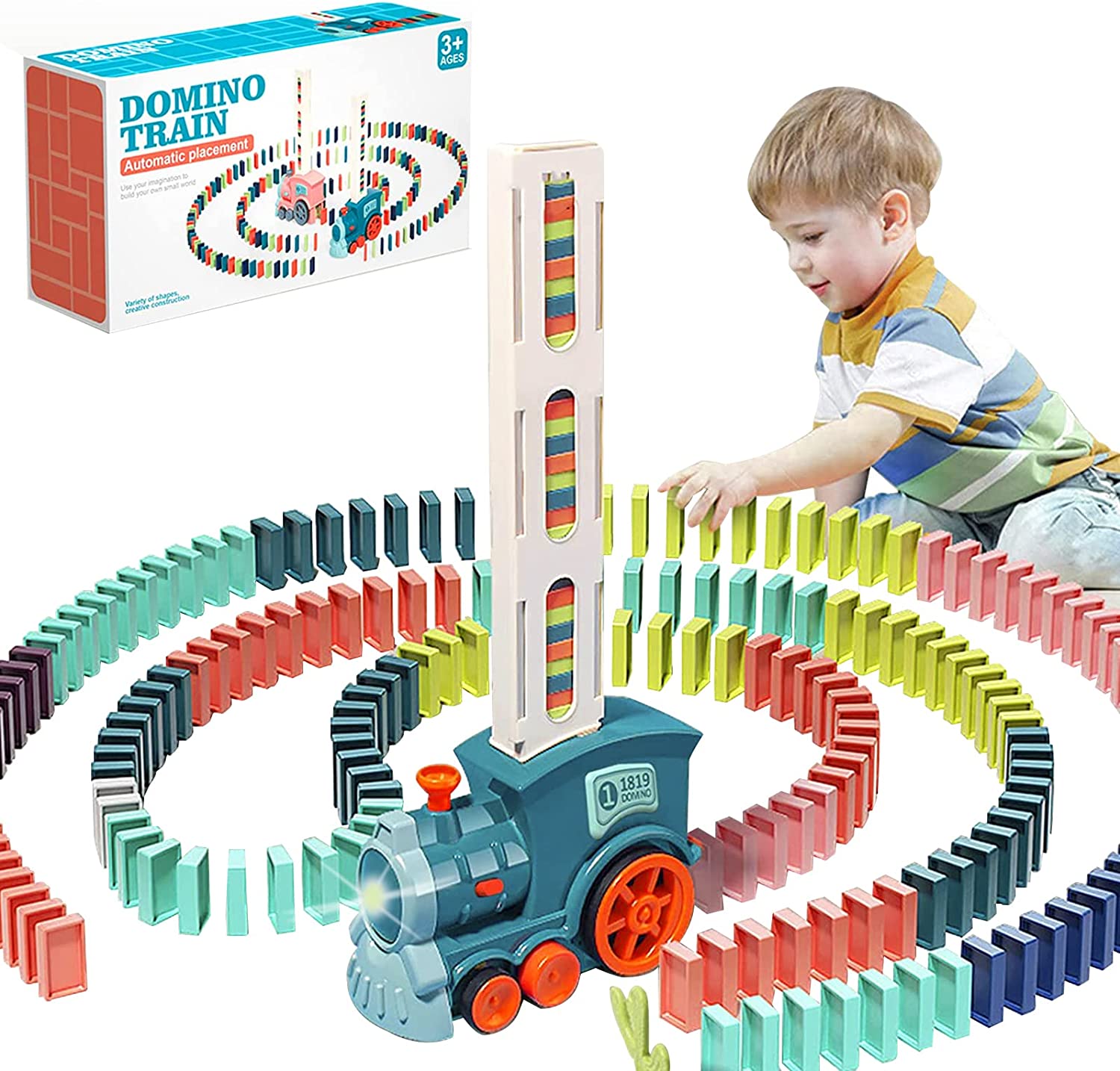
The concept behind a domino train toy set is simple once you see it. Tiles are loaded into a hopper on top of a small battery-powered train. As the train moves forward, a mechanism releases them one at a time and stands each one upright at a consistent spacing behind it.
The child’s job becomes steering rather than placing. You point the train where you want the line to go, add curves and junctions from the accessories, and reload the hopper as it empties. The result is a long, evenly spaced chain built in a fraction of the time hand-placing would take.
Then comes the part everyone actually wants: the topple. The physics of a falling chain is genuinely interesting and is covered well in the Wikipedia article on dominoes, but for a child it is simply the most satisfying payoff in the toy box.
That loop of build, watch, rebuild is what makes a domino train toy set different from a bag of tiles. The reward arrives fast enough that a young child stays engaged, and the rebuild is quick enough that they want to do it again immediately.
Why it holds attention longer than plain dominoes
Standing up two hundred dominoes by hand is a task for a patient ten-year-old. For a four-year-old it is an exercise in frustration, because a single knocked tile undoes several minutes of careful work and the whole thing collapses before it is finished.
Removing that failure point changes the activity completely. With a domino train toy set, an accidental knock costs seconds rather than the entire session, so children keep experimenting instead of giving up.
The second reason is that the toy adds a second decision layer. Beyond where the line goes, there is how tight a curve the train can hold, where to put the junction pieces, and how to route around furniture. Those choices are what keep an older child interested after the novelty of the mechanism wears off.
Group play works well too. One child drives, another reloads, a third plans the route ahead, and everyone watches the topple. A domino train toy set is one of the few construction toys that genuinely scales to three or four children without arguments over whose turn it is.
What to look for in a domino train toy set
Four things separate a domino train toy set that lasts from one that ends up in a cupboard after a fortnight.
Tile count and accessories
Tile count sets the ceiling on what a domino train toy set can build. A small handful of tiles produces a short line and a brief topple; a generous count makes long routes and branching layouts possible. The WLD Store set includes more than 120 dominoes along with curves and accessories.
Accessories matter as much as the raw count. Curve pieces, bridges and junction elements are what turn a straight line into a layout, and they are the parts children reach for once they have built a few simple runs.
Tile consistency
Tile consistency is the specification nobody lists but everyone notices in a domino train toy set. Tiles need to be the same thickness and weight, because the train places them at a fixed spacing and the chain only falls reliably if each tile can reach the next one.
Warped, uneven or overly light tiles cause the frustrating half-topple where the chain stops for no visible reason. A good domino train toy set uses tiles moulded consistently enough that this rarely happens.
The train mechanism
The dispensing mechanism is the heart of any domino train toy set. It has to grip a tile, release it upright and drive away without knocking it over, several times a second, on whatever surface a child has chosen.
Look for a design that reloads easily. Children reload the hopper constantly, so a wide opening they can pour tiles into without adult help is worth more than any other refinement in a domino train toy set.
Power and controls
Battery-powered trains are the norm. What matters is that the controls are simple enough for the target age: a single switch a small hand can operate, and a compartment an adult can open without tools when the batteries run down.
The WLD Store pick: Domino Train Toy Set
Here is what the WLD Store listing states for this product, with nothing added:
- Product: Domino Train Toy Set, an auto-stacking domino builder for children
- Brand: WLD
- Categories: Baby & Kids, and Toys
- How it works: an electric train automatically stacks colourful domino tiles as it moves
- Contents: more than 120 dominoes, plus curves and accessories
- Benefits described: stimulates spatial thinking and creativity
- Age guidance: suitable for ages three and above
- Availability: sold across Saudi Arabia, including Riyadh and Jeddah, with secure checkout
- SKU: WLD-KSA-0106-(KD-229)
The tile count and the included curves are the numbers that matter most here, because together they decide how ambitious a layout a child can attempt. You can see the full listing on the Domino Train Toy Set product page.
Setting it up for the first time
First sessions with a domino train toy set go wrong for predictable reasons, and a few minutes of preparation prevents nearly all of them.
- Fit the batteries before handing it over. Nothing deflates a child faster than unwrapping a toy that cannot move yet.
- Do a short test run yourself. Ten tiles on a clear floor tells you how the mechanism behaves before an audience is watching.
- Clear a proper area first. A domino train toy set needs more floor than people expect, and clearing space halfway through a build is how layouts get knocked over.
- Start with a straight line. Let the first build succeed easily. Curves and junctions are much more fun once the basic loop is understood.
- Show the reload, then step back. Reloading is the skill that makes a child independent with this toy, so teach it early and let them take over.
One extra tip: agree before the first build who gets to push the first tile. It sounds trivial, but with several children the topple is the prize, and settling it in advance saves the session.
Where to play: surfaces that work
Surface choice affects how a domino train toy set performs more than anything else, and it is the most common reason a set seems to underperform.
Hard, flat and smooth is what you want. Tiled floors, wooden floors and large low tables all work well because the train drives in a straight line and the tiles stand square.
Carpet is the usual problem. Thick pile absorbs the topple energy so chains stop halfway, and the train struggles to drive evenly. If carpet is all you have, a large sheet of hardboard or a folding table transforms how the domino train toy set behaves.
Avoid slopes and uneven joints. A slight gradient makes tiles lean before the chain is finished, and wide gaps between floor tiles will swallow the occasional domino. A quick look at the floor before starting prevents both.
Age suitability and sensible supervision
The listing gives an age guide of three and above, and that is a reasonable starting point for supervised play with an adult nearby.
Younger children in the house are the thing to watch. Any set with more than a hundred small tiles needs an adult keeping an eye out when a crawling sibling is in the room, and packing up completely afterwards matters more than usual for that reason.
Interest tends to grow rather than fade with age. A three-year-old enjoys watching the train and knocking the line down; a six-year-old starts designing routes; an eight-year-old will attempt branching layouts and try to beat their own record. A domino train toy set is unusual in spanning that range.
What children actually learn from it
The educational claims around toys are often overblown, so it is worth being specific about what is really happening here.
Planning a route is spatial reasoning in practice. A child has to visualise where a line will end up before the train gets there, judge whether a curve will fit the space available, and adjust when it does not.
Cause and effect is the second lesson, and it is unusually vivid. When a chain stops halfway, the reason is always physical and visible: a gap too wide, a tile leaning, a corner too tight. Children work out these rules themselves after a few failures.
Patience is the third, and a domino train toy set teaches it gently. There is still a wait between starting a build and the payoff, but it is short enough that a young child can tolerate it, which is exactly how patience gets built.
Keeping the set complete
The single biggest threat to a domino train toy set is not breakage but attrition. Tiles disappear under sofas, into toy boxes and behind cupboards, and a set slowly stops being able to build anything impressive.
A count-back habit fixes it. Tip everything into the box at the end of the session and do a quick sweep of the floor edges. Doing this every time is far easier than searching for thirty missing tiles in six months.
Keep the accessories separate from the tiles. Curves and junctions are the pieces most easily lost because they do not look like the rest, and a small bag inside the main box keeps them findable.
Store the train with the hopper empty. Tiles left in the mechanism can press against the release over months, and an empty hopper also means the domino train toy set is ready to reload cleanly next time.
Domino train toy set versus traditional dominoes
A plain box of dominoes is cheaper and has no batteries to fail, and for an older child with patience it is a perfectly good toy. Hand-placing gives complete freedom over spacing and layout in a way no machine matches.
What it does not give is early success. The gap between effort and reward is long, and that gap is exactly where younger children lose interest. A domino train toy set closes it.
Compared with building blocks, the difference is the payoff. Blocks reward the finished structure; dominoes reward the collapse. Children who lose interest in blocks halfway through often stay engaged here because the ending is the best part.
In practice the two coexist happily. Many families end up using the train to lay long runs quickly and hand-placing the fiddly bits around obstacles, which is the best of both approaches.
Layout ideas that keep it interesting
Once a child can build a straight run reliably with a domino train toy set, the toy needs new challenges or interest fades. These are the ideas that work, roughly in order of difficulty.
Start with the loop: run the line out and bring it back so the chain finishes where it started. It teaches curve control and gives an obvious goal to aim at.
Then try the branch. Split the run into two lines using the junction accessories so that a single push topples both at once. This is the point where most children start planning ahead instead of improvising.
Obstacle routing comes next. Put a chair leg, a book or a toy in the way and make the line go around it. A domino train toy set handles this well because the curve pieces give a repeatable turning radius to plan with.
For older children, add a timing challenge: two lines of different lengths that should fall at the same moment. Getting that right means counting tiles and thinking about speed, and it will occupy an eight-year-old for an afternoon.
Finally, try a whole-room run. Emptying every tile in the domino train toy set into one continuous route is the kind of ambitious project children remember, and it makes the tidy-up afterwards feel worth doing.
Care and maintenance
- Keep the tiles clean. Dust and grit on the base of a tile makes it lean, and leaning tiles break chains. An occasional wipe is enough.
- Clear the mechanism. If tiles jam, check for a chipped one wedged in the hopper before assuming the motor is at fault.
- Remove batteries for long storage. Leaking cells ruin more toys than wear ever does, so take them out if the set is going away for a season.
- Check the wheels. Hair and carpet fibres wrap around small axles and make the train wander off a straight line.
- Store it flat. Tiles kept in a crushed box under other toys can warp, and warped tiles are the ones that fail to topple.
None of this takes long, and a domino train toy set treated this way stays as good as new for years of use.
Common problems and quick fixes
- The chain stops halfway. Almost always a gap that is slightly too wide or a leaning tile. Check the surface is level and remove any chipped tiles from circulation.
- The train knocks over its own tiles. The surface is uneven or slightly sloped. Move to a flatter area or lay a board down.
- Tiles jam in the hopper. Empty it, check for a damaged tile, and reload without overfilling.
- The train drifts off course. Look for fibres wrapped around the wheels, which is the usual cause after play on carpet or rugs.
Buying checklist
- How many tiles are included, and is that enough for the layouts your child imagines?
- Does the set include curves and junctions, or only straight-line pieces?
- Can a child reload the hopper without adult help?
- Is there a hard, flat floor or table at home where it can actually be used?
- Is the stated age guidance right for your child, and is there a younger sibling to consider?
Other kids and toys picks at WLD Store
These three sit in the same children’s range if you are shopping for more than one gift.


Frequently asked questions about the domino train toy set
What age is a domino train toy set best for?
The listing gives three and above. In practice the youngest children enjoy watching and toppling, while route planning and branching layouts appeal from around five or six onwards. That wide span is one of the reasons these sets stay in use longer than most toys.
Does it work on carpet?
Poorly. Thick pile absorbs the energy of the falling chain and makes the train wander. A hard floor, a large low table or a sheet of board laid over the carpet solves it completely and costs nothing.
Can the tiles be used by hand as well?
Yes, and most children end up doing both. Hand-placing is useful for tight corners and for bridging obstacles the train cannot navigate, then the machine handles the long straight runs that would take ages to build by hand.
How many tiles does a good layout need?
More than most people guess. A satisfying run uses a large proportion of a set in one go, which is why tile count is the specification worth checking first. The WLD Store set includes over 120 dominoes plus curves and accessories.
What happens if tiles go missing?
The set simply builds shorter runs. Nothing breaks, but the fun shrinks, which is why a strict tidy-up habit matters more with this toy than with most. Sweep the room edges each time and the domino train toy set stays complete.
Is a domino train toy set a good gift?
It works well as one because the appeal is immediate and visible in the first five minutes, and because it suits several children playing together. It is also large enough to feel substantial when unwrapped, which matters for a birthday present.
Clear a hard floor, load the hopper, and let a child work out for themselves why some chains fall all the way and others stop. That discovery is the real value here. The Domino Train Toy Set lists its full contents on the product page, and the rest of the children’s range is in the Toys section.





Add comment