A motorcycle USB charger turns a bike into something you can actually navigate with. Screen on, maps running, brightness high in daylight: that combination flattens a phone in about two hours, which is exactly the length of the ride where you least want to lose directions. A handlebar-mounted motorcycle USB charger fixes it permanently, and this guide covers how to choose one, how to wire it without draining the battery, how the lighter socket earns its place, and what maintenance keeps it working through a wet season.
Why a motorcycle USB charger is worth fitting
Navigation is the obvious reason. A phone running maps with the screen bright is doing the most power-hungry thing it can do, and on a long ride it will not last. Arriving somewhere unfamiliar with a dead phone is the sort of problem that is trivial to prevent and genuinely stressful to experience.
Safety is the quieter argument. A charged phone means you can call for help, share a location or check a route without pulling into a petrol station to beg for a socket. For anyone riding at night or between towns, that matters more than convenience.
There is also the equipment question. Riders increasingly carry action cameras, intercoms, tyre gauges and portable compressors, and all of them need power. A motorcycle USB charger with a lighter socket covers both the small devices and the twelve-volt accessories from one installation.
Finally, it removes a daily annoyance. No more power bank in a jacket pocket with a cable snaking up to the bars, no more choosing between music and maps. The setup gets fitted once and then stops being something you think about.
How a motorcycle USB charger works on a bike
A bike’s electrical system runs at roughly twelve volts, supplied by the battery and topped up by the alternator and regulator while the engine runs. USB devices want five volts, so every motorcycle USB charger contains a converter that steps the voltage down and regulates it.
That converter is the part that separates a good unit from a poor one. A well-made one holds a steady output while the bike’s voltage swings between idle and cruising, and it protects against the spikes that a motorcycle electrical system naturally produces.
The lighter socket, by contrast, is a straight twelve-volt output. Nothing is converted; it simply gives you the same socket standard used in cars, which is why compressors, gauges and heated accessories are designed around it.
Both outputs draw from the same feed, so the wiring matters. A motorcycle USB charger should be fused close to its power source, and ideally switched, so it is not quietly drawing current from a parked bike for a week.
What makes a good motorcycle USB charger
Four things decide whether a motorcycle USB charger survives its first monsoon.
Weather sealing
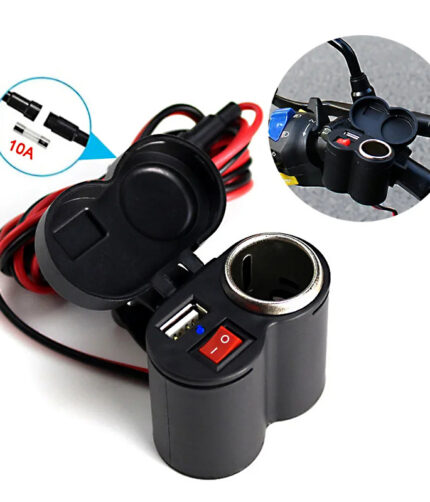
This is the first thing to check and the most common failure point. Sockets face upwards on a handlebar, which is precisely where rain collects, so spring-loaded waterproof caps and a sealed body are not luxuries. A motorcycle USB charger without proper caps will corrode in a single wet season.
The mounting clamp
Handlebar diameters vary, so check the clamp range against your bars before buying. A clamp with a rubber shim grips without marking, and a solid metal bracket resists the constant vibration that eventually cracks thin plastic.
Output and what you intend to run
Check the listing for the rated output and compare it with what you actually charge. A modern phone running navigation draws steadily, so a charger that merely slows the discharge is not enough. If you plan to run a camera and a phone at once, the total matters.
Cable, fuse and connectors
Look for reasonable cable length, a proper inline fuse holder and terminals you can attach securely. A motorcycle USB charger supplied with an unfused lead is asking for trouble, and adding a fuse yourself is the first thing to do if one is missing.
The WLD Store pick: 2-in-1 Motorcycle Handlebar USB Charger
WLD Store lists this motorcycle USB charger under Automotive and Car Accessories. Here are the listing details.
- Product: 2-in-1 Motorcycle Handlebar USB Charger with lighter socket
- Brand: WLD
- Categories: Automotive, Car Accessories
- Type: a waterproof 12V fast charger for bikes
- Outputs: a USB port plus a lighter socket in one handlebar unit
- SKU: WLD-PK-0001-(PD-260503065600)
- Availability: available across Pakistan through secure checkout
The full listing is on the 2-in-1 Motorcycle Handlebar USB Charger product page. The two-output design is the practical part: the USB port handles the phone while the lighter socket covers twelve-volt accessories, so one installation does both jobs.
Wiring it safely
Fitting a motorcycle USB charger is basic twelve-volt work, but it is on a vehicle, so do it properly or have a workshop do it. A bad connection on a bike is not the same as a bad connection on a desk lamp.
- Disconnect the battery negative first. Always, before touching anything electrical.
- Fit an inline fuse near the power source. The fuse protects the wire, not the device, so it belongs as close to the battery or fuse box as possible.
- Prefer a switched live. Wiring a motorcycle USB charger to a circuit that dies with the ignition prevents it from draining the battery while the bike is parked.
- Use a relay for heavier loads. If you intend to run a compressor or heated gear from the socket, a relay lets the heavy current bypass the ignition switch entirely.
- Make weatherproof joins. Solder and heatshrink, or sealed crimps. Twisted wire and insulating tape will corrode.
- Route away from heat and pivots. Keep cables clear of the exhaust and the steering stops, and secure them with ties so nothing chafes.
- Leave a drip loop. A downward loop before the unit stops water running along the cable into the body.
If your bike has a small battery, be conservative. Charging a phone while the engine is off will drain it faster than most riders expect, which is another reason a switched feed is the right choice for a motorcycle USB charger.
Where to mount it on the bars
Placement of a motorcycle USB charger is a compromise between reach, weather and cable strain. Get it right and the setup disappears into the bike.
Mount it where a plugged cable will not foul the steering at full lock. This is the mistake that catches people out, because everything looks fine until the first tight turn in a car park.
Keep it away from the brake and clutch reservoirs and any lever pivot, and choose a spot where the socket faces slightly downward or sideways rather than straight up. A socket pointing at the sky collects rain and dust every time you park.
Think about where the phone will sit, since the cable should run in a gentle curve rather than pulling tight. A motorcycle USB charger positioned near the phone mount keeps the cable short, which reduces both strain and clutter.
What you can actually run from it
The USB output covers phones, intercoms, action cameras, small lights and battery packs. Charging while navigating is the demanding case: the phone is consuming and charging at the same time, so expect it to hold steady rather than fill quickly.
The lighter socket opens up twelve-volt accessories, most usefully a tyre inflator. Being able to correct a soft tyre at the roadside is a real safety benefit, and a small compressor is one of the best things to carry on a long trip.
Heated gear and larger accessories need more thought. Check the rated capacity of the socket and the current draw of the accessory before connecting anything substantial, and use a relay if the load is significant. A motorcycle USB charger is not a substitute for a properly specified accessory circuit on a heavily loaded bike.
Keep an eye on the phone itself in hot weather. A phone in direct sun, running maps and charging, gets hot enough to slow down or stop charging, and that is the phone protecting itself rather than a fault in the charger.
Motorcycle USB charger versus a power bank
A power bank costs nothing to install and moves between vehicles, which suits riders who only occasionally need power. It is also the honest choice on a bike you do not want to modify at all.
The drawbacks are the ones you meet in practice: it needs charging itself, it lives in a pocket or a tank bag with a cable running out of it, and it always seems to be flat on the day you need it most. It adds a step to every ride.
A hard-wired motorcycle USB charger has no such routine. Power is there whenever the engine runs, there is nothing to remember, and the lighter socket handles accessories a power bank cannot touch. The trade-off is a one-time wiring job and a permanent fitting on the bars.
For a daily rider or anyone who tours, hard wiring wins easily. For an occasional weekend rider with a bike kept original, the power bank is a reasonable answer.
Care and maintenance
- Every ride: close the caps when nothing is plugged in. This one habit prevents most failures.
- Monthly: open the sockets and check for moisture, grit or green corrosion on the contacts.
- Monthly: check the clamp is tight, since vibration works fasteners loose and a swinging unit strains the cable.
- Every few months: inspect the inline fuse holder for water, and repack the connectors with dielectric grease.
- Before storage: if the bike is off the road for a while, disconnect the feed or use a battery tender, because even a small standing draw will flatten a battery over weeks.
When washing the bike, keep a pressure washer away from the sockets. Forcing water past a seal is the quickest way to ruin a motorcycle USB charger that would otherwise last for years.
Common problems and quick fixes
- No power at all. Check the inline fuse first, then the ground connection. A ground made onto painted metal is a classic cause.
- It works only sometimes. Vibration is moving a marginal connection. Redo the joins with solder and heatshrink rather than chasing the fault.
- The phone charges very slowly. The phone is consuming as much as it receives, especially with maps and a bright screen. Reduce brightness and check the cable, which is often the weak link.
- Water inside the socket. The cap was left open or the seal has aged. Dry it fully, clean the contacts and replace the cap if it no longer springs shut.
Who does not need one
Riders whose journeys are short commutes with a charger waiting at both ends will rarely notice the benefit. A phone that starts full and rides for twenty minutes does not need help.
Owners of bikes with a factory accessory socket already have this covered, and adding a second feed only complicates the loom. Check what your bike came with before buying anything.
Anyone unwilling to disconnect a battery and make a fused connection should either budget for fitting or use a power bank instead. There is no shame in that, and a motorcycle USB charger fitted badly is worse than no charger at all.
Buying checklist
- Does it have proper spring-loaded waterproof caps on both outputs?
- Will the clamp fit my handlebar diameter, and does it come with a shim?
- Is the rated output enough for what I actually run, including navigation while charging?
- Does it come with an inline fuse, and can I reach a switched live to wire it to?
- Is there a mounting position where a plugged cable will not foul the steering at full lock?
Other Automotive picks at WLD Store
These three sit alongside it in the same part of the catalogue.
Frequently asked questions about the motorcycle USB charger
Will a motorcycle USB charger drain my battery?
Only if it is wired to a permanently live feed and something is left plugged in, or if the unit itself draws standby current. Wiring it to a switched live that dies with the ignition removes the risk almost entirely.
Can I fit a motorcycle USB charger myself?
If you can disconnect a battery, run a fused wire and make a sealed join, yes. If any of that is unfamiliar, have a workshop do it. The job is quick for someone who does it regularly and expensive to fix if it goes wrong.
Is a motorcycle USB charger really waterproof?
Sealed units with closed caps handle rain and washing well. Nothing survives a pressure washer aimed straight at a socket, and any port left open in heavy rain will take on water regardless of how it is rated.
What can I run from the lighter socket?
Twelve-volt accessories such as a tyre inflator, a gauge or a small light. Check the rated capacity before connecting anything with a substantial draw, and use a relay for heavier loads such as heated clothing.
Why is my phone charging so slowly?
Navigation with a bright screen consumes almost as much power as it receives, so charging looks slow. Lower the brightness, use a short, good-quality cable, and keep the phone out of direct sun so it does not throttle.
Does it work while the engine is off?
That depends on the wiring. On a switched feed it powers down with the ignition, which is what you want. On a permanent feed a motorcycle USB charger keeps working, and keeps drawing from the battery, which is a good way to find yourself unable to start.
Long rides: a power plan that actually works
On a full day in the saddle, power becomes a small logistics problem. Solving it before you leave is far easier than solving it at a fuel stop with a flat phone.
- Decide the priority order. Navigation first, intercom second, camera last. If everything is charging at once, the phone you are steering by should never be the device that loses.
- Use short cables. A short, good-quality lead loses less and tangles less. Long cables flapping in the wind eventually fail at the connector.
- Carry one spare cable. Cables fail far more often than a motorcycle USB charger does, and a spare weighs nothing in a tank bag.
- Start the day full. Charging from twenty per cent while riding in daylight with a bright screen is a losing race on most phones.
- Keep a small power bank as backup. Not as the main supply, but as insurance for the day a fuse blows a hundred kilometres from anywhere.
- Check the battery before a long trip. An old battery struggling to start the bike will not enjoy running accessories, and that is a problem best discovered at home.
On group rides, agree who carries what. One compressor and one set of cables between three bikes is lighter than everyone duplicating everything, and a motorcycle USB charger on each bike means any of you can power the shared kit.
Seasonal care: rain, dust and long storage
Bikes live outdoors, and the two things that end most accessory electrics are water and vibration. A little seasonal attention prevents both.
Before a wet season, check that both caps still spring shut firmly and that the seal around the body is intact. Repack the connectors with dielectric grease and confirm the drip loop is still in place after a year of cable ties settling.
In dusty conditions, fine grit works into an open socket and sits on the contacts, where it causes intermittent connections that are maddening to diagnose. Blow the socket out occasionally and keep the caps closed whenever nothing is plugged in.
For long storage, disconnect the feed or put the battery on a tender. Even a small standing draw will flatten a battery over a few weeks, and a motorcycle USB charger left live on a bike that sits all winter is a common reason a bike will not start in spring.
Fitted properly, this is one of the least glamorous and most useful upgrades a bike can have. Choose a sealed unit, mount it where cables will not foul the steering, wire it through a fuse to a switched live, and close the caps every time you unplug. You can see the listing on the 2-in-1 Motorcycle Handlebar USB Charger page or browse more accessories in the Car Accessories section. If you want to understand what waterproof ratings actually promise, the explanation of the IP Code on Wikipedia is the clearest short reference.





Add comment