If winter heating or year-round air conditioning has left your throat scratchy by mid-morning, a mini ultrasonic humidifier is the smallest, quietest fix available. This guide covers how the ultrasonic method actually produces mist, what separates a unit worth keeping from one that ends up in a cupboard, and the water and cleaning routines that decide whether yours lasts two months or two years. There is also honest advice about the room sizes these units can and cannot handle, a troubleshooting list for the faults that come up most often, and six questions buyers ask before ordering. No prior knowledge of humidifiers is assumed.
Why a mini ultrasonic humidifier helps in a dry room
Indoor air gets dry for boring mechanical reasons. Heating systems warm air without adding any moisture to it, and air conditioning actively strips moisture out as it cools. The result in both cases is the same: relative humidity drops well below the comfortable range, and your body notices before any gauge does.
The symptoms are familiar. A dry nose on waking, static shocks off door handles, lips that crack no matter how much water you drink, and wooden furniture or instruments that develop small gaps at the joints. None of these are dramatic on their own, but together they make a room feel harsher than it needs to.
A mini ultrasonic humidifier addresses this by adding a fine, cool mist directly to the air around you. Rather than heating water into steam, it uses a small ceramic disc vibrating at a frequency far above hearing to fling microscopic droplets off the water surface. Because there is no heater involved, the unit stays cool to the touch, draws very little power and runs almost silently, which is exactly why the design suits a desk or a bedside table.
Scale is the honest limitation and also the appeal. A mini ultrasonic humidifier is a personal-space device, not a whole-home solution. It raises humidity in the metre or two around it noticeably, which is precisely where you are sitting or sleeping. Understanding how humidity behaves in a room makes it much easier to set expectations before you buy.
What makes a good mini ultrasonic humidifier
The mini ultrasonic humidifier market is full of near-identical looking units at wildly different quality levels. Four details separate the ones that keep working from the ones that gurgle, leak or quit.
Mist output and how quiet it really is
Silent is a claim worth testing against reality. A well-built mini ultrasonic humidifier produces almost no motor noise, but a poorly designed water tank can still make an audible trickling or bubbling sound as the level drops. If a unit will live beside your pillow, that difference matters far more than the headline decibel figure.
Tank access and how easily it refills
This is the single most underrated feature. A tank with a wide opening can be filled at a tap and cleaned with a finger and a cloth. A tank with a narrow port has to be filled from a bottle and can never really be scrubbed inside, which is where problems begin. Check refill design before anything else.
Power source and where it can live
USB power is what makes this format flexible. It runs from a laptop, a plug adapter or a power bank, so the unit can move from a desk to a bedside to a hotel room without a special cable. It also means the device draws modest power, which is part of why continuous running is practical.
Auto shut-off and build quality
Running a piezo disc dry is the classic way to kill one of these units. Automatic shut-off when the water runs out is the feature that protects it from a single forgetful evening. Beyond that, look at how the seams meet and how the base sits: a unit that flexes when you press it will usually seep at the joint eventually.
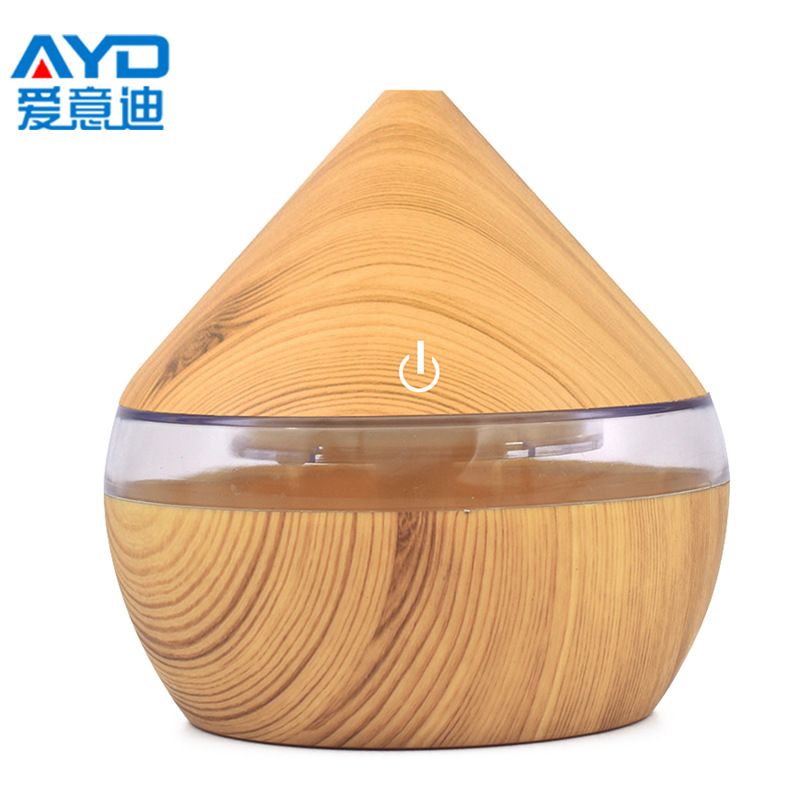
The WLD Store pick: Wood Grain Mini Ultrasonic Humidifier
WLD Store lists the Wood Grain Mini Ultrasonic Humidifier, a compact unit styled to look like timber rather than a plastic gadget. These are the details from the listing, with nothing invented:
- Product: Wood Grain Mini Ultrasonic Humidifier, described as silent mist
- Categories: Home & Kitchen, Home Appliances
- Brand: WLD
- Intended use: desk and bedroom
- Power: USB powered
- Available in: the USA, with secure checkout
- SKU: WLD-US-0021
The wood-grain finish is a practical choice as much as a cosmetic one, since a device that suits a bedside table is a device that stays out and gets used. Full photographs and current details are on the Wood Grain Mini Ultrasonic Humidifier product page.
First run: filling and starting up
Unpack the mini ultrasonic humidifier and rinse the tank before the first use, even though it looks clean. Manufacturing residue has a faint smell that becomes very obvious once it is atomised into a fine mist and you are breathing it at close range.
Fill to the marked line and no further. Overfilling is the most common cause of that alarming first-day symptom where water appears around the base, and it is almost never a defect. The chamber needs air space above the water for the mist to form and escape properly.
Sit the unit on a hard, level surface and give it a minute after filling before switching on, which lets the wick or disc wet through evenly. When it starts, you should see a steady plume rather than an intermittent spit. An intermittent plume on a brand-new mini ultrasonic humidifier almost always means the water level is either too high or too low.
Which water to use, and why it matters
This is the part most people skip, and it is the single biggest factor in how long a mini ultrasonic humidifier lasts. Ultrasonic units atomise whatever is in the water, including dissolved minerals. With hard tap water, those minerals leave the tank as an ultra-fine airborne powder that settles as a pale film on nearby surfaces, commonly called white dust.
Distilled or demineralised water eliminates the problem entirely, because there are no minerals to atomise. If distilled water is impractical, filtered water is a clear improvement over hard tap water, and cooled boiled water helps a little though less than people assume. The mineral scale that builds on the ceramic disc is also what gradually reduces mist output, so water choice is a performance issue rather than just a cleaning one.
Never add essential oils unless the manufacturer states the unit is designed for them. Oils attack the plastics and the disc coating in units built purely as a humidifier, and this is one of the most common ways a working device is destroyed within weeks. A diffuser and a mini ultrasonic humidifier look similar but are not interchangeable.
Where to place it for the best effect
Placement changes what a mini ultrasonic humidifier achieves more than any setting does. Raise the unit off the floor by at least a foot or two, because cool mist is denser than warm room air and sinks. A unit on a desk or a low shelf distributes far better than one on the carpet.
Keep roughly thirty centimetres of clear space around the mist outlet and never aim the plume directly at a wall, a wooden surface, fabric or electronics. Fine mist that lands on a surface before it evaporates leaves a damp patch, and over weeks that becomes a mark. Angle the outlet towards open room space instead.
For sleeping, put a mini ultrasonic humidifier on a bedside table at roughly mattress height, a little away from your head rather than pointed at your face. You want to be inside the humidified pocket of air, not inside the plume itself. A small towel or coaster underneath catches any condensation on humid nights and saves the furniture.
Cleaning schedule that actually prevents problems
A mini ultrasonic humidifier is a small reservoir of standing water, which is a good description of an ideal environment for bacteria and mould. Cleaning is not optional maintenance on this category; it is the whole safety case for using one.
- Daily: empty any water left in the tank rather than topping it up. Stale water sitting for a day is where biofilm starts.
- Every few days: rinse the tank and wipe the inside dry with a clean cloth. Thirty seconds of work.
- Weekly: descale with a solution of white vinegar and water, left to sit for twenty to thirty minutes, then rinsed very thoroughly.
- Around the disc: clean the small ceramic transducer gently with a soft brush or cotton bud. Never scrape it with anything metal, because the coating is what generates the mist.
- Before storage: dry the tank completely and leave it open, since a sealed damp tank in a cupboard grows exactly what you would expect.
If the mist ever smells musty, stop using the unit and do a full descale before running it again. That smell is the one warning sign you should never run through.
Common problems and quick fixes
Four faults account for the overwhelming majority of mini ultrasonic humidifier complaints, and three of them are not faults at all.
- No mist or a weak plume: usually mineral scale on the disc. Descale with vinegar solution, then check the water level is between the minimum and maximum marks.
- White dust on nearby surfaces: hard water, not a defect. Switch to distilled or filtered water and the dust stops appearing.
- Water pooling around the base: nearly always overfilling or an uneven surface. Empty to the fill line and move it onto something flat and hard.
- Unit cuts out early: the auto shut-off doing its job as the level drops, or a sensor confused by scale. Descale, refill correctly, and it typically returns to normal.
Room size limits and who should skip this
A mini ultrasonic humidifier is honest about its scale if you read it correctly. It is built to condition personal space, so it works beautifully on a desk, a bedside table, a nursery corner or a small home office. In an open-plan living room it will run all day and change the reading on a hygrometer very little.
If your goal is to raise humidity across a whole floor of a house, this is the wrong category and no amount of running time will fix that. Look at a larger evaporative or whole-house unit instead. Similarly, if anyone in the room has asthma or a respiratory condition, talk to a doctor first and be scrupulous about the cleaning schedule, because a poorly maintained humidifier can make air quality worse rather than better.
It is also worth owning a cheap hygrometer. Comfortable indoor humidity generally sits somewhere around forty to sixty percent, and pushing well beyond that causes condensation on windows and encourages mould. More mist is not automatically better, and a mini ultrasonic humidifier running unchecked in an already damp room is a genuine liability.
Ultrasonic versus evaporative: which suits you
The main alternative to a mini ultrasonic humidifier is the evaporative humidifier, which blows air through a wet wick. The two work so differently that the choice is usually obvious once you know the trade-off.
Evaporative units are self-regulating, because air can only absorb so much moisture, and they produce no white dust regardless of water hardness since minerals stay trapped in the wick. The costs are a fan that you can hear, a wick that must be replaced regularly, and a bulkier body.
An ultrasonic unit is near-silent, much smaller, has no consumable filter and gives you visible mist as reassurance that it is working. In exchange you must manage water quality and clean it diligently. For a quiet bedside or desk device, the ultrasonic design wins on almost every count that matters at that scale.
Buying checklist
Five questions to answer before ordering a mini ultrasonic humidifier.
- Is the space I want to treat genuinely personal-sized, rather than a whole open-plan room?
- Can I reach a USB power source where I actually want the unit to sit?
- Does the tank open wide enough that I can clean inside it properly by hand?
- Am I willing to use distilled or filtered water, or accept white dust if I am not?
- Does it shut off automatically when the tank runs dry, so a forgotten refill does not kill it?
Seasonal use: when to run it and when to stop
Dry indoor air is a seasonal problem in most climates, and treating it as a year-round habit is how people end up over-humidifying a room. In cold months the cause is heating: warm air holds more moisture, so heated air that started cold and dry arrives in your room drier still. This is the stretch when a mini ultrasonic humidifier earns its place, roughly from the first week the heating goes on to the week it goes off.
Air-conditioned summers create the same symptom by a different route. Cooling coils condense moisture out of the air and drain it away, so a heavily air-conditioned office or bedroom can be as dry in August as an unheated one in January. If you run air conditioning constantly, a mini ultrasonic humidifier is a summer device too.
The season to be careful is the mild shoulder period in spring and autumn, when the heating is off, the cooling is off and outdoor humidity is already comfortable. Running a humidifier through those weeks is the fastest route to condensation on the inside of windows, which is the visible early warning of moisture problems in the wall behind them.
A few practical seasonal habits make the difference:
- Check before you run: a hygrometer costs very little and answers the question directly. Below about forty percent, run it; above sixty, switch it off.
- Watch the windows: morning condensation on the glass means you are adding more moisture than the room can hold. Reduce running hours immediately.
- Store it properly: when the season ends, descale, rinse, dry the tank completely and store it uncovered rather than sealed in a box.
- Restart carefully: descale before the first run of a new season, because whatever scale was left behind has had months to harden.
Treated as a seasonal tool rather than a permanent fixture, a mini ultrasonic humidifier does its job during the weeks it is genuinely needed and stays out of the way the rest of the year.
Other WLD Store picks worth a look
A few more items from the wider WLD Store range.


Frequently asked questions about the mini ultrasonic humidifier
Can I run it all night while I sleep?
Yes, and that is the most common way these units are used. Because the mist is cool and the power draw is small, overnight running is safe provided the unit has auto shut-off and you empty and rinse the tank in the morning rather than leaving yesterday’s water in it.
Why is there white powder on my desk?
That is mineral content from hard tap water being atomised along with the water and settling as it dries. It is harmless to furniture but easy to eliminate: switch to distilled or filtered water and it disappears completely.
Can I put essential oils in the tank?
Only if the manufacturer specifically says the unit supports them. In a device built purely as a mini ultrasonic humidifier, oils degrade the plastic tank and the ceramic disc coating, and the damage is not covered by any reasonable definition of normal use.
How often do I really need to clean it?
Rinse and dry every few days, and descale weekly with a vinegar solution. If that sounds frequent, remember you are breathing whatever grows in the tank. A unit used daily and never descaled becomes unpleasant within a couple of weeks.
Will it help with dry skin and a blocked nose?
Many people find comfortable humidity eases dry nasal passages, chapped lips and static-prone skin, particularly overnight. It is a comfort device rather than a medical treatment, so persistent symptoms are still worth raising with a doctor.
Can it work in a large living room?
Not meaningfully. A mini ultrasonic humidifier conditions the air within a metre or two of itself, which is ideal beside a bed or on a desk and inadequate for an open-plan space. Match the device to the pocket of air you actually occupy.
Chosen for the right space and looked after properly, a mini ultrasonic humidifier is one of the least demanding comfort upgrades you can make to a desk or bedroom. Use clean water, keep it off the floor, rinse it often and descale it weekly, and it will run quietly for a long time. You can see the Wood Grain Mini Ultrasonic Humidifier on the storefront, or browse the full range in the Home Appliances section.




Add comment