A rechargeable massage gun is a percussion device: a motor drives a head back and forth rapidly against muscle, and that repeated tapping is what people find loosens a tight area faster than rubbing it by hand. Used sensibly it is a genuinely useful recovery tool. Used carelessly it is an expensive way to bruise yourself. This guide covers what the different heads are actually for, how long to spend on each muscle, where a rechargeable massage gun should never be pointed, how to look after the battery, and what to check before ordering one.
What a rechargeable massage gun is for
Muscles get tight for ordinary reasons: a hard training session, a long drive, a day at a desk with shoulders creeping towards the ears, or carrying something heavy up several flights of stairs. The traditional answers are stretching, rest and massage, and all three still work.
What a percussion device adds is reach and repeatability. You can treat your own calves at eleven at night without booking anyone, apply the same pressure to both legs, and stop when you have had enough. That is why a rechargeable massage gun has moved from professional sports settings into ordinary homes over the last few years.
The most common use is after exercise, when muscles feel stiff and heavy. The soreness that arrives a day or two after unfamiliar exercise, known as delayed onset muscle soreness, is a normal part of adapting to training. Many people find a short session with a rechargeable massage gun makes that stiffness more comfortable to move through.
The second big use has nothing to do with the gym. Desk workers get tight upper backs, forearms and necks from holding one position for hours, and a few minutes of treatment at the end of the day is easier to sustain than a stretching routine nobody actually does. The listing for this model describes it as a way to relieve muscle pain and relax after gym or work.
What to look for in a rechargeable massage gun
Specifications in this category are noisy. Four things genuinely change the experience.
Battery capacity and real runtime
Battery is the difference between a tool you grab without thinking and one that is always flat. A 3000mAh cell rated at around six hours per charge means a rechargeable massage gun of this type covers weeks of normal use between charges, since sessions are measured in minutes rather than hours.
Speed settings
One speed is not enough, because muscles differ enormously. A calf or a thigh can take a firm setting comfortably; the muscles along the shoulder blade or the forearm cannot. Four speeds give you a low setting for sensitive areas, a middle range for general use and a higher setting for large, thick muscle groups.
The heads, and what each one does
Most kits include four attachments, and they are not interchangeable in practice. A round or ball head is the general-purpose option for large muscles. A flat head spreads force over a wider area and suits denser groups. A bullet or cone head concentrates force into a small point for specific spots, and should be used briefly and carefully. A fork or U-shaped head is designed to straddle a tendon or the spine rather than hit it. Choosing the right head matters as much as choosing the right speed.
Weight, grip and noise
You hold this at awkward angles, sometimes reaching behind your own shoulder. A rechargeable massage gun that is comfortable to grip and not excessively heavy is one you will actually use on the areas that need it, rather than only the easy ones. Noise matters if you use it while others are asleep.
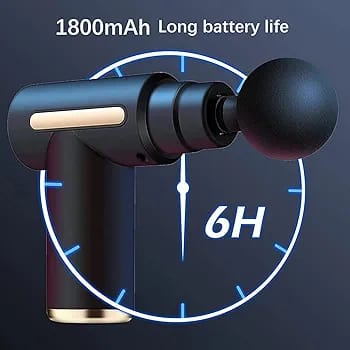
The WLD Store pick: Rechargeable Massage Gun
This is the rechargeable massage gun listed at WLD Store, described as a deep tissue muscle massager.
- Product: Rechargeable Massage Gun, a cordless deep tissue muscle massager.
- Battery: 3000mAh.
- Runtime: the listing states around 6 hours per charge.
- Speeds: 4 speed settings.
- Heads: 4 attachments included.
- Intended use: relieving muscle pain and relaxing after gym or work.
- Category: Beauty and Personal Care.
- Brand: WLD.
- SKU: WLD-PK-0005-(HHC-3762916).
- Availability: available across Pakistan through secure checkout.
Full listing: Rechargeable Massage Gun at WLD Store.
How to use a rechargeable massage gun properly
More pressure and more time do not produce better results. The technique below is the conservative approach, and it is the one that avoids problems.
- Start on the lowest speed. Get a feel for how the muscle responds before increasing anything. You can always go up.
- Keep it moving. Glide slowly across the muscle rather than parking the head in one place. Holding it still on one spot is how bruising happens.
- Spend one to two minutes per muscle group. This is a short treatment, not a long one. Ten minutes on one calf is not more effective, it is just more trauma.
- Let the weight of the tool do the work. Rest it against the muscle. Pushing a rechargeable massage gun hard into tissue adds force the device was not designed to deliver.
- Stay on soft tissue. Muscle only. Keep away from bones, joints, the spine itself, the front and sides of the neck, the head and the abdomen.
- Relax the muscle you are treating. A tensed muscle resists the head. Sit or lie so the area is supported and slack.
- Stop if it hurts. Discomfort that feels like a deep stretch is normal; sharp pain is a signal to stop, not to push through.
Before exercise, brief passes over the muscles you are about to use can help you feel readier to move. After exercise, a slower session helps stiffness feel more manageable. If you have an injury, a recent operation, a circulation or nerve condition, varicose veins, osteoporosis, or you are pregnant, ask a doctor or physiotherapist before using a rechargeable massage gun at all. Never use one over an area that is swollen, bruised, broken or numb.
A simple routine: which muscles, and in what order
Most people buy a percussion device, use it enthusiastically on their calves for a week, and then stop. A short fixed routine is easier to keep up, and working from the largest muscles to the smallest is the sensible order because the big groups tolerate more and warm the area up.
Legs come first after any session on your feet. Calves respond well to a ball head on a low or medium speed, with the foot relaxed and the leg supported rather than braced. Quadriceps at the front of the thigh can usually take a firmer setting, and hamstrings at the back are best treated sitting down with the leg extended so the muscle is slack.
Glutes are the group people skip most often and the one that causes the most trouble for anyone who sits all day. They are thick enough for a firmer setting and a flat head works well across the broad area.
The upper body needs more care. The large muscles of the back either side of the spine can be treated with a rechargeable massage gun held at an angle, staying clearly off the spine itself. Shoulders and the tops of the traps are sensitive, so drop the speed and shorten the time. Forearms, which get tight from typing and gripping, respond surprisingly well to a low setting and thirty seconds each.
Two rules hold this routine together. First, no area gets more than a couple of minutes, even if it feels good. Second, symmetry: if you treat one calf, treat the other, because leaving one side untouched is how people end up moving unevenly the following day.
Fitted around a shower after training or ten minutes before bed, that whole sequence takes well under ten minutes. That is realistic enough to become a habit, which is the only way a rechargeable massage gun ever repays what it cost.
Battery care and maintenance
The battery decides the lifespan of the whole device, and it responds well to a few simple habits.
- Avoid running it to empty repeatedly. Partial top-ups are kinder to lithium cells than deep discharges.
- Do not store it flat. If it will not be used for a month, charge it partly first, then put it away.
- Keep it out of heat. A hot car in summer is one of the worst places to leave any battery device.
- Use the supplied cable and a normal adapter. High-power fast chargers are unnecessary for a device like this.
- Wipe the heads after use. Sweat and skin oil transfer onto the attachments. Wipe them and let them dry before returning them to the case.
- Check attachments are locked in. A loose head rattles, wears the socket and is uncomfortable against skin.
- Keep the case closed. Dust in a motor housing shortens the life of a rechargeable massage gun more than usage does.
Always follow the instruction manual supplied with your unit for charging, use and any contraindications, ahead of general guidance like this.
Common problems and quick fixes
- It leaves red marks. Too much pressure, too long in one spot, or too high a speed for that muscle. Move continuously, lighten the contact and drop a speed.
- It feels uncomfortable rather than relieving. Try a different head. A bullet head on a sensitive area feels very different from a flat or ball head on the same spot.
- The motor bogs down. You are pressing too hard. The head should skim the surface, not be driven into the muscle.
- Runtime seems short. Check whether you are running it on the highest speed constantly, which drains any battery faster, and confirm it is charging fully rather than being unplugged early.
Buying checklist: five questions before you order
- What am I treating? Large leg muscles after training and a tight upper back after work call for different speeds and different heads.
- Do I need it to travel? A cordless rechargeable massage gun with a solid battery works in a hotel room or at the gym as easily as at home.
- How many heads come with it? Four attachments cover the realistic range of muscle groups without needing extras.
- Can I reach the areas I need alone? Consider your own shoulders and upper back, which are the hardest places to self-treat.
- Is there any medical reason to check first? If you have an existing condition or a recent injury, that question comes before all the others.
Other personal care picks at WLD Store
Three more items from the same part of the range.
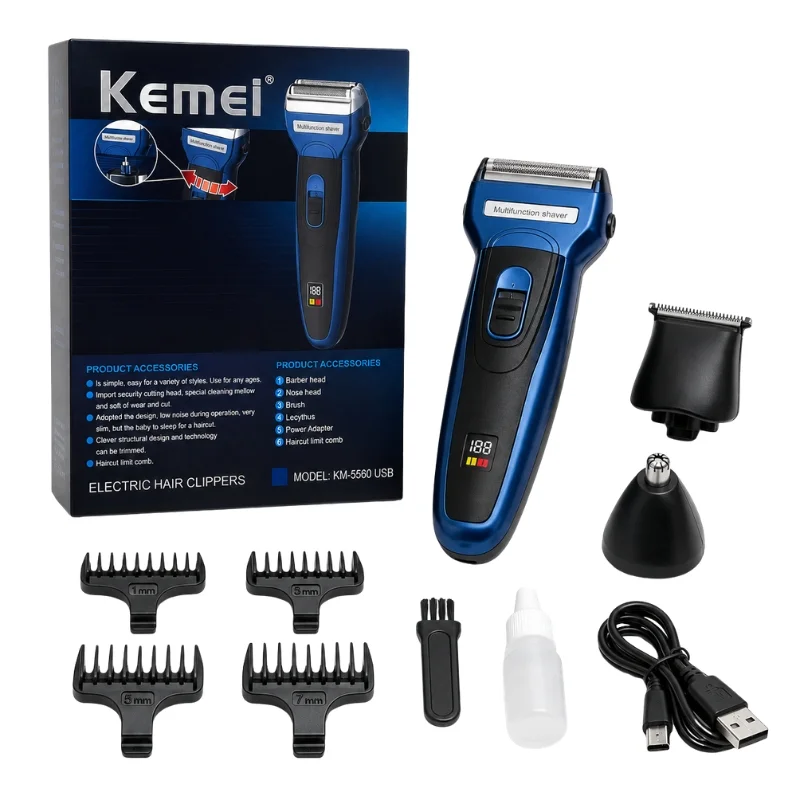
Kemei KM-5560 Electric Hair Clipper for home haircuts.
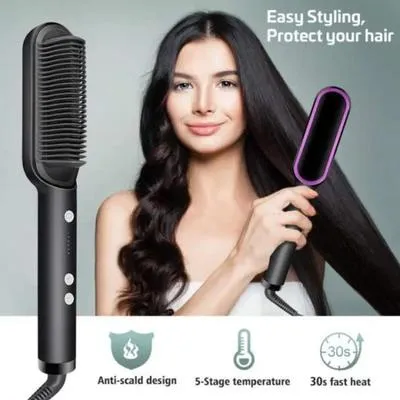
Hair Straightener Brush for styling in a single pass.
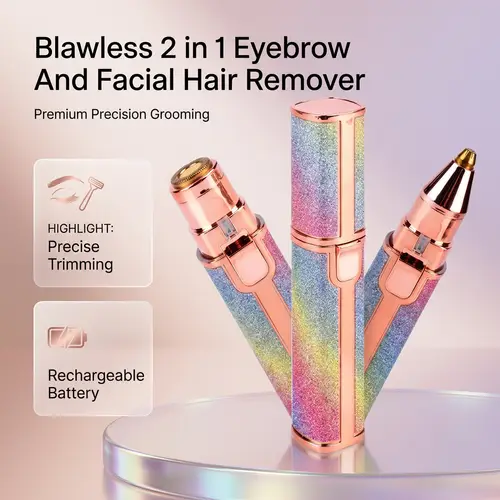
Blawless 2-in-1 Eyebrow and Facial Hair Remover for daily touch-ups.
Where not to use a rechargeable massage gun
Percussion works on muscle. Anywhere there is not much muscle between the head of a rechargeable massage gun and something important, it is the wrong tool for the job.
Keep the head off bone. The shin, the kneecap, the elbow, the collarbone, the spine itself and the bony ridges of the hip and shoulder blade all send vibration straight into joints and nerves, which is uncomfortable at best. Work the muscle either side of the spine, never the vertebrae.
Keep it off the front and sides of the neck, the throat, the armpit and the crease of the groin. Those areas carry major blood vessels and nerves close to the surface. The abdomen is the same story: soft tissue over organs is not what a rechargeable massage gun is designed for.
Skip recent injuries entirely. A fresh strain, a suspected tear, a swollen joint, a bruise, a burn or broken skin all need time and, unless the problem is obviously minor, a professional opinion. This is a recovery tool for healthy tired muscle, not a treatment for damage.
Some people should ask a doctor before using one at all: anyone pregnant, anyone taking blood thinners, and anyone with varicose veins, a clotting disorder, osteoporosis, diabetes with reduced sensation, a pacemaker or another implanted device, or any condition affecting circulation or nerve feeling. That is not boilerplate. Reduced sensation in particular means you may not feel the warning that would normally make you stop.
Fitting a rechargeable massage gun into a normal week
Most people buy a rechargeable massage gun, use it hard for a fortnight and then forget about it. A light routine tied to things you already do lasts much longer than an ambitious one.
Before training, keep it short and brisk. Thirty to forty-five seconds per major muscle group at a low speed wakes the tissue up without leaving it sluggish. This is a warm-up aid rather than the warm-up itself, so still move the joints through their range afterwards.
After training, go slower and longer. One to two minutes per worked muscle, gliding rather than pressing, at whichever speed feels like firm pressure and not like gritting your teeth. If you are wincing you are pushing too hard, and harder does not mean better here.
On rest days, use it on whatever your job does to you rather than whatever your training did. Desk workers usually need the upper back, the outside of the hips and the calves. Anyone on their feet all day needs calves, feet and the front of the thighs.
- Training days, before: 30 to 45 seconds per group, low speed.
- Training days, after: one to two minutes per worked muscle, moving slowly.
- Rest days: about five minutes on whatever your daily posture loads.
- Evenings: calves and feet, low speed, while you watch something.
- Every session: stop at two minutes on any single spot.
Charging follows the same logic. Put the rechargeable massage gun back on charge on a fixed day rather than when it dies, and it will be ready on the evening you actually want it. A rechargeable massage gun sitting flat in a drawer helps nobody.
Frequently asked questions about the rechargeable massage gun
How long should a session last?
Short. One to two minutes per muscle group is the usual guidance, with the head moving continuously. A full body session should still be measured in minutes, not tens of minutes. Longer is not better with percussion.
When is the best time to use it?
Briefly before exercise if you want to feel looser going in, and more slowly afterwards for stiffness. Plenty of people also use a rechargeable massage gun in the evening after a long day at a desk, which has nothing to do with training at all.
Where should I never use it?
Avoid bone, joints, the spine, the front and sides of the neck, the head, the abdomen, and anywhere that is swollen, bruised, numb or injured. If you are unsure whether an area is safe, that uncertainty is itself a good reason to ask a professional first.
Which head should I start with?
The round or ball head on a low speed. It is the most forgiving attachment and suits most large muscles. Move to the flat head for broader coverage, and treat the pointed head as a specialist tool for brief, careful use.
Can it replace a physiotherapist?
No. It is a self-care tool for ordinary tightness and post-exercise stiffness. Persistent pain, pain that came from a specific injury, numbness, or anything that is getting worse needs proper assessment by a qualified professional rather than a device.
How often does it need charging?
Given how short sessions are, a battery of this capacity typically lasts a long time between charges in normal use. Charging it after every few sessions, rather than waiting for it to die, keeps a rechargeable massage gun ready whenever you want it.
The short version
Low speed, keep it moving, one to two minutes per muscle, soft tissue only, and stop when it stops feeling useful. A rechargeable massage gun rewards restraint far more than enthusiasm. You can view this model on its product page, or browse the wider range in the Beauty & Personal Care section.



Add comment