A retinol serum is probably the most researched product category on a skincare shelf, and also the one most often used badly. Applied slowly and consistently it is a sensible long-term step; applied enthusiastically it produces a fortnight of red, flaking skin.
This guide explains what retinol is, what squalane contributes when the two are combined, how to introduce a serum without wrecking your skin barrier, what it must never be layered with, and who should not use it at all. There is a starting schedule, a storage section, a troubleshooting list, a buying checklist and six questions answered for readers in Saudi Arabia.
What a retinol serum actually is
The active in a retinol serum belongs to the vitamin A family, a group of compounds collectively called retinoids. Skin converts retinol through a couple of steps into the form it can actually use.
That conversion is the key to understanding the whole category. Prescription retinoids skip some of those steps, which is why they act faster and irritate more. An over-the-counter retinol serum works more gradually because the skin has to do the conversion itself.
Gradual is not a weakness here. For most people the slower route is the one they can sustain, and a product used for a year beats a stronger one abandoned after ten days.
What the category is generally associated with is skin texture and the appearance of fine lines over an extended period. The compound itself, and where it sits in the vitamin A family, is described on the retinol reference page.
What squalane adds to the formula
Retinol on its own can be drying, and this is where the base of a retinol serum matters as much as the active itself.
Squalane is a lightweight emollient that is well tolerated by most skin types, including oily ones. It is not an active ingredient in the way retinol is; it is the cushioning around it.
Pairing the two is a common and sensible formulation approach. A retinol serum in a squalane base is generally more comfortable during the first weeks than the same strength in a thin watery base.
It also makes the product easier to spread thinly, which matters more than it sounds. An even, sparse layer is the goal, and a slippery base is far easier to spread evenly than a fast-drying one.
What makes a good retinol serum
Four things are worth checking on any retinol serum before anything else.
A strength you can actually start with
Strength is stated as a percentage, and higher is not better for a beginner. A lower concentration used nightly is a better outcome than a strong one used twice and then abandoned.
If you have never used the category before, treat any retinol serum as something to build up to rather than to dive into. The percentage is a destination, not a starting point.
Packaging that keeps light and air out
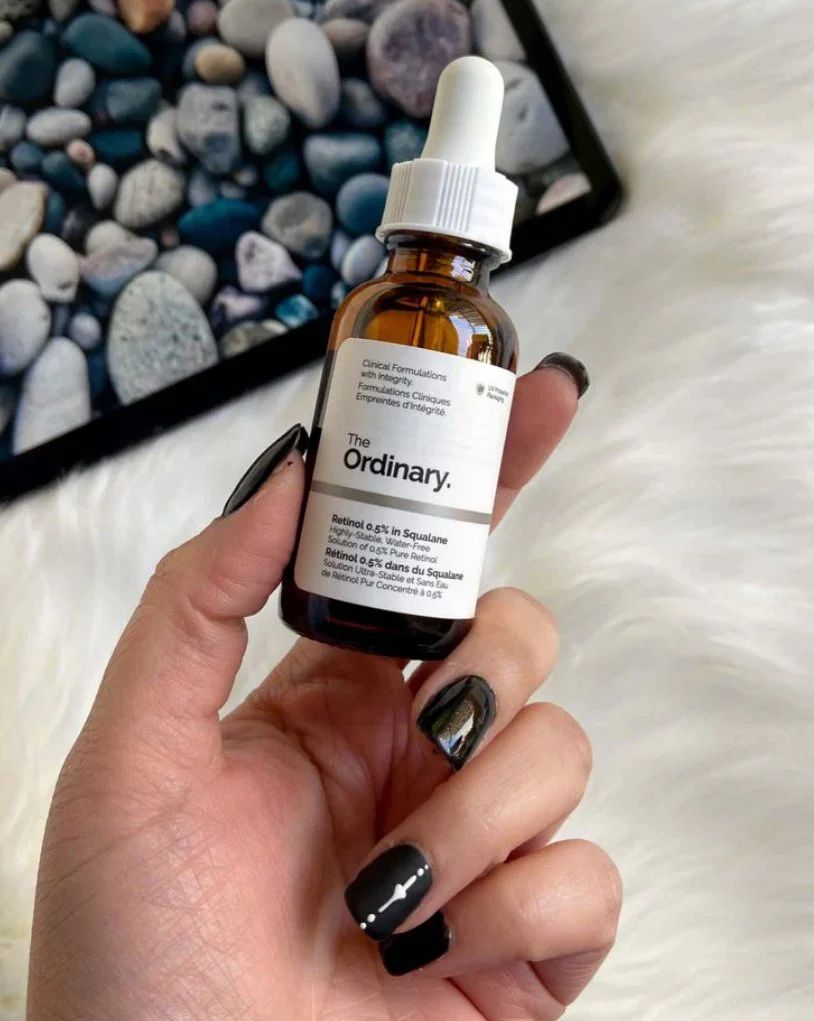
Retinol degrades in light and air, which makes packaging a functional decision rather than a cosmetic one.
An opaque bottle with a pump or a well-sealed dropper protects the formula. A clear jar you dip fingers into is the worst possible container for a retinol serum, however attractive it looks on a shelf.
A short ingredient list, ideally fragrance-free
The category already asks something of your skin. Adding fragrance on top increases the chance of a reaction and makes it harder to work out what caused one.
Clear instructions on the label
A brand that tells you to start twice a week and build up is giving you the right advice. One that implies nightly use from day one is not.
The WLD Store pick: Retinol 0.5% + Squalane Serum
WLD Store lists the Retinol 0.5% + Squalane Serum in its Beauty & Personal Care and Skin Care range. Here is what the listing states:
- Product: Retinol 0.5% + Squalane Serum
- Brand: WLD
- Category: Beauty & Personal Care — Skin Care
- Formula: described as combining pure retinol with hydrating squalane
- Claimed action: the listing states it reduces wrinkles, improves skin texture and boosts cell renewal
- Suggested use: described as gentle enough for nightly use
- Availability: available across Saudi Arabia with secure checkout
- SKU: WLD-KSA-0065-(KD-KD0166)
The full ingredient list, images and current availability are on the Retinol 0.5% + Squalane Serum product page. Read the label and patch test before adding any new active to your routine.
How to start without wrecking your skin
Almost every bad experience with a retinol serum comes from starting too fast. A slow introduction takes six weeks and saves months of repair.
- Week one: twice, at night only. Two applications in the whole week, on clean dry skin, several days apart.
- Week two to three: every third night. If there is no stinging or flaking, move up. If there is, stay where you are.
- Week four to five: every other night. This is where many people settle permanently, and there is nothing wrong with stopping here.
- Week six onward: nightly, if your skin agrees. Some skin never gets to nightly, and a retinol serum used three times a week for years is still doing its job.
- Use a pea-sized amount. For the entire face. More is not faster; it is just more irritation.
- Apply to dry skin. Damp skin absorbs more and increases the chance of stinging, particularly at the start.
- Buffer if needed. Moisturiser first, then the retinol serum on top, softens the introduction considerably.
What the first weeks feel like
A period of mild dryness and light flaking is common when starting this category, and knowing that in advance stops people abandoning it unnecessarily.
Typical early experiences include slight tightness, a little peeling around the nose and chin, and skin that feels more sensitive to a usual moisturiser. This generally settles as the skin adjusts.
What is not normal is burning, swelling, weeping or a rash. Those are signs to stop, not to push through, and they warrant asking a pharmacist or doctor.
The sensible response to mild irritation is to reduce frequency rather than to stop entirely. Dropping a retinol serum from every other night to twice a week usually resolves it within a week.
Sun protection is not optional
This is the single most important paragraph in any guide to the category, and it is the one people skip.
Retinoids can increase skin sensitivity to sunlight. Using a retinol serum without daily sunscreen works against the very thing you are trying to achieve.
In a high-sun region this matters more than in most. Broad spectrum sunscreen every morning, reapplied when outdoors, is part of the commitment you make when you start this category.
Night application is standard for the same reason. The product is used in the evening, and sunscreen protects the skin through the following day.
What not to layer with it
Most bad reactions come from combinations rather than from a retinol serum alone.
Strong exfoliating acids are the main culprit. Using a glycolic or salicylic product on the same night as a retinol serum is asking a great deal of the skin barrier.
Physical scrubs are worth pausing entirely while you build up. Skin adjusting to a retinoid does not need abrasion on top of it.
Benzoyl peroxide is usually kept to a different time of day, and some formulations are described as inactivating each other when mixed. Separating them by morning and evening avoids the question.
Alternating nights is the simplest system. Acids on one night, a retinol serum on another, and neither on the night after a long day in the sun.
Who should not use it
This category has a genuine list of exclusions, and it should be taken seriously rather than treated as small print.
Anyone pregnant, trying to conceive or breastfeeding should not use retinoids without medical advice. This is the clearest and most widely repeated caution in the category, and a doctor should be the one to answer it.
Anyone with an active skin condition — eczema, rosacea, dermatitis or broken skin — should ask a dermatologist before starting a retinol serum rather than experimenting.
People already using a prescription retinoid should not add an over-the-counter one on top. That is doubling the same class of ingredient with no added benefit.
And anyone with a planned cosmetic procedure, waxing appointment or laser treatment should ask beforehand, because most practitioners ask you to pause retinoids in advance.
Storage and shelf life
The active in a retinol serum is one of the less stable ingredients on a shelf, and storage genuinely affects how long a bottle stays effective.
Keep it away from light. A bathroom windowsill in this climate is the fastest way to degrade a retinol serum, and a closed drawer is a much better home.
Keep it cool. Heat accelerates breakdown, so a bathroom cabinet that bakes every afternoon is not ideal, and a bedroom drawer usually is.
Close it properly every time. Air exposure matters as much as light, and a dropper left resting open on a counter overnight is a small, repeated loss.
Note the date you opened it. Most products carry a period-after-opening symbol, and a retinol serum kept well beyond it is unlikely to be doing much.
Common problems and quick fixes
- Flaking around the nose and mouth. Common at the start. Reduce to twice a week, moisturise more, and build up again slowly.
- Stinging on application. Usually damp skin or too much product. Wait until the face is fully dry and use a pea-sized amount.
- Breakouts in the first month. Often reported as skin adjusts. If it persists beyond six to eight weeks, ask a pharmacist or dermatologist.
- The serum has darkened. Likely oxidation from light or heat. Store it darker and cooler, and replace it if the colour or smell has clearly changed.
How it compares with other options
It helps to know what else occupies the same shelf and what each is for.
An antioxidant serum is preventive and generally used in the morning. It sits comfortably alongside a retinol serum used at night, and the two are a common pairing.
Exfoliating acids work on the surface and give faster visible smoothness. They are also the ingredient most likely to clash with a retinoid on the same evening.
A prescription retinoid is stronger and faster, and it comes with medical supervision. That is the right route for some people and unnecessary for many others.
Moisturiser does none of what a retinol serum does, and it is still the product that makes the routine tolerable. Do not cut it to make room.
Fitting it into a real week
Routines fail when they demand more than an evening realistically allows, so it is worth planning around a normal week rather than an ideal one.
Pick fixed nights rather than deciding each evening. Sunday, Tuesday and Thursday is easier to keep than a vague intention to use a retinol serum a few times a week.
Skip a night after significant sun exposure, a long flight or anything that has already left skin dry. Missing one application costs nothing.
Keep the rest of the routine boring while you build up. Introducing a new cleanser in the same month makes it impossible to know what caused a reaction.
Reading a percentage on the label
Percentages cause more confusion in this category than any other number, partly because they are not directly comparable between brands.
A stated figure tells you how much retinol is in the formula. It does not tell you how much reaches the skin, how stable the formula is, or how the base affects tolerance. Two products at the same percentage can feel very different.
What the number is genuinely useful for is comparing one retinol serum with another from the same brand, and for judging whether you are stepping up sensibly rather than doubling overnight.
The practical approach is to ignore the marketing hierarchy of higher numbers and choose by tolerance. A well-formulated lower strength used consistently outperforms a strong one used sporadically.
Barrier care while you build up
Skin adjusting to a retinoid needs its barrier looked after, and that is mostly about what you stop doing rather than what you add.
Switch to a gentle, non-foaming cleanser during the first weeks. Anything that leaves skin feeling tight is working against the retinol serum rather than with it.
Moisturise generously, morning and night. There is no benefit to letting skin stay dry, and a good moisturiser does not stop the active working.
Pause everything optional. Toners, essences, masks and scrubs can all wait six weeks while your skin decides what it thinks of the new product.
If the barrier does get damaged — persistent redness, stinging from plain water — stop the retinol serum entirely for a week or two and reintroduce it from the beginning of the schedule.
Applying it around the eyes and neck
These two areas are where people most often go wrong, in opposite directions.
The skin around the eyes is thinner and reacts sooner. Keep the product away from the immediate eye area unless the label specifically says otherwise, and never apply it to the lid itself.
The neck and chest are usually neglected instead. They show sun exposure clearly and are worth including, but they are also more reactive than the face, so extend a retinol serum there at a lower frequency.
Whatever you decide, keep it consistent. Alternating between including the neck and forgetting it produces uneven tolerance and an obvious line at the jaw.
Who should skip it entirely
Anyone unwilling to wear sunscreen daily should not start. The two are a package, and using one without the other is counterproductive.
People who want a change in two weeks are in the wrong category. A retinol serum works over months, and expecting a fortnight result guarantees disappointment.
Anyone whose skin is currently irritated from another product should fix that first. Starting a retinoid on an already compromised barrier makes both problems worse.
Buying checklist
- Is the strength appropriate for your experience? Beginners should build up rather than start high.
- Is the bottle opaque and sealed? Light and air are what degrade the active.
- Is the base comfortable? Squalane and similar emollients make the first weeks easier.
- Is it fragrance-free? One fewer variable when your skin is adjusting.
- Are you committed to daily sunscreen? If not, this is the wrong purchase.
Other beauty and personal care picks at WLD Store
These related listings sit nearby in the Beauty & Personal Care range.

Frequently asked questions about a retinol serum
How often should I use a retinol serum?
Start with twice a week and increase gradually over about six weeks if your skin tolerates it. Many people settle at every other night permanently, and that is a perfectly good place to stay.
Morning or night?
Night. Retinoids can increase sensitivity to sunlight, so evening application with broad spectrum sunscreen the following morning is the standard approach.
Can I use it while pregnant?
Do not use retinoids during pregnancy, while trying to conceive or while breastfeeding without medical advice. Ask a doctor first — this is the one caution in the category that is never worth guessing about.
Can I use vitamin C at the same time?
Most people separate them: an antioxidant serum in the morning and a retinol serum at night. That avoids layering two demanding actives in one session and is easier on the skin barrier.
How long until I see anything?
Weeks to months rather than days. Skin turnover is slow, and this category rewards consistency over intensity. Judging it after two weeks tells you nothing useful.
What if my skin flakes?
Mild flaking is common early on. Reduce frequency, moisturise more, and build back up slowly. If a retinol serum causes burning, swelling or a rash, stop and speak to a pharmacist or doctor.
Introduced slowly and paired with daily sun protection, a retinol serum is a patient, well-studied part of an evening routine rather than a quick fix. You can view the current listing on the Retinol 0.5% + Squalane Serum page or browse more skincare in the Skin Care section, with secure checkout and availability across Saudi Arabia.





Add comment