A crystal hair remover is the reusable glass-look pad that has quietly replaced razors and wax strips in a lot of bathrooms. There are no blades, no heating, no strips to pull and nothing to throw away after each session. This guide explains what actually happens when you use one, how it compares with shaving and waxing, which areas it suits, how to avoid the irritation people occasionally report, how to keep the surface working properly, and who should choose something else. It also sets out exactly what the WLD Store listing states about the model it stocks in Saudi Arabia.
How a crystal hair remover actually works
The working surface of a crystal hair remover is covered in an extremely fine abrasive texture. When you move it against the skin in a circular motion, that texture catches the hair shafts and wears them away at the surface, while also lifting loose dead skin cells at the same time.
That dual action is the reason people describe the result as unusually smooth. You are not only removing hair, you are also exfoliating, and skin that has just been exfoliated feels noticeably different from skin that has simply been shaved.
It is worth being precise about the mechanism, because it sets expectations correctly. A crystal hair remover works at the surface, similar in principle to shaving rather than to waxing. It does not pull hair out from the root, and no reputable listing claims it does. If you want a broader picture of the different approaches available, the Wikipedia overview of hair removal is a good starting point.
Understanding that also explains why it feels painless. There is no pulling, no tugging and no blade edge against the skin, which is exactly why the technique appeals to people who dislike both waxing and shaving.
Why people switch to one
The most common reason is simple discomfort with the alternatives. Waxing hurts, and plenty of people never get used to it no matter how many times they do it. Razors bring nicks, razor burn and ingrown hairs, particularly on areas that are awkward to reach.
A crystal hair remover removes both of those problems in one step. There is nothing sharp involved, and nothing is being pulled, so the sensation is closer to buffing than to grooming.
Cost and waste are the second reason. Disposable razor cartridges and wax strips are a recurring purchase that never ends. A reusable tool changes that pattern entirely, which is why the listing describes it as eco-friendly.
Convenience is the third. There is no heating, no mess, no strips to warm between your palms and no water required, which means a crystal hair remover works just as well in a bedroom before getting dressed as it does in a bathroom.
What makes a good crystal hair remover
Every crystal hair remover looks almost identical in photographs, so it is worth knowing which differences actually matter.
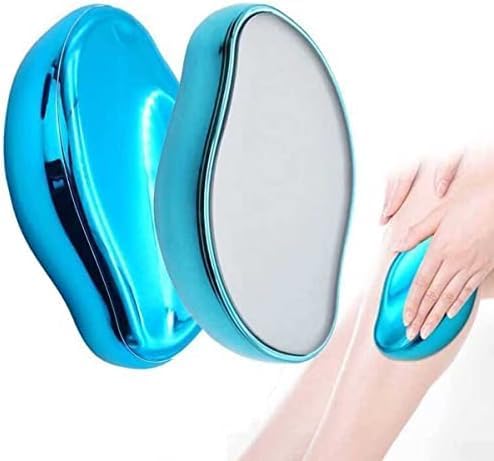
The abrasive surface
Everything about a crystal hair remover depends on this. The texture needs to be fine enough to be comfortable on skin but consistent enough to catch hair across the whole working face rather than only in patches.
An uneven surface is what produces the complaint that a crystal hair remover works on one part of a leg and not another. A good one feels uniform when you run a fingertip lightly across it.
Shape and grip
You will be using this on shins, forearms and possibly a partner’s back, which means awkward angles and repetitive circular motion. A shape your hand can hold securely without cramping matters more than any aesthetic detail.
Check the size against the area you actually care about. A larger face covers a leg quickly but is clumsy around an ankle or a knee, while a smaller one is more controllable but takes longer over big areas.
Durability of the surface
Reusability is the main selling point of a crystal hair remover, so how long the surface stays effective is the specification that decides value. Surfaces do dull with use, and one that dulls quickly undoes the entire cost argument.
How it is protected in storage
The working face needs to stay clean and undamaged between uses. A cover or a case keeps grit off it, and grit is the thing most likely to scratch a surface that is otherwise perfectly durable.
The WLD Store pick: Crystal Hair Remover
Here is exactly what the WLD Store listing states about this product, with nothing added:
- Product: Crystal Hair Remover, a painless reusable hair eraser
- Brand: WLD
- Categories: Home & Kitchen, and Personal Care
- Technology: described as painless nano-crystal technology that erases hair in minutes
- Reusable: no wax strips or blades needed, described as eco-friendly
- Areas: legs, arms and back
- Skin types: described as suitable for all skin types
- Availability: sold across Saudi Arabia with secure checkout
- SKU: WLD-KSA-0103-(KD-147)
The areas listed are the detail worth noting: legs, arms and back. That is the intended scope of this crystal hair remover, and it is a sensible one for a surface-abrasion tool. You can read the listing in full on the Crystal Hair Remover product page.
How to use it, step by step
With a crystal hair remover, technique makes the difference between smooth skin and an irritated patch, and it takes very little to get right.
- Start clean and completely dry. Moisture makes hair cling to the skin instead of being caught by the surface, so this is the step people most often skip.
- Work in small circles. Circular motion is what lets the surface catch hairs from every direction. Straight strokes are much less effective.
- Use gentle pressure. Let the surface do the work. Pressing hard does not remove more hair and is the main cause of redness.
- Do one small area at a time. Treat a patch, check the result, then move on rather than sweeping over a whole leg at once.
- Brush the residue away. Hair dust and dead skin build up as you go and need wiping off so you can see progress.
- Moisturise afterwards. Freshly exfoliated skin takes moisturiser well, and this is the step that makes the result feel finished.
If it is your first time with a crystal hair remover, do one small patch and then leave it for a day before doing more. That single habit prevents almost every bad first experience people report.
Patch testing and skin safety
A patch test is not an over-cautious formality here. Because the tool exfoliates as well as removes hair, skin that tolerates shaving does not automatically tolerate abrasion.
Choose an inconspicuous area, use the crystal hair remover exactly as you would normally, then wait a full day. Mild pinkness that fades within an hour is normal; anything that is still red, sore or itchy the next day means this is not the right method for your skin.
Never use it on broken skin, sunburn, active spots, moles, tattoos that are still healing, or any area that is already irritated. Abrasion on compromised skin makes things worse rather than better.
And do not treat the same area twice in quick succession. If some hair remains, it is better to leave it and come back in a few days than to keep working over skin that has already been exfoliated once.
Which areas suit it, and which do not
The listing names legs, arms and back, and that is a good guide to where this method works best. Those areas have relatively robust skin and large, flat surfaces that suit a circular buffing motion.
Legs are the easiest place to start. Shins in particular are flat, visible and easy to reach, so they are the best area to learn the technique on before trying anywhere trickier.
Backs are the area where a crystal hair remover has an unusual advantage: there is nothing sharp involved, so having someone help is far less nerve-racking than handing them a razor.
Faces, underarms and bikini areas are a different matter. Skin there is thinner, more sensitive and more prone to reacting to abrasion, and the product listing does not name them. Use a method designed for those areas instead.
Regrowth and how often to use it
Because a crystal hair remover works at the surface rather than at the root, regrowth follows a similar pattern to shaving. Hair returns on its usual cycle rather than being delayed for weeks.
What many people notice is that the regrowth feels different. A blade cuts a hair at an angle and leaves a blunt tip, which is what produces that sharp stubble feel. Abrading the hair away tends to leave a less defined edge, so returning hair often feels softer.
Frequency should be led by your skin, not the calendar. Once a week is a reasonable starting point for most people, and increasing that only makes sense if the skin has shown it is comfortable with the routine.
Skin needs recovery time between sessions because of the exfoliation. That is the important difference from shaving, where the skin barrier is disturbed far less.
Aftercare that makes the difference
Aftercare after using a crystal hair remover matters more than with a razor, and it is straightforward.
Moisturise immediately. Exfoliated skin loses moisture faster than untouched skin, and a simple unscented lotion applied straight away keeps it comfortable.
Avoid strong actives for a day. Retinoids, acids and heavily perfumed products on freshly abraded skin are the most common cause of stinging that people blame on the tool itself.
Keep the area out of strong sun on the same day, and skip the swimming pool. Chlorine on freshly exfoliated skin is uncomfortable and entirely avoidable by waiting a day.
Loose clothing helps too. Tight fabric rubbing over an area you have just used a crystal hair remover on is a small thing that makes a noticeable difference to how the skin feels that evening.
What to expect in the first month
The first few sessions with a crystal hair remover are a learning period, and knowing that stops people giving up before the method has had a fair trial.
Session one is usually the slowest. You are still finding the right pressure, the right circle size and the right amount of time per patch, so results are often uneven and that is entirely normal.
By the third or fourth session most people have settled into a rhythm, and a full leg takes noticeably less time than it did at first. That improvement comes from technique, not from anything changing in the tool.
Skin adjusts as well. The mild pinkness that appeared after early sessions usually fades once you stop pressing hard, which is the single most common beginner correction with a crystal hair remover.
By the end of a month you should know whether the method suits you. If the routine feels comfortable and the results are consistent, a crystal hair remover has earned its place in the drawer. If your skin has been persistently irritated despite a light touch, that is a clear answer too.
Cleaning and looking after the tool
- Wipe it after every use. Hair dust and skin cells clog the surface and reduce how well it catches hair.
- Rinse and dry it fully. If you rinse under a tap, let it dry completely before putting the cover back on.
- Keep it covered. Grit in a drawer is what scratches a working surface, so store it in its cover or a small pouch.
- Keep it personal. Like a razor, a crystal hair remover should not be shared between people.
- Do not drop it. A chipped edge is uncomfortable on skin and cannot be repaired.
If the surface stops catching hair even after a proper clean, it has dulled and is due for replacement. That is normal wear rather than a fault.
Crystal hair remover versus razors, wax and epilators
Against a razor, the advantages are no nicks, no blade cost and exfoliation included. The trade-off is that it takes longer on large areas and needs dry skin rather than a lathered leg in the shower.
Against waxing, it is painless and can be done at any hair length. Waxing removes hair from the root and therefore lasts longer between sessions, so if long-lasting smoothness is your priority, wax still wins on duration.
Against an epilator, a crystal hair remover is quieter, gentler and far less intimidating for a first-timer. Epilators also pull from the root and so last longer, but they are the least comfortable of the three.
The realistic conclusion is that this is a comfort-and-convenience choice rather than a longevity one. People who switch to it usually do so because they disliked the alternatives, not because it lasts longer than they did.
Who should choose something else
Anyone with eczema, psoriasis, very sensitive skin or a condition affecting skin healing should ask a doctor before using an abrasive method anywhere.
People using prescription retinoids or acid treatments should also be careful, since that skin is already being exfoliated chemically and adding physical abrasion on top is a reliable route to irritation.
And if you want hair gone for weeks at a time, a surface method is not the answer. A crystal hair remover suits someone who prefers a comfortable, frequent, low-cost routine, not someone looking for the longest possible gap between sessions.
Common problems and quick fixes
- It is not catching the hair. The skin or the hair is damp, or the surface is clogged. Dry the area thoroughly and wipe the tool clean.
- My skin went red. Too much pressure or too long on one spot. Use a lighter touch, move on sooner, and give the area several days before returning.
- It works on my legs but not my arms. Finer hair needs more passes and a lighter touch. Slow the circular motion down rather than pressing harder.
- The surface feels smooth now. It has dulled with use. A crystal hair remover is a consumable in the end, and a dull one simply needs replacing.
Buying checklist
- Does the working surface feel even across its whole face rather than patchy?
- Is the size right for the areas you actually plan to treat?
- Does it come with a cover to protect the surface in storage?
- Is your skin suited to a physical exfoliating method, and have you patch tested?
- Are you comfortable with surface-level removal rather than root removal?
Other home and personal care picks at WLD Store
These three are also listed at WLD Store if you are browsing more widely.


Frequently asked questions about the crystal hair remover
Does a crystal hair remover hurt?
It should not. Nothing is being pulled from the root and there is no blade involved, so the sensation is closer to buffing than to grooming. Discomfort usually means too much pressure or too many passes over the same patch.
How long do the results last?
Similar to shaving, because hair is removed at the surface rather than at the root. Many people find the regrowth feels softer than stubble from a razor, but it appears on the same natural cycle rather than being delayed.
Can I use it on my face?
The listing names legs, arms and back, and facial skin is thinner and more reactive than any of those. Use a method designed specifically for the face rather than adapting a crystal hair remover to an area it was not intended for.
How many times can it be reused?
Until the surface dulls, which depends entirely on how often and how large an area you treat. When it stops catching hair after a thorough clean, that is the signal it has reached the end of its useful life.
Does it work on coarse hair?
Coarse hair generally needs more passes than fine hair, and patience works better than pressure. If a patch is stubborn, come back to it in a few days rather than working the same skin repeatedly in one session.
Can two people share one?
No. Treat a crystal hair remover the same way you would treat a razor: it is a personal item, it collects skin and hair debris, and sharing one between people is not a good idea even within a family.
Start small, keep the skin dry, use light pressure and moisturise afterwards, and this is one of the most comfortable routines available. The Crystal Hair Remover lists its full description on the product page, and the rest of the personal care range is in the Personal Care section.




Add comment