An arabic numeral watch is a small act of design confidence: instead of the Roman or Western digits everyone expects, the dial carries the Eastern Arabic figures used across the Gulf. This guide is for anyone weighing one up. It explains the difference between the two numbering systems that both get called Arabic, what to check on the dial, case and movement, how to size a watch properly at home, what an all-black finish really means for daily wear, and which claims you should confirm on the product page rather than assume.
What the numerals on the dial actually are
Here is the point that trips up most shoppers. In English, “Arabic numerals” means the familiar 1, 2, 3 we all write. The figures on a Gulf-style dial are Eastern Arabic numerals, the ٠١٢٣ forms used in Saudi Arabia, Egypt and much of the region.
So when a shop lists an arabic numeral watch, it almost always means the Eastern forms. It is worth confirming from the product photograph rather than the description, because the two systems look nothing alike on a dial and you cannot swap one for the other later.
That distinction matters practically, not just pedantically. Eastern figures for one and nine are visually close at a glance, and some are easy to confuse in poor light. A well-designed dial spaces them generously and prints them large; a cramped one turns telling the time into a small puzzle.
The cultural appeal of an arabic numeral watch is straightforward. For many buyers in the Kingdom, an arabic numeral watch reads as an everyday piece of heritage — recognisable, understated and appropriate anywhere from the office to a family gathering.
Reading the dial: a short primer
If the figures are new to you, half an hour is usually enough to become fluent. The forms for one, two and three are the quickest to learn, and they are also the ones you glance at most often during a working day.
The pairs worth practising are five and zero, which look alike to an untrained eye, and one and nine, which are easy to confuse at speed. A dial with generous spacing and a clear minute track makes both pairs far less troublesome, which is why layout matters as much as typeface on an arabic numeral watch.
Give yourself a week of ordinary use before judging. Most people report that reading stops being conscious after a few days, at which point the arabic numeral watch simply becomes a watch again.
What to look for
An arabic numeral watch is among the easiest products to buy badly, because the photographs flatter and the specifications are often thin. Four areas carry most of the risk.

Dial legibility
On an arabic numeral watch, look at contrast first. Dark numerals on a dark dial photograph beautifully and become hard work in a dim majlis or a night drive. Check whether the hands are a different tone from the markers, whether the numerals are printed or applied, and whether the seconds hand is visible at all. A good arabic numeral watch is readable in one glance without tilting your wrist toward a lamp.
Case material and finish
Stainless steel is the standard for this price segment, and for good reason: it resists corrosion, takes a finish well and survives daily knocks. Read up on why stainless steel behaves the way it does if you are choosing between materials. Alloy and plated cases exist too, and they wear through faster at the edges.
The movement
A quartz movement is battery-powered, highly accurate and needs almost no attention beyond a cell change every few years. A mechanical or automatic movement is self-winding or hand-wound, drifts more, and needs periodic servicing. Neither is better in the abstract; quartz is simply the lower-maintenance choice for a watch you intend to wear without thinking about it.
Strap, bracelet and sizing
The strap is what you actually feel all day. A steel bracelet is durable and adjustable by removing links; leather is lighter and softer but perishes faster in heat and sweat. Check how the clasp works, because a poor clasp is the most common reason a watch stops being worn.
The WLD Store pick: Black Arabic Aura Watch
Here is what the WLD Store listing states about this model. These are the seller’s descriptions, not measurements we have independently verified:
- Product: Black Arabic Aura Watch, described as featuring an authentic Arabic numeral dial.
- Case per the listing: a sleek all-black stainless steel case.
- Movement per the listing: a premium quartz movement.
- Positioning per the listing: a men’s accessory intended for daily wear, blending Islamic heritage with modern style.
- Category: Fashion, filed under Watches.
- Brand: WLD | SKU: WLD-KSA-0151-(KD-ksa-10008)
- Availability: listed for customers across Saudi Arabia, with secure checkout.
Note what is not stated: the listing gives no water-resistance rating, no case diameter, no lug width and no battery specification. Treat the absence of a water rating as meaning the watch is not intended for swimming, and check the product page and packaging for current details. Full information is on the Black Arabic Aura Watch product page.
Getting the fit right
Sizing is where most online arabic numeral watch purchases go wrong, and it is entirely avoidable with five minutes and a strip of paper.
- Measure your wrist. Wrap a paper strip around the bone, mark it, and measure flat. That number decides both bracelet length and how large a case will look.
- Match case size to wrist. As a rough guide, slimmer wrists suit a smaller arabic numeral watch; a large case on a narrow wrist overhangs and catches on cuffs.
- Check the lug-to-lug distance, not just the diameter. A case can be modest across and still sit badly if the lugs are long.
- Leave a finger of slack. A bracelet should move a little. Wrists swell in heat, and an arabic numeral watch fitted tight in an air-conditioned room becomes uncomfortable outdoors.
- Adjust rather than endure. Steel bracelets are shortened by removing links, which any watch shop will do quickly.
What an all-black finish really means
Black steel is a coating over the metal rather than the metal itself, which has two practical consequences worth knowing before you buy.
The first is that coatings wear. Edges, the clasp and the underside of the bracelet see the most friction and will eventually show the steel beneath. How quickly depends on the coating process and how hard you are on it; desk work is gentle, manual work is not.
The second is that black hides scratches better than it hides wear-through. A brushed steel watch collects fine scratches that blend into the finish; a black arabic numeral watch stays looking clean for longer and then shows a bright mark where the coating has gone. Neither is a fault, but it does change how the watch ages.
Water, sweat and daily wear
This section matters because assumptions about an arabic numeral watch cause the most avoidable damage. Unless a watch states a water-resistance rating, treat it as not water resistant at all.
That means removing it before wudu, showers, swimming and washing up. Steam is particularly damaging, so a sauna or a hot kitchen is worse than a brief splash. Even a rated watch loses resistance as its gaskets age, which is why divers’ watches are pressure-tested periodically.
Sweat is the quieter problem. Salt residue works into the bracelet links and the case back over months, and in a Saudi summer that happens quickly. Wiping an arabic numeral watch with a dry cloth at the end of the day genuinely extends its life.
Spotting a weak piece before you order
Photographs hide a lot, but a careful look at the listing images tells you more than the description does.
- Zoom in on the numerals. Printing that looks blurred or unevenly spaced in a product photo will look worse in the hand.
- Check the hands align. At twelve o’clock, hour and minute hands should overlap cleanly. A visible offset suggests careless assembly.
- Look at the crown and case joins. Rough seams and uneven gaps around the crown are the usual signs of a cheaply finished case.
- Read what is missing. A listing that gives no case size and no water rating is telling you something; an arabic numeral watch described only in adjectives has less behind it.
- Compare the images to each other. Dial colour that shifts noticeably between photographs usually means heavy editing on at least one of them.
Care and maintenance
- Wipe your arabic numeral watch and its bracelet with a soft dry cloth daily, and clean between links occasionally with a soft brush.
- Keep it away from perfume, bakhour smoke residue, hairspray and cleaning chemicals, all of which attack coatings and leather.
- Store it out of direct sunlight and away from heat. A car dashboard is the worst possible place.
- Keep it clear of strong magnets — speakers, magnetic phone mounts and tablet covers — which can affect some movements.
- Remove it for sport, DIY and gym work. Most damage to an arabic numeral watch comes from a single impact, not from gradual wear.
None of this takes real effort. Two minutes a week is the difference between a watch that looks new after two years and one that looks tired after six months.
Batteries and servicing
The quartz movement in an arabic numeral watch will eventually stop, and that is normal rather than a fault. Have the cell replaced by someone who will also reseat the case back properly, because a poorly closed back lets in dust and humidity.
Do not leave a dead battery inside for months. Old cells can leak, and a leak inside the movement is usually terminal. If the watch begins running noticeably fast or slow, or the seconds hand starts jumping in multiples, those are the standard signs that the battery is nearly finished.
The first week with a new watch
Do three things and you will avoid most early disappointments. Set your arabic numeral watch against a phone clock rather than by eye, so you have a baseline to judge accuracy against.
Wear it for a few full days before adjusting the bracelet permanently, because a fit that feels right in the shop often feels tight by afternoon. And keep the packaging until you are certain, since an arabic numeral watch that turns out to be the wrong size is far easier to return in its original box.
After a week, check the case back and clasp for any mark that appeared unusually fast. Early wear in an odd place is worth raising with the seller while it is still clearly a new-item issue.
Common problems and quick fixes
- Condensation under the glass. Moisture has entered the arabic numeral watch. Stop wearing it, and have the case opened and dried professionally rather than leaving it in rice.
- The bracelet pinches skin or hair. Usually a clasp issue or a bracelet fitted too loose. Adjusting the link count normally solves it.
- Coating wearing at the edges. Expected on any black-coated case with daily use. Reduce contact with rough surfaces; it cannot be reversed at home.
- Hard to read at night. Contrast is the culprit. If low light is a daily reality for you, choose a dial with a stronger tonal difference next time.
Buying checklist
- Do the photographs clearly show Eastern Arabic figures rather than Western digits?
- Does the listing state a case size, and does that match my measured wrist?
- Is a water-resistance rating given, and if not, am I comfortable treating it as none?
- Is the movement quartz or mechanical, and does that match how much attention I want to give it?
- Will this arabic numeral watch suit my daily setting — office, site work, or occasion wear?
Matching it to what you wear
A dark, restrained case is the easiest kind of watch to place. It disappears under a cuff, reads as formal with a thobe, and does not fight with a plain shirt.
Where people go wrong is pairing a decorative dial with equally decorative everything else. If the arabic numeral watch is the interesting element, let it be the only one — a heavy ring, a bright bracelet and a busy dial together read as clutter rather than confidence.
For occasion wear, an arabic numeral watch on a steel bracelet is more formal than one on a worn leather strap. Keeping a spare strap is a cheap way to get two registers out of a single piece.
Who it is not for
If you swim, dive or work around water, an arabic numeral watch without a stated water rating is the wrong purchase, however good it looks. Buy something explicitly rated instead.
If you cannot read Eastern Arabic figures quickly, do not assume you will adapt. Some people do within a week; others find it a permanent small friction. Borrowing or trying one first is sensible before buying an arabic numeral watch for daily use.
And if you work in an environment full of impacts and abrasives, a coated dress watch will look battered fast. A tool watch with a hardened case is the honest answer there.
Quartz or mechanical for this style?
For a daily-wear arabic numeral watch with a decorative dial, quartz is usually the sensible pick. It keeps better time, costs less to maintain, survives being left in a drawer for a month, and shrugs off the accuracy questions entirely.
Mechanical movements earn their keep when the movement itself is part of the appeal — a display case back, a sweeping seconds hand, the pleasure of winding it. They also demand servicing every few years and lose or gain time daily. If you want an arabic numeral watch you simply put on each morning, quartz removes all of that from your life.
Other picks at WLD Store
If you are shopping the same catalogue that carries this arabic numeral watch, these three listings suit a similar buyer:

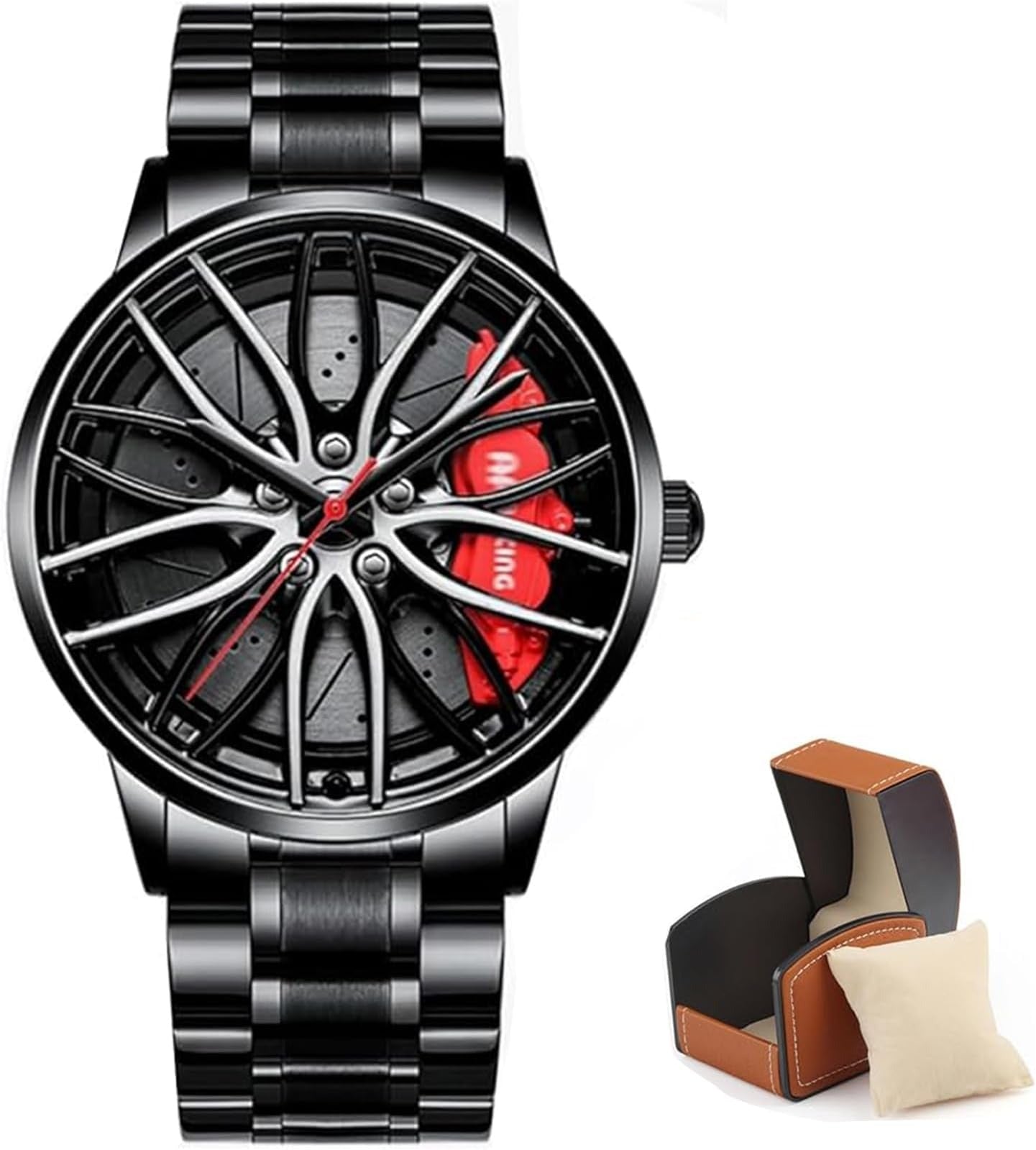
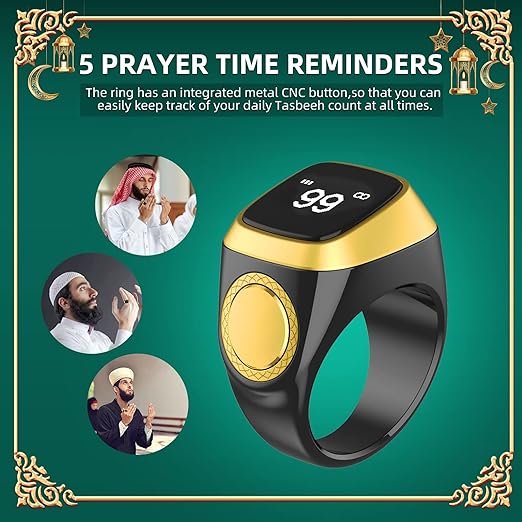
The 3D Car Wheel Rotating Wrist Watch is the obvious alternative if you want something more playful on the wrist. The Equantu Qibla Ring Tasbih Counter and the Moon Lamp Quran Speaker cover the same gifting bracket.
Frequently asked questions about the arabic numeral watch
Are the numerals the same as the ones I write in English?
No. English uses what are called Arabic numerals — 1, 2, 3 — while a Gulf-style dial normally carries Eastern Arabic figures. Both names are correct in their own context, which is exactly why checking the photograph matters more than reading the title.
Can I wear it for wudu?
If no water-resistance rating is given, take it off first. Repeated wetting works moisture past the case back and into the movement, and the damage is gradual enough that people rarely connect cause and effect until it is too late.
How long does a quartz battery last?
Typically a few years, though it varies by movement and by how much the watch is used. When the seconds hand starts moving in jumps or the watch drifts noticeably, have the cell replaced promptly rather than waiting for it to stop.
Will the black finish scratch off?
All coatings wear eventually, particularly on clasp edges and the bracelet underside. Careful daily use slows it considerably. It is a normal ageing process rather than a defect, and it cannot be repaired at home.
Is an arabic numeral watch suitable as a gift?
It is a strong gift for someone who appreciates the design language, and it avoids the sizing problems of rings. If the strap is steel, mention that links can be removed, so the recipient knows it can be fitted properly.
Does it work with formal and casual clothing?
An understated all-black case is one of the more versatile options, sitting comfortably under a cuff and with a thobe alike. Louder dials and larger cases are harder to place, which is worth weighing if you only want to own one watch.
Buy for legibility, size and honesty about water resistance, and the rest is taste. Handled with a little care, an arabic numeral watch is a piece you will still be wearing in five years. You can see this model on its product page, or browse the full range in the Watches section.







Add comment