An exercise band set is the closest thing to a full gym that fits in a drawer. Eleven pieces, a carry bag, and enough resistance combinations to train every major muscle group without a single weight plate in the house.
This guide covers what each part of the kit is for, how to choose the right resistance for a given exercise, how to use a door anchor safely, a sensible full-body routine to start with, and how to look after the bands so they last. It also covers what an exercise band set genuinely cannot replace.
Why an exercise band set works
Resistance training does not care where the resistance comes from. Muscle responds to tension and to the effort of producing force, whether that force is resisting a dumbbell falling toward the floor or a band trying to snap back to its resting length.
What bands change is the shape of the resistance. A dumbbell is hardest at the point where gravity has the most leverage and easier everywhere else. A band gets progressively harder the further you stretch it, so the hardest point is the end of the movement, where muscles are usually shortest and strongest.
That difference is genuinely useful. Strength training with an exercise band set puts the peak load where a free weight puts the least, which is why bands are widely used alongside weights rather than only as a substitute for them.
There is also the practical case, which for most people is the deciding one. An exercise band set weighs almost nothing, needs no floor space, makes no noise, cannot damage a tiled floor and travels in hand luggage. A rack of dumbbells does none of that.
What is actually in an 11-piece exercise band set
The piece count sounds like marketing until you see how the parts combine. Each component has a specific job, and using them together is what turns a bag of rubber into a training system.
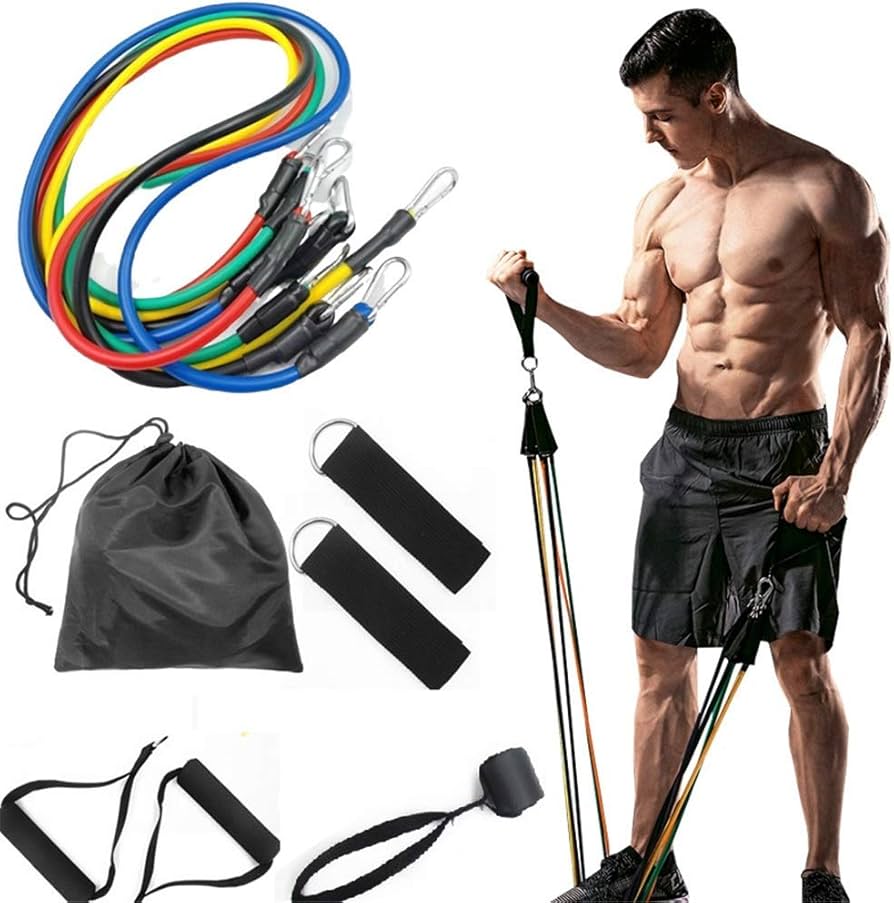
The five loop bands
These are the core of the exercise band set, running from light to extra heavy. They clip to handles or straps and stack together, so five bands give far more than five resistance levels once you start combining them.
The handles
Handles turn a band into something you can press, row and curl with a proper grip. They are what make chest presses, rows and shoulder work possible, and they spare your hands from the discomfort of gripping stretched rubber directly.
The ankle straps
Ankle straps open up the lower body: kickbacks, hip abduction, standing leg curls and lateral walks. This is the part of an exercise band set most people ignore at first and use constantly once they discover it.
The door anchor and carry bag
The door anchor is what makes the kit self-sufficient, since it creates a solid attachment point at any height without drilling anything. The bag matters more than it sounds: an exercise band set that lives loose in a cupboard tangles, and tangled bands do not get used.
The WLD Store pick: Exercise Band Set of 11 Pcs
This is the exercise band set WLD Store stocks for people building a home gym without dedicating a room to it.
- Product: Exercise Band Set of 11 Pcs, resistance bands for workouts
- Bands: 5 loop bands with varying resistance, from light to extra heavy
- Accessories: handles, ankle straps and a door anchor
- Storage: carry bag included
- Suitable for: all fitness levels
- Category: Sports & Fitness · Brand: WLD · SKU: WLD-KSA-0114-(KD-232)
- Availability: available in Riyadh, Jeddah and across Saudi Arabia through secure checkout
Photographs and the full listing are on the Exercise Band Set of 11 Pcs product page. The five-band spread is the part worth noting, because it is what lets the same kit serve a beginner and someone already training seriously.
How to use an exercise band set: 9 easy steps
Bands reward good setup more than heavy effort. These nine points cover the essentials of a safe, effective session.
- 1. Inspect before every session. Run each band through your fingers looking for nicks, thin spots or cloudy patches. A damaged band is the one that fails mid-rep.
- 2. Check the anchor twice. If you are using a door, make sure it opens away from you and cannot be pulled open by someone on the other side.
- 3. Start lighter than you think. Band resistance builds sharply at full stretch, so a band that feels easy at the start can be very hard at the end of the range.
- 4. Remove the slack first. Step into position so there is light tension before the first rep, rather than starting from a loose band that snaps taut.
- 5. Control the return. The band pulling you back is training too. Letting it snap back wastes half the repetition and is where most injuries come from.
- 6. Keep the line of pull sensible. The band should run in line with the movement, not across a joint at an odd angle.
- 7. Never stretch a band toward your face. Position yourself so that if an anchor slips, nothing travels toward your eyes.
- 8. Progress by combining. When a band gets easy, stack a second one rather than jumping straight to the heaviest in the exercise band set.
- 9. Pack it away properly. Unclip everything and return it to the bag, so the next session starts in thirty seconds rather than five minutes of untangling.
None of this takes long, and after a few sessions the setup becomes automatic.
Choosing the right exercise band set resistance
The most common mistake is treating the heaviest band as the goal. Resistance should be matched to the muscle group, not to ego, and the same person will use very different bands across a single session.
Large muscle groups take more. Legs, back and chest work well with the heavier bands, because those muscles produce a lot of force and a light band gives them almost nothing to work against.
Small muscle groups take much less. Shoulders, rotator cuff work, biceps and anything involving the wrists are best served by the lightest bands in an exercise band set, and using a heavy band there usually means the form breaks down.
The honest test is the last repetition. If the final two reps of a set are difficult but still controlled, the resistance is right. If you are jerking the weight up or cannot finish, it is too heavy; if you could carry on indefinitely, add a band.
A simple full-body routine to start with
One kit covers a complete session. A reasonable starting structure is a push, a pull, a leg movement, a hinge and something for the core, done twice or three times a week.
For pushing, anchor the band behind you at chest height and press forward with the handles. For pulling, anchor it in front and row toward your ribs, keeping the shoulders down and the elbows close.
For legs, stand on the band and squat, or loop a light band above the knees for lateral walks. For the hinge, stand on the band and drive the hips forward against it. For the core, anchor at chest height and press straight out while resisting the twist.
Two or three sets of eight to fifteen repetitions on each is plenty at the start. What matters far more than the exact numbers is repeating the session consistently for a few weeks before changing anything.
Using the door anchor safely
The door anchor is the most useful accessory in an exercise band set and the one that needs the most care. Feed it through at the hinge side or the top, and always on a door that opens away from you.
Check the latch is fully closed before applying tension. A door that is merely pushed to can be pulled open by a strong band, which is exactly the sort of surprise you do not want mid-set.
Avoid sliding doors, folding doors and anything with a glass panel. These are not built for lateral load, and the anchor needs a solid, hinged door to be safe.
Tell people in the house. A door being pulled from the other side while you are anchored to it is a genuine hazard, and a simple warning removes it entirely.
Who an exercise band set suits
Beginners get the most immediate benefit, because bands are forgiving on joints, easy to scale down and impossible to drop on a foot. Starting resistance training with an exercise band set is far less intimidating than starting with a barbell.
Frequent travellers are the other obvious group. The entire kit weighs less than a pair of shoes and fits into any bag, which is what makes it possible to train in a hotel room with no equipment at all.
People already lifting weights use bands as a supplement rather than a replacement, typically for warm-ups, shoulder health work, glute activation and finishing sets. The band’s increasing resistance suits all of those particularly well.
Anyone returning from injury should take advice first. Bands are widely used in rehabilitation because the load is gentle at the start of a movement, but the specifics should come from a physiotherapist rather than from a product guide.
Fitting training into a real week
The advantage of keeping equipment at home is that sessions can be short. Twenty minutes three times a week, done consistently, produces far more than a ninety-minute session that happens when the mood strikes.
Leave the kit visible. An exercise band set in its bag beside the sofa gets used; the same bag in a cupboard under the stairs does not. Friction is what kills home training, not motivation.
Pair it with something you already do. Many people train while something is cooking, or in the half hour before the household wakes up, precisely because those slots already exist.
Keep a simple record. Writing down which bands you used for each exercise takes seconds and removes all the guesswork at the start of the next session.
Training indoors in a hot climate
Heat changes home training more than most people plan for. A room that is comfortable at seven in the morning can be difficult by mid-afternoon, and the sensible answer is usually to move the session rather than to cut it short.
Early morning and late evening are the practical windows. An exercise band set makes using them easy in a way a gym trip does not, because a twenty-minute session before the rest of the household wakes up needs no travel and no planning at all.
Watch where the kit is kept as well. A room catching strong afternoon sun through a window is exactly the wrong place to store elastic, and the heat that makes a session uncomfortable also shortens the working life of the bands.
Grip suffers as the temperature rises. Sweaty hands slip on handles, so keep a towel within reach, wipe the grips between sets, and wipe the exercise band set down properly at the end rather than packing it away damp.
Exercise band set care, storage and replacement
Bands are consumables. Latex and similar elastics degrade with heat, sunlight, oil and time, and a band that has been left on a sunny windowsill will fail long before one kept in a bag.
Keep them cool and dark. A drawer or the supplied carry bag is ideal; a car boot in summer is the worst place, since repeated heat cycling weakens the material quickly.
Wipe them down after sweaty sessions and let them dry fully before packing. Salt and skin oils sit on the surface and accelerate breakdown, and it takes ten seconds to prevent.
Retire a band at the first sign of damage. Small tears, sticky patches, cloudiness or a section that feels thinner than the rest all mean the same thing. Replacing one band from an exercise band set is far cheaper than an injury.
Common problems and quick fixes
Four issues cover almost everything people run into with an exercise band set.
- The band rolls or slips under your feet. Stand on it with the middle of the foot and slightly wider than usual, or use trainers rather than bare feet on a smooth floor.
- Handles dig into your hands. Usually a grip that is too tight for the resistance. Ease the grip, and drop to a lighter band if your forearms are failing before the target muscle.
- The door anchor keeps sliding. Push it further through and reposition it at the hinge side, then confirm the latch is fully engaged before loading it.
- Everything is tangled. The commonest reason an exercise band set stops being used. Unclip after every session and put each piece back in the bag.
An exercise band set compared with dumbbells
Dumbbells give a fixed, known load and are simpler for tracking progress: ten kilograms is ten kilograms every time. They also take up space, cost more per kilogram, and are impractical to travel with.
An exercise band set gives variable resistance that peaks at the end of the movement, which suits some exercises better and others worse. Progress is measured by band combination and repetitions rather than by a number stamped on metal.
Neither is strictly better. The bands win decisively on space, portability, joint comfort and price; free weights win on precise loading and on very heavy lower-body work. Many people end up using both, which is why bands are standard equipment in gyms full of dumbbells.
Buying checklist before you order
Five questions worth answering before any resistance kit goes into a basket.
- How many resistance levels? Five bands from light to extra heavy cover a wide range once stacked.
- Does it include handles and ankle straps? Without them, most upper-body and lower-body exercises are awkward or impossible.
- Is there a door anchor? This is what makes an exercise band set usable without any fixed equipment.
- Is there a bag? Storage is the difference between a kit you use and a knot you avoid.
- Does it suit your level? A set listed for all fitness levels lets you start light and grow into it.
Other Sports & Fitness picks at WLD Store
These three sit alongside it in the catalogue and cover the rest of a compact home setup.
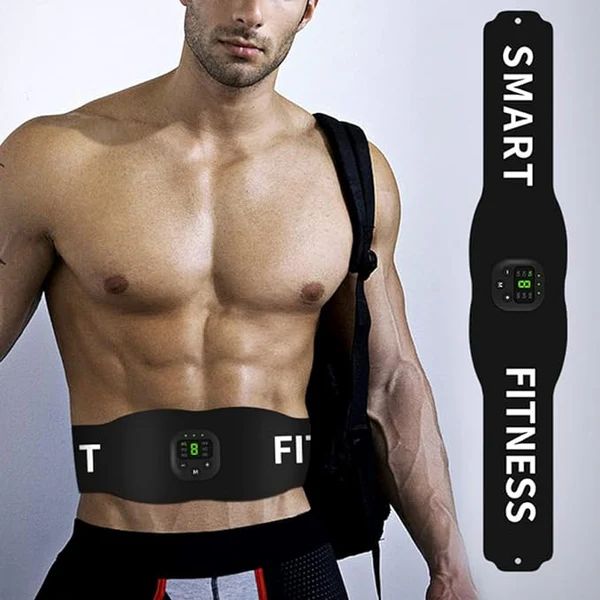
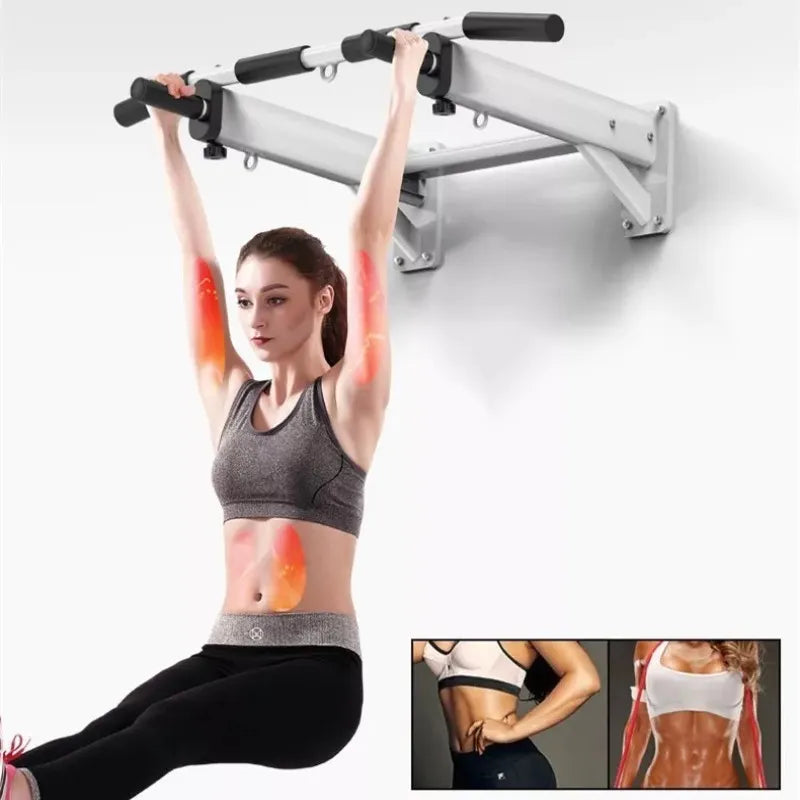
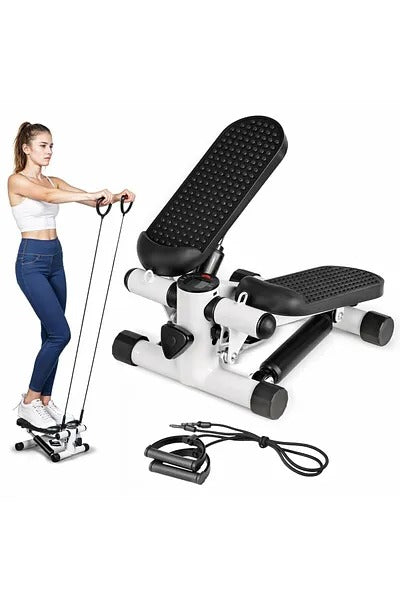
The Wall Mounted Pull Up Bar is the natural next step, since bands and a bar between them cover almost every pulling movement you would want.
Frequently asked questions about the exercise band set
Can I really build muscle with bands alone?
Yes, particularly at the beginner and intermediate stages. Muscle responds to tension and progressive overload, and an exercise band set provides both through heavier bands, stacked bands and more repetitions. Very advanced lower-body training eventually needs loads bands struggle to supply.
How do I know which band to use?
Match the band to the muscle group rather than to your ambition: heavier for legs, back and chest, lighter for shoulders and arms. The last two repetitions of a set should be hard but controlled.
Are resistance bands safe for beginners?
They are one of the gentler ways to start, since there is nothing to drop and the load is light at the beginning of each movement. The main precautions are inspecting bands before use and never anchoring one so it could travel toward your face.
Do I need a door for the anchor?
A solid hinged door that opens away from you is ideal, but not essential. Many exercises use the bands under your feet or looped around a fixed object, so an exercise band set is still fully usable without a suitable door.
How long do the bands last?
It depends far more on storage than on use. Kept cool, dry and out of sunlight they last a long time; left in a hot car or on a windowsill they degrade quickly. Replace any band showing tears, stickiness or thin patches.
Can I take it in hand luggage?
Bands, handles, straps and a fabric anchor are light and compact, which is one of the main reasons people choose them. Airline rules vary, so check with your carrier, but an exercise band set is among the easiest fitness equipment to travel with.
The strongest argument for bands is not that they beat weights, but that they get used. Equipment that lives in a bag by the sofa and sets up in thirty seconds fits into real weeks in a way a gym membership often does not.
Full details are on the Exercise Band Set of 11 Pcs product page, and there is more home fitness equipment in the Sports & Fitness section, available across Saudi Arabia.


Add comment