A car dent repair tool is a small kit that lets you pull a shallow dent back towards its original shape without sanding, filling or repainting. The panel is steel or aluminium with a flexible paint layer on top, and provided that paint is intact, gentle pulling from the outside can persuade the metal to return. That is the whole idea behind paintless dent removal.
This guide explains what a car dent repair tool can realistically fix, how the parts of a typical kit work together, the technique that gives the best result, and the situations where reaching for a kit will make things worse. It ends with a buying checklist and the questions people ask before their first attempt.
What a car dent repair tool actually does
Sheet metal has memory. When something presses it inwards, the metal stretches slightly and locks into a new shape held there by tension around the edge of the dent. Release that tension evenly and the panel wants to spring back. A car dent repair tool is simply a controlled way of applying outward force to the centre while the surrounding metal stays supported.
Professionals normally work from behind the panel with long rods, pushing the low spot out from the inside. That requires access, and on a modern car most panels are boxed in. Exterior pulling kits exist precisely because the inside face is unreachable on doors, roofs and many bumper sections.
The paint layer is the reason this works at all. Automotive clear coat is surprisingly elastic, so it flexes with the metal rather than cracking, which is why a dent with unbroken paint can often be improved dramatically. Once paint is cracked or chipped, a car dent repair tool cannot restore it, and the job becomes a refinishing job instead.
It is also worth setting expectations. Paintless work is about improvement, not always perfection. A good outcome on a door crease is a dent that becomes invisible at a normal viewing distance, with perhaps a faint trace visible under a strip light at an angle. Anyone promising showroom results from a home car dent repair tool is overselling.
The upside is cost and time. A shallow supermarket car park ding is a genuinely annoying blemish that body shops charge real money to fix. Being able to attempt it yourself first, with no chemicals and no repainting, is why the humble car dent repair tool has become a common garage item.
What makes a good car dent repair tool kit
Kits look similar in listings but differ in the details that decide whether you get a clean pull or a slipped tab and a scratched panel.
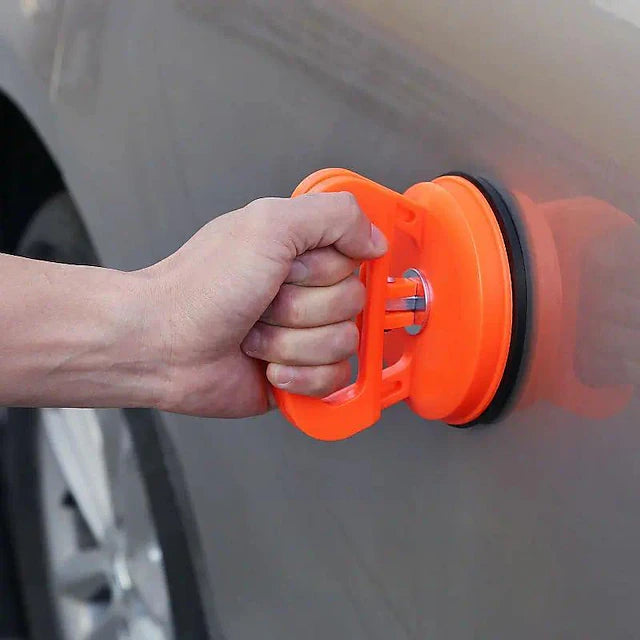
The pulling bridge
The bridge straddles the dent, resting on the good metal either side while a central screw draws the tab upwards. Look for wide, well-padded feet. Narrow or bare feet concentrate load on two small points, and on a soft panel that can leave two new low spots beside the one you were fixing. Adjustable feet spacing is useful for wider creases.
Suction tabs and their sizing
Tabs come in several diameters because the tab should roughly match the dent, not the panel. A tab far larger than the dent grips undamaged metal and pulls it too, flattening the whole area. A tab far too small concentrates all the force in one spot and can create a small high point. A car dent repair tool kit with a range of tab sizes gives you far more control.
The tap-down tool
Almost every pull overshoots slightly, leaving a low ring around a small crown. The tap-down is a blunt plastic or nylon punch used with light taps to knock that crown back level. This is the part beginners skip and then wonder why the panel looks wavy. Any car dent repair tool without one is only half a kit.
Screw feel and thread quality
The central screw should turn smoothly and predictably, because you are reading the panel through your fingers. A gritty or loose thread makes it impossible to apply the small, gradual increments the job needs. Turn the screw through its full travel before you buy into a technique that depends on it.
Kit completeness and storage
Loose parts in a bag get lost, and a missing tab size on the day you need it is genuinely frustrating. A moulded case that holds every piece in its own recess makes it obvious what is missing before you start. It also stops tabs collecting grit, which matters because grit between tab and paint is how scratches happen.
The WLD Store pick: Car Dent Repair Tool
WLD Store lists this as a paintless dent puller kit. These are the details taken directly from the product listing:
- Category: Automotive, listed under Car Accessories.
- Brand: WLD. SKU: WLD-KSA-0099-(KD-099).
- Described as professional paintless dent removal, fixing dents without painting.
- Listed as working on doors, hoods and bumpers.
- No heat and no chemicals required.
- Kit includes suction tabs, a pulling bridge and a tap-down tool.
- Positioned as a way to save money on body shop repairs, available across Saudi Arabia with secure checkout.
You can view the photographs and current availability on the Car Dent Repair Tool product page. For neutral background on the technique itself, the reference article on paintless dent repair explains the professional version of the same process.
How to use a car dent repair tool, step by step
Slow and small is the whole technique. Nine steps, in order, and no shortcuts on the first two.
- Wash and dry the panel thoroughly. Any grit under a tab becomes a scratch under load.
- Inspect the paint closely for cracks or chips. If the paint is broken, stop; this is a body shop job.
- Choose a tab that roughly matches the width of the dent, not the width of the panel.
- Warm the panel gently in sunlight if it is cold, so the paint is flexible rather than brittle.
- Seat the tab in the centre of the low point and press firmly so the suction fully engages.
- Position the bridge so both feet rest on flat, undamaged metal at equal distance from the dent.
- Turn the central screw a quarter turn at a time and pause after each one to look along the panel.
- Stop as soon as the low point is nearly level. Overpulling is harder to undo than underpulling.
- Release the tab, then use the tap-down with light taps to settle any small high spot.
Repeat the cycle two or three times rather than trying to finish in one pull. Every experienced user of a car dent repair tool works this way, because incremental pulls let the metal relax between attempts instead of being forced.
Reading the panel before you pull
The single most useful skill is learning to see the dent properly, and that is about light rather than eyesight. Look along the panel almost edge-on with a straight light source, such as a fluorescent tube or the edge of a doorway, reflected in the paint. A straight reflection that bends tells you exactly where the metal is low.
Trace the outline with a finger too. Your fingertips detect changes in curvature that your eyes will miss on a dark colour. Mark the deepest point with a small piece of tape so you know precisely where to place the tab, since it is easy to lose the centre once the bridge is over the top.
Check the shape as well as the depth. A round, dish-shaped dent responds well to a single central pull. A long crease needs several smaller pulls along its length, working from the ends towards the middle. Using a car dent repair tool on a crease with one big central pull is the classic way to create a bulge.
Where to practise before the real thing
Nobody’s first pull is their best pull, and the worst place to learn is the driver door of a car you care about. A little practice costs nothing and changes the result noticeably.
The easiest practice surface is a scrap panel from a breaker’s yard, but a more accessible option is a low rear quarter or the bottom edge of a boot lid, where a small imperfection will never be seen from normal viewing height. Working a car dent repair tool somewhere hidden teaches you how much a quarter turn actually moves metal.
Pay attention to sound and feel rather than watching the screw. Metal releasing gives a faint tick you can hear and feel through the bridge, and that tick is the signal to stop and look. Learning to notice it is the difference between a controlled repair and an overpull.
Practise the tap-down separately as well, because most people hit far too hard the first time. Tap a scrap panel until you can flatten a small crown without leaving a ring of marks, then take the car dent repair tool to the dent that actually bothers you.
Which dents pull out and which do not
Shallow, round dents in the middle of a large flat area are the best case. There is plenty of surrounding metal to hold tension, the panel is unsupported behind, and the metal has not been stretched far.
Dents on or very near a body line are much harder. The pressed line makes the panel far stiffer there, so pulling tends to distort the line itself, which is more noticeable than the original dent. Leave those alone unless you are willing to accept an imperfect result.
Sharp, deep dents with a small hard centre have usually stretched the metal, and stretched metal cannot simply be pulled back; it has to be shrunk, which is a specialist skill. Similarly, plastic bumper dents behave differently from steel and often respond better to careful warmth and hand pressure than to a car dent repair tool.
Anywhere the paint has cracked is out of scope entirely. Pulling cracked paint lifts flakes off the panel and turns a cosmetic mark into an area that will corrode.
Temperature, timing and patience
Panel temperature changes how the paint and metal behave, so it is worth thinking about when you work. Cold paint is stiffer and more likely to craze under load, so working on a freezing morning is a poor idea.
Equally, a panel that has been baking in full sun all afternoon can be uncomfortably hot to touch and the suction tabs will struggle to hold. A mildly warm panel, in the shade on a warm day, is close to ideal for a car dent repair tool.
Give yourself unhurried time. A rushed pull is a hard pull, and a hard pull is what turns a small dent into a visible bulge. Most people who are disappointed by their results were working against the clock.
Who a car dent repair tool is not for
If the vehicle is leased, or the damage will go through an insurance claim, do not attempt it. An unsuccessful home repair can complicate an assessment and may cost more to put right than the original dent.
Aluminium panels, common on some bonnets and tailgates, are far less forgiving than steel and are best left to someone with experience. Classic cars with original paint, and any vehicle with a repaint of unknown quality, are also poor candidates because the paint may not flex as modern clear coat does.
Finally, if the thought of possibly making a small blemish slightly worse would genuinely bother you, a car dent repair tool is not the right purchase. It is a tool that rewards patience and a tolerance for imperfect outcomes.
A home kit compared with a body shop
A professional paintless technician brings two things no car dent repair tool can supply: access to the back of the panel with rods, and years of reading metal. That combination produces results a bridge puller cannot match on difficult damage.
What a home kit offers instead is immediacy and cost. You can attempt a small ding the same afternoon you notice it, in your own parking space, without booking anything. For a shallow dent in the middle of a door, the gap in results between the two approaches is often small.
A sensible strategy is to use the kit for easy dents and get a quote for anything on a body line, anything with cracked paint, and anything on a leased vehicle. Trying the easy ones yourself is also the fastest way to learn which category a new dent belongs to.
Care and maintenance
The kit itself needs very little, but the little it needs directly affects your paint.
- Wipe every suction tab clean after use; trapped grit is the main cause of scratches.
- Store tabs face-down in their recesses so the contact surface stays free of dust.
- Keep the bridge screw lightly lubricated so it turns smoothly and predictably.
- Inspect the bridge feet for wear and replace or re-pad them if the surface has hardened.
- Keep the whole car dent repair tool kit out of direct sun, since heat hardens suction rubber over time.
- Check tabs for splits before each job by pressing one against a window and feeling for slow release.
Suction cups are the consumable part of any car dent repair tool. They lose grip gradually rather than suddenly, so replace them when a tab starts releasing early instead of fighting a failing one.
Common problems and quick fixes
- The tab keeps releasing mid-pull. The surface is dirty, dusty or slightly curved. Clean and dry both faces, then reseat with firm pressure.
- A small bump appeared where the dent was. You overpulled. Release everything and use the tap-down with very light taps until the reflection straightens.
- Two faint marks appeared beside the dent. The bridge feet loaded the panel. Widen the feet onto flatter metal and pull in smaller increments.
- Nothing moves at all. The dent is too deep, too sharp or on a body line. Stop before you stretch the metal and get a quote instead.
The first three are recoverable. The fourth is the panel telling you honestly that this repair is beyond what a car dent repair tool is designed for.
Buying checklist
- Does the kit include a tap-down tool, or only a bridge and tabs?
- Are there several tab diameters, so you can match the tab to the dent?
- Do the bridge feet have wide padded contact surfaces?
- Does the central screw turn smoothly enough to feel small increments?
- Is the paint on your dent completely unbroken, so the job is in scope at all?
If the answer to the last question is no, no car dent repair tool will help and the money is better spent on a proper quote.
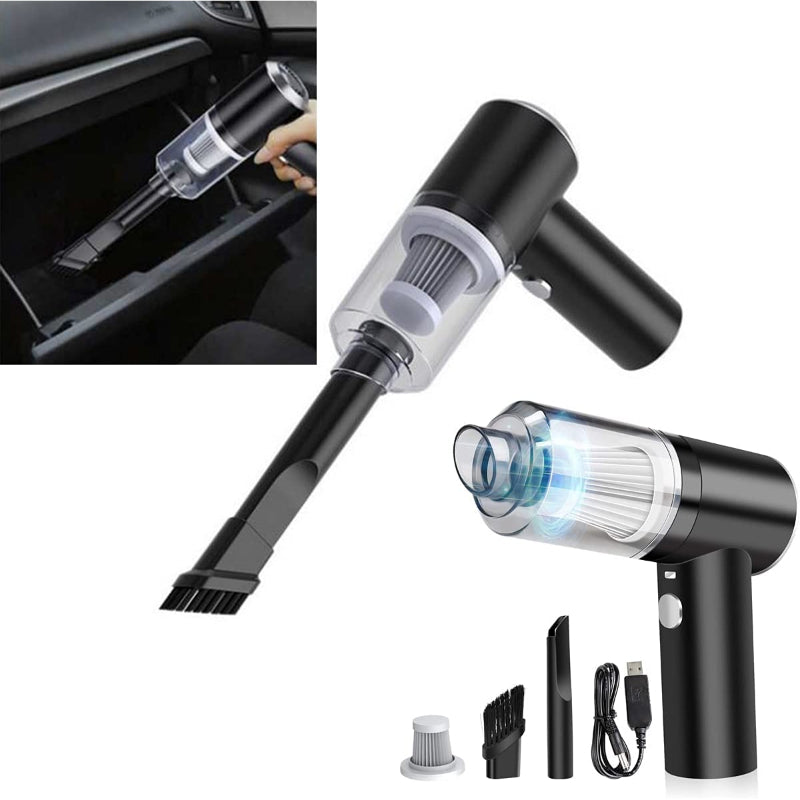
Other Automotive picks at WLD Store
Three more items from the same section that often end up in the same order.


Frequently asked questions about a car dent repair tool
Will a car dent repair tool damage my paint?
Not if the paint is intact and the panel is clean. The two things that cause damage are grit trapped under a tab and pulling far too hard. Wash the area first and work in quarter turns and the risk is low.
Does it work on plastic bumpers?
Sometimes. The WLD listing states the kit works on doors, hoods and bumpers, but plastic behaves differently from steel and often responds better to gentle warmth and hand pressure from behind where you can reach it.
Do I need heat or any chemicals?
No. The WLD listing specifically states no heat and no chemicals are needed. A mildly warm panel simply helps the paint flex; that is a matter of choosing your moment, not applying a heat source.
How long does one dent take?
A simple shallow dent is often twenty to thirty minutes including cleaning and inspection. Rushing is the main cause of poor results, so treat any car dent repair tool session as an unhurried job rather than a quick fix.
Can I use it on a dent with cracked paint?
No. Pulling cracked paint lifts flakes away and exposes bare metal to moisture. Once paint is broken the repair needs filling and refinishing, which is outside what any paintless kit can do.
What if I make it worse?
Small overpulls are usually correctable with the tap-down tool. Serious distortion needs a professional, which is why it is sensible to practise on a low-visibility panel first and to leave body lines alone until you are confident.
Used on the right damage and with an unhurried hand, a car dent repair tool turns an irritating car park ding into an afternoon job. Check the current listing on the product page, or browse the rest of the range in the Car Accessories section.






Add comment