Handwriting is one of the few school skills that improves almost entirely through repetition, which is exactly why an arabic practice copybook works so well for young learners. This guide explains how the grooved, self-erasing format actually functions, what separates a set worth buying from one abandoned after a week, and how to build short practice sessions a child will accept without a fight. It also covers correct pen grip, why Arabic letters change shape depending on where they sit in a word, honest notes on the age range this suits, and the six questions parents ask most often before ordering.
Why an arabic practice copybook helps young learners
Learning to write is a motor skill before it is an academic one. A child who knows every letter by sight can still struggle to produce one, because the hand has not yet learned the movement. Repetition is what converts recognition into muscle memory, and repetition is precisely what an arabic practice copybook is built to deliver.
The difficulty with ordinary exercise books is that they run out. A child fills twenty pages, the book is finished, and the parent either buys another or the practice quietly stops. A reusable arabic practice copybook removes that ceiling entirely, which changes the economics of practice and, more importantly, removes the sense that paper is precious and mistakes are costly.
There is a psychological benefit that parents notice quickly. When a page wipes itself clean, a mistake stops being permanent. Children who are anxious about getting things wrong will often attempt a difficult letter far more readily when they know the evidence disappears, and that willingness to attempt is most of the battle at this age.
Arabic adds a specific challenge that makes guided practice especially valuable. The script is written right to left, most letters connect to their neighbours, and the same letter takes different shapes depending on its position in a word. The Arabic alphabet has twenty-eight letters, but the number of shapes a child must actually learn to produce is considerably higher. Structured tracing in an arabic practice copybook introduces those forms in a controlled order rather than all at once.
How the self-erasing system works
There is no complicated technology inside an arabic practice copybook, which is part of the appeal. The pages carry grooves shaped like the letters, and the child runs the pen tip along the channel. The groove does two jobs at once: it guides the stroke in the correct direction, and it provides physical feedback when the hand drifts off the path.
The ink is the second half of the system. It is formulated to fade on its own after a period, so a completed page gradually clears itself and is ready to be used again without wiping, scrubbing or any effort from the child. Nothing needs to be washed, and no cloth is required.
That combination is what makes an arabic practice copybook reusable in a practical sense rather than a theoretical one. A child can complete the same page today, tomorrow and next week, and each repetition reinforces the same movement. For handwriting, repeating one page ten times is genuinely more useful than completing ten different pages once.
What makes a good arabic practice copybook
Sets look similar in listings, and the differences that matter are not always photographed. Four things decide whether a set becomes part of a routine or ends up in a drawer.
Groove depth and how clearly it guides
The groove is the whole mechanism of an arabic practice copybook, so its quality decides everything. Too shallow and the pen wanders freely, which defeats the purpose. Too deep and the pen jams at corners, which frustrates a young child quickly. A well-made arabic practice copybook has a channel deep enough to feel through the pen but smooth enough to flow around curves.
Letter forms and how faithful they are
Check the letter shapes in any arabic practice copybook against the script your child is being taught at school. Arabic handwriting styles vary, and a copybook whose forms differ noticeably from the classroom standard creates confusion rather than reinforcement. The shapes should look like careful handwriting rather than a decorative display font.
Page quality and how many times it survives
Reusable only counts if the pages survive reuse. Thicker, coated pages tolerate hundreds of passes; thin pages soften at the groove edges and lose definition. Since the entire value of an arabic practice copybook rests on repetition, page durability matters more here than in a normal workbook.
Pens, grips and refills
Look at what comes in the box with an arabic practice copybook. Pens with a moulded triangular grip encourage a correct three-finger hold, which is a genuine bonus at this age. Spare refills matter too, because the pen is the consumable part of the system and a set that cannot be refilled has a fixed lifespan regardless of how well the books hold up.
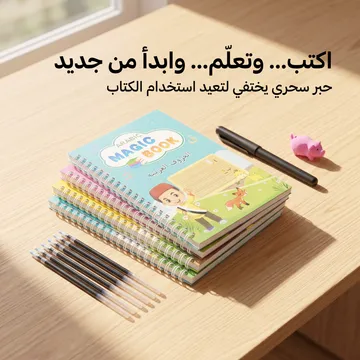
The WLD Store pick: Reusable Arabic Magic Practice Copybook
WLD Store lists the Reusable Arabic Magic Practice Copybook as a four-piece set. Here is what the listing states, with nothing added:
- Product: Reusable Arabic Magic Practice Copybook, 4 pieces
- Category: Books & Education
- Brand: WLD
- Format: self-erasing Arabic handwriting practice books for children
- Included: four books together with magic pens
- Available in: Saudi Arabia, with secure checkout
- SKU: WLD-KSA-0136
Four books is a sensible quantity, because it allows different books to cover different stages rather than repeating one level. You can see current photographs and details on the Reusable Arabic Magic Practice Copybook product page.
Getting started: the first session
The first session with an arabic practice copybook sets the tone, so keep it short and deliberately easy. Assemble the pen, check the ink flows on a corner of a page, and let the child hold it for a moment before any writing is expected. A pen that skips on the first stroke turns a child off faster than any difficulty with the letters.
Begin with the simplest shapes rather than page one, if page one happens to be complex. Straight strokes and gentle curves build confidence and grip control, and confidence is what carries a child through the harder forms later. Ten minutes is plenty for a first attempt, and stopping while the child is still enjoying it is the single most useful habit a parent can build.
Sit alongside rather than opposite. Watching the direction of a stroke from the wrong side makes it surprisingly hard to correct gently, and correcting direction early is far easier than unpicking a habit months later.
Building a routine that lasts
With an arabic practice copybook, consistency beats duration by a wide margin. Ten focused minutes daily produces better handwriting than an hour once a week, because motor learning consolidates between sessions rather than during them.
- Anchor it to something fixed such as after breakfast or before a bedtime story, so it does not depend on anyone remembering.
- Keep sessions short. Five to fifteen minutes suits most young children, and the arabic practice copybook format supports frequent short bursts perfectly.
- Repeat pages deliberately rather than racing to the end. Mastery of a shape matters more than coverage of the book.
- End on something achievable so the last memory of the session is success rather than struggle.
- Track progress visibly, perhaps with a simple chart, since young children respond strongly to seeing accumulated effort.
Resist the urge to extend a good session dramatically. A child who is enjoying practice will happily continue, but overlong sessions are what turn an arabic practice copybook from a game into a chore, and that shift is hard to reverse.
Grip, posture and stroke direction
Three physical habits determine handwriting quality far more than effort does, and all three are easiest to fix at the beginning.
Grip comes first. The pen should rest between thumb and index finger, supported by the middle finger, with the hand relaxed. A tight fist grip tires the hand within minutes and produces shaky letters no amount of practice will smooth out. Moulded grips help, and gentle reminders help more than corrections.
Posture matters next. Feet flat, back reasonably upright, book angled slightly to suit the writing hand. A child hunched sideways over a low table will fight their own position on every stroke.
Stroke direction is the one parents most often miss. Arabic is written right to left, and individual letters have conventional starting points and directions. A child can produce a letter that looks correct while forming it backwards, which becomes a real problem once words need to be joined at speed. Watching the pen rather than the finished page is how you catch this, and an arabic practice copybook makes it easy because the groove reveals hesitation immediately.
Why Arabic letter shapes change
This is the concept that confuses beginners most, and understanding it early prevents a lot of frustration with any arabic practice copybook. Most Arabic letters connect to the letters around them, and their shape adapts depending on position: at the start of a word, in the middle, at the end, or standing alone.
To a child who has just mastered an isolated letter, meeting the same letter in a different form can feel like starting again. Explaining that it is the same letter wearing a different coat, rather than a new letter entirely, reframes it usefully. A structured arabic practice copybook usually introduces isolated forms first and connected forms later, which is the right order.
Dots are the other detail worth attention. Several Arabic letters share an identical skeleton and are distinguished only by the number and position of dots above or below. Practising the dots as part of the letter rather than as an afterthought avoids ambiguity later, and it is a habit best formed at the very beginning.
Care, storage and looking after the pens
In an arabic practice copybook set the books are durable; the pens are the fragile part. A little care keeps a set usable for a long time.
- Cap the pens immediately after use. An uncapped pen dries out faster than anything else will wear out.
- Store the books flat rather than bent into a bag, since a crease across a groove permanently disrupts the guide path.
- Keep them out of direct sun and heat, which can affect both the ink and the page coating.
- Let pages clear naturally instead of rubbing them, because abrasion wears the groove edges over time.
- Keep refills together in the box, so a dry pen means a two-minute pause rather than the end of the routine.
If a page ever needs cleaning after a spill, a barely damp cloth and a gentle wipe is the limit. Soaking a page is the one thing that reliably ruins an arabic practice copybook, because the coating and the board underneath do not recover.
Common problems and quick fixes
Four issues cover almost everything parents run into with an arabic practice copybook.
- The pen skips or writes faintly: usually a drying tip. Cap it properly, and swap in a refill if the flow does not return after a few strokes.
- Ink is not fading: give it longer before assuming a fault, and keep the page out of a cold draught. Fading is gradual rather than instant.
- The child rushes and ignores the groove: shorten the session and reduce the number of repetitions rather than asking for more effort. Rushing is nearly always a sign of fatigue.
- Grooves feel shallow on some pages: heavy use wears the most-practised pages first, which is why a four-book set with overlapping content is genuinely useful.
Who it suits, and who it does not
An arabic practice copybook is aimed squarely at children in the early stages of handwriting, roughly the years when letter formation is being taught and consolidated. For that group it is close to ideal.
It is less suitable for a child who has not yet developed the fine motor control to hold a pen steadily, and pushing too early tends to create resistance that lasts. It is equally unsuitable for an older learner who already writes fluently and needs vocabulary, grammar and reading practice rather than letter formation. Adults learning Arabic can certainly use one for the first few weeks of script practice, but they will outgrow it quickly.
Very young children should always be supervised, as with any set containing pens and small parts. Supervision also happens to be when the most useful correction occurs, so it is worth the parent’s time regardless.
Copybook versus a plain lined workbook
The alternative most families already own is an ordinary lined exercise book, and it and the arabic practice copybook serve different stages. A lined workbook offers freedom: the child writes anything, at any size, and the parent sees genuinely independent output.
An arabic practice copybook offers structure instead. The groove constrains the stroke, so the child cannot practise a letter incorrectly for twenty repetitions without noticing. That constraint is exactly what a beginner needs and exactly what an experienced writer finds limiting.
The sensible approach is sequential rather than either-or. Use the copybook to build correct formation and confidence, then move to a lined book to develop independence and speed, returning to the grooves whenever a particular letter proves stubborn.
Buying checklist
Five questions before ordering an arabic practice copybook set.
- Do the letter forms match the handwriting style my child is taught at school?
- Is my child at the stage of learning letter formation, rather than before or well past it?
- Are the pages thick enough to survive repeated use over months?
- Does the set include usable pens and, ideally, spare refills?
- Do the books cover a progression of stages rather than repeating one difficulty level?
Other WLD Store picks worth a look
A few more items from the wider WLD Store range.


Frequently asked questions about the arabic practice copybook
What age is this suitable for?
An arabic practice copybook suits children in the early handwriting years, once they can hold a pen with reasonable control and are learning to form letters. Below that stage the grooves frustrate rather than help, and well beyond it a child needs free writing practice instead.
How long does the ink take to disappear?
The ink in an arabic practice copybook clears gradually on its own rather than instantly, so a page written now will be ready to use again shortly afterwards without any wiping. Warmth and airflow affect the speed a little, so a page in a cold room may take slightly longer.
Can the pages really be reused indefinitely?
Not indefinitely, but an arabic practice copybook page survives a great many uses. The limiting factor is the groove edge softening under heavy use, which is why page thickness is worth checking before buying and why a multi-book set spreads wear across more pages.
What happens when the pens run out?
The pen is the consumable part of any arabic practice copybook, so refills are the thing to keep spare. Store them with the books, and check the refill diameter before buying replacements separately, since sizes are not universal.
Will this teach my child to read Arabic?
No, and it is not designed to. It builds handwriting and letter recognition through repetition. Reading requires vocabulary, phonics and comprehension work alongside it, so treat the copybook as one component of learning rather than a complete programme.
My child rushes through without following the groove. What should I do?
Shorten the session rather than lengthening it, and reduce how many lines you ask for. Rushing almost always signals fatigue or boredom, and both respond better to less work done well than to more work demanded.
Used as a short daily habit rather than an occasional activity, an arabic practice copybook is one of the most effective handwriting tools available to a family, largely because it removes the friction that stops practice happening at all. Keep sessions brief, watch stroke direction rather than the finished page, and let repetition do the work. You can view the Reusable Arabic Magic Practice Copybook on the storefront, or browse more in the Books & Education section.







Add comment